Program managers face a real constraint: mission requirements now call for rapid beam steering, ruggedness, and multi-mission flexibility, but mechanically steered systems carry maintenance burdens that contested environments simply won't tolerate. A motor that jams during a firefight isn't a maintenance ticket. It's a mission failure.
Phased array UHF antennas solve this by replacing moving parts with electronic control. This guide breaks down how they work, why the UHF band matters for defense, and what to look for when selecting a manufacturing partner for a program that can't afford downtime.
Key Takeaways
- Phased array UHF antennas steer beams electronically in microseconds, eliminating mechanical failure points
- UHF (300 MHz–3 GHz) balances compact size with strong propagation for tactical and long-range links
- AESA and digital beamforming enable multi-beam operation despite individual element failures
- A defense-grade manufacturing partner needs certifications, in-house testing, and real engineering experience
What Is a Phased Array UHF Antenna?
A phased array antenna uses a computer-controlled grid of radiating elements instead of a single dish or rod. Each element transmits or receives the same signal, but with a precisely controlled phase offset.
When those signals combine in space, they add constructively in one direction and cancel out in others. The result: a focused, steerable beam with no motors, gimbals, or rotating hardware.
The UHF band, defined by the ITU as 300 MHz to 3 GHz, sits at a practical sweet spot for this technology. Wavelengths at these frequencies are short enough to fit dozens or hundreds of elements into a manageable aperture, yet long enough to travel farther and penetrate obstacles better than higher-frequency bands like Ku or Ka.
Why UHF Specifically Matters for Defense
UHF's physical properties directly answer one of the most common defense procurement questions: what antenna is best for UHF-band tactical operations?
- Foliage and structure penetration: Lower frequencies within the UHF range lose less signal strength passing through trees, walls, and vehicles compared to microwave bands
- Long-range propagation: UHF supports both direct ground-wave links and satellite relay, making it suitable for dismounted troops and mobile command posts
- Established defense use: UHF underpins many fielded radar and communications systems already trusted by the DoD and allied forces
UHF's beyond-line-of-sight capability comes mostly from satellite relay or elevated platforms, not the frequency band alone. Ground-to-ground UHF links are typically limited to a few miles of direct line of sight, so network architecture still matters as much as antenna selection.
Core Architectures: PESA, AESA, and Digital Beamforming
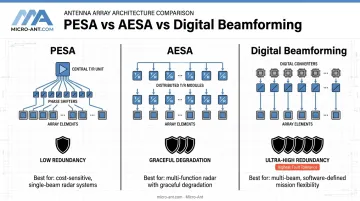
Three architectures dominate phased array design, and each carries different tradeoffs for defense buyers:
| Architecture | How it works | Best for |
|---|---|---|
| PESA | One central transmitter/receiver feeds all elements through phase shifters | Lower-cost applications with single-beam requirements |
| AESA | Each element has its own transmit/receive module | Missions requiring redundancy and multi-function operation |
| Digital Beamforming | Each element digitizes its own signal independently | Simultaneous multi-beam operation and adaptive nulling |
AESA and digital beamforming architectures have become the preferred choice for defense programs. Distributing amplification and control across many independent modules means a handful of failed elements degrades performance gradually rather than knocking the whole system offline.
How Phased Array UHF Antennas Work
The underlying principle is interference. Each element in the array radiates a wave. Where those waves arrive in phase, they reinforce each other and form the main beam. Where they arrive out of phase, they cancel out, suppressing energy in unwanted directions.
Engineers control this through the array factor, which describes how element spacing, element count, and applied phase shift determine three things:
- Beam direction (where the main lobe points)
- Gain (how much energy concentrates in that direction)
- Sidelobe level (how much unwanted energy leaks elsewhere)
Add more elements, and the beam narrows while gain increases, though at the cost of a larger physical aperture and more control channels to manage.
Beam Steering Methods
Not every phased array steers the same way. Three approaches show up across fielded systems:
- Electronic steering: Phase shifters redirect the beam instantly, with no moving parts. Gain and beamwidth degrade somewhat at wide scan angles, a known limitation called scan loss.
- Mechanical steering: A motor physically rotates the aperture. Gain stays consistent across all angles, but repositioning is slower and introduces hardware that can wear out.
- Hybrid electro-mechanical steering: Combines both methods. The Lockheed Martin AN/APY-9 radar, for example, pairs mechanical rotation with electronic elevation scanning to retain gain across a wider field of view.
Key Performance Metrics Engineers Should Know
Defense buyers evaluating phased array UHF antennas should focus on a handful of metrics that translate directly to mission performance:
- Antenna gain (dBi): How strongly the array concentrates energy in the beam direction, affecting detection range and link margin
- Sidelobe attenuation: How well the design suppresses unwanted energy outside the main beam, which matters for jamming resistance and reducing detectability
- Half-power beamwidth (HPBW): How narrow the main beam is, which drives angular resolution for tracking
- Field of view: The total angular range the array can scan without mechanical assistance
Element count drives these numbers predictably. According to Analog Devices' phased array antenna pattern analysis, a uniform half-wavelength linear array follows a 10 log10(N) dB gain formula. A 16-element array yields roughly 12 dB of coherent gain and a 6.3-degree beamwidth, while scaling to 100 elements tightens the beamwidth to about 1 degree.
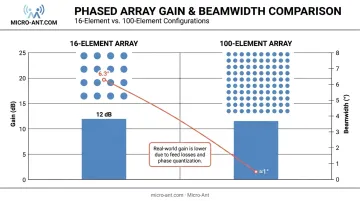
These figures represent ideal array-factor benchmarks. Real-world gain will be lower once feed losses, mutual coupling, and phase quantization are factored in.
Key Advantages of Phased Array UHF Antennas for Defense
Phased array UHF antennas solve problems that mechanically steered systems simply can't. Here's what changes when you remove the moving parts.
Rapid, all-electronic beam steering. Phase shifters can rephase an entire array in microseconds, according to Naval Research Laboratory documentation on phased array lens radar systems. That speed enables one antenna to track multiple targets or maintain multiple communication links nearly simultaneously, something a rotating dish physically cannot do.
Multi-function, multi-beam operation. A single array can handle surveillance, tracking, and communications at once by dividing its aperture or interleaving beam schedules. This reduces the number of separate antennas a platform needs to carry, which matters when every pound and every square foot of deck or hull space counts.
Graceful degradation. Individual T/R module failures reduce performance incrementally rather than causing total system failure. For a mission running in contested territory, that difference between "degraded" and "dead" can decide the outcome.
Jamming and interference resistance. Adaptive beamforming and null-steering let the array suppress energy toward known jammers while maintaining gain toward the target or link partner. Combined with low sidelobe design, this supports the kind of low-probability-of-intercept operation that contested-environment missions require.
Field durability. Every antenna Micro-Ant produces goes through production testing to confirm it holds up under real operating conditions. That standard comes from two decades of designing for defense, aviation, maritime, and land customers who don't get to call in a repair crew mid-mission.
Defense Applications and Use Cases
Phased array UHF technology shows up wherever a mission needs speed and redundancy without sacrificing range.
Tactical and BLOS communications. Ground vehicles, dismounted units, and command posts operating in remote terrain rely on UHF links for both line-of-sight range and satellite-relayed beyond-line-of-sight connectivity. The band's obstacle penetration makes it a practical choice when troops are moving through wooded or urban terrain.
Multi-orbit SATCOM connectivity. Modern defense networks increasingly need terminals that can roam across satellite operators and orbital regimes, from geostationary to MEO and LEO constellations, without swapping hardware. Phased array and beam-switching designs, like the terminals Micro-Ant engineers for multi-operator roaming, make that kind of operator-agnostic connectivity achievable in a compact footprint.
ISR and surveillance radar. UHF phased arrays anchor some of the most proven long-range detection systems in service today. The Lockheed Martin AN/APY-9 radar, flown on the E-2D Advanced Hawkeye, operates in the UHF band and combines mechanical and electronic scanning to detect stressing targets at long range. It's a real-world example of what hybrid UHF array architecture delivers in an operational airborne platform.
These use cases share a common thread: they all demand an antenna that performs consistently whether it's mounted on a moving vehicle, a rolling ship deck, or an aircraft pulling maneuvers.
Choosing the Right Phased Array UHF Antenna Manufacturing Partner
Not every antenna supplier can deliver a phased array UHF system that survives defense-grade conditions. A handful of criteria separate the partners worth trusting from the ones that will slow a program down.
Certifications and registration. Look for AS9100:2016 and ISO 9001:2015 certification at minimum, along with an active CAGE code for federal procurement eligibility. Micro-Ant holds both certifications plus CAGE code 6XJFO, positioning it as a procurement-ready supplier for DoD, civil government, and intelligence community customers.
Bespoke engineering over catalog parts. Defense missions rarely fit an off-the-shelf form factor. A partner built around custom design, rather than adapting a standard product line, can match antenna geometry to the platform instead of forcing the platform to accommodate it.
Micro-Ant's entire production model, spanning parabolic, flat panel, phased array, and beam-switching designs, is built on 100% custom engineering rather than catalog offerings.
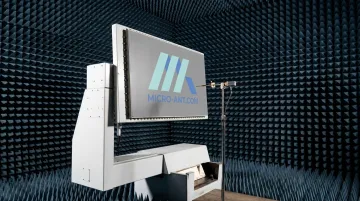
In-house testing capability. Near-field and far-field validation shouldn't require shipping hardware across the country and waiting weeks for results. Micro-Ant's Jacksonville, Florida facility includes spherical and planar test chambers, letting engineering teams validate performance and iterate quickly without third-party scheduling delays.
Proven experience and innovation track record. More than two decades of antenna design work stands behind that experience. Awards like the 2022 Innovation of the Year and SatCom Technology of the Year honors for its Ultra-Wide Band antenna systems confirm a proven track record of solving hard engineering problems.
When evaluating partners, ask direct questions:
- Can you show test data from your own facility, or does it come from a third party?
- What is your typical design-to-first-article timeline for a custom phased array?
- Which defense or government customers can you reference for similar programs?
Frequently Asked Questions
What antenna is best for UHF?
Phased array antennas with multiple radiating elements are generally preferred for UHF defense applications. They offer electronic beam steering, higher gain, and multi-function capability that single-element or Yagi antennas cannot match.
What does a phased array antenna do?
A phased array antenna combines signals from multiple elements using phase shifters, allowing it to electronically steer a directional beam without any physical movement. This lets the antenna redirect its focus in microseconds.
What are the advantages of phased array antennas?
Key advantages include rapid electronic beam steering, multi-beam and multi-function capability, graceful degradation when individual elements fail, and improved resistance to jamming through adaptive nulling.
What is the difference between AESA and PESA?
AESA (Active Electronically Scanned Array) places an amplifier and phase shifter at each individual element, enabling multi-beam operation and better fault tolerance. PESA (Passive Electronically Scanned Array) relies on a single central transmitter and receiver shared across all elements, simplifying design but creating a single point of failure.
What frequency range is considered UHF?
UHF spans 300 MHz to 3 GHz, per ITU-R standards. This range balances compact array construction with propagation strong enough for long-range and obstacle-penetrating defense communications.
Are phased array antennas better than parabolic antennas for defense applications?
Phased arrays offer faster steering, multi-target tracking, and no moving parts, making them ideal for dynamic missions. Parabolic antennas can deliver higher gain at lower cost for fixed, single-target applications where speed is not the priority.