Identification Friend or Foe (IFF) antennas are the hardware that makes this exchange possible — yet procurement teams and engineers often get tangled in the terminology. Modes, SIF, Mark XIIA, transponders: the acronyms pile up fast, and picking the wrong antenna for a platform can mean failed qualification testing or, worse, a compromised identification system.
This guide breaks down how IFF antennas actually work, the frequency and mode standards that govern them, and what to look for when selecting a manufacturer that can deliver a rugged, mission-ready design.
Key Takeaways
- IFF antennas transmit interrogation signals and receive coded replies on 1030 MHz and 1090 MHz (L-band).
- Mode 5 replaces Mode 4 as the NATO standard, adding NSA-certified encryption under Mark XIIA.
- Radiation pattern, size, and ruggedization directly affect platform performance and mission reliability.
- Manufacturer certifications like AS9100 and in-house near-field testing reduce qualification risk before deployment.
What Is an IFF Antenna?
Identification Friend or Foe is a cooperative identification system, not a radar. That distinction matters more than most people realize.
A radar system sends out a pulse and listens for the echo bouncing off an object. IFF works differently. An interrogator transmits a coded challenge, and a friendly platform's transponder replies with encoded data confirming its identity. There's no bounce, no echo — just a structured question-and-answer exchange between two cooperating systems.
A System Born From Necessity
IFF has military roots that stretch back to World War II Britain. According to Imperial War Museums archival records, the original Mark III IFF equipment from 1943 had to be paired directly with Chain Home radar.
Chain Home could detect a target, but it had no way to confirm whether that target was friendly. Mark III solved this by adding a ground-based challenge and an automatic transponder response carried aboard friendly aircraft.
That same equipment eventually extended to tanks and naval ships, laying the groundwork for the multi-domain identification systems used today.
Where IFF Antennas Show Up Today
Modern IFF antennas serve a far wider range of platforms than their WWII predecessors:
- Military fighter jets, transport aircraft, and helicopters
- Naval vessels requiring 360-degree shipboard coverage
- Ground-based air defense and surveillance systems
- UAVs equipped with reduced-size transponders for cooperative identification
- Civil ADS-B systems that trace their technical lineage back to military IFF concepts
The antenna itself is just one piece of a larger system. It's the physical interface that sends the interrogation and captures the reply, but the "brains" of identification live in the transponder and its supporting cryptographic hardware.
How IFF Antennas Work: Frequency Bands, Modes, and SIF
Every modern IFF system, regardless of platform, operates on the same two frequencies. Interrogators transmit on 1030 MHz, and airborne or shipborne transponders reply on 1090 MHz.
According to FAA Advisory Circular 90-114, this same channel pair also supports Mode S addressed interrogations in civil airspace. Both frequencies sit inside the L-band range, making L-band performance a non-negotiable spec for any IFF antenna design.
SIF: Coding the Reply
A simple friend-or-foe response wouldn't be much use on a crowded battlefield or in busy airspace. That's where the Selective Identification Feature (SIF) comes in.
SIF layers a coding scheme onto the basic Mark X reply pulse. This lets a single transponder response carry multiple digits of information, such as aircraft type, tail number, altitude, or squawk code, instead of a binary yes-or-no.
The Mode Progression
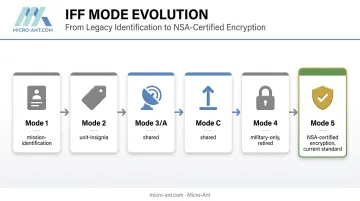
IFF modes have evolved over decades, each one addressing gaps left by the last:
| Mode | Function | Military-Only or Shared |
|---|---|---|
| Mode 1 | General mission ID; 32 two-digit codes | Military-only |
| Mode 2 | Unit-specific ID; 4,096 four-digit codes | Military-only |
| Mode 3/A | ATC identification, shared waveform with civil Mode A | Shared |
| Mode C | Automatic altitude reporting | Shared |
| Mode 4 | Secure military mode within Mark XII | Military-only |
| Mode 5 | NSA-certified encrypted interrogation and reply | Military-only |
Mode 5 is the current standard, and for good reason. It directly addresses the security shortcomings of Mode 4 by encrypting both the interrogation and the reply.
The Mark XIIA Transition
The shift to Mode 5 is a full framework upgrade documented under NATO STANAG 4193. The Defense Security Cooperation Agency identifies this as the governing standard for Mark XII and Mark XIIA interrogators and transponders.
Dual Mode 4/5 equipment remains backward-compatible with legacy IFF, which matters for coalition operations where not every partner platform has upgraded at the same pace.
Mounting Position Matters
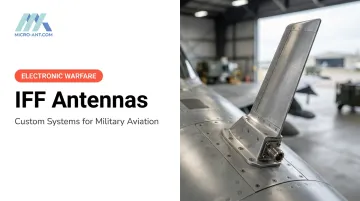
Encryption and mode architecture solve the identification problem, but where the antenna sits on the platform shapes how well that solution performs. Early IFF antennas stood alone as dedicated units. Many modern designs now combine the IFF antenna and search radar into a single turning unit, while others use directional blade antennas for interferometry-based systems. The right mounting choice depends heavily on the platform's available real estate and required coverage pattern.
IFF Antenna vs. Transponder vs. SIF: Key Differences
These three terms get used almost interchangeably in casual conversation, but they describe distinct things.
| Term | What It Actually Is |
|---|---|
| IFF | The complete cooperative identification system — interrogators, transponders, crypto, and processing logic working together |
| Transponder | The physical hardware onboard a platform that receives the 1030 MHz interrogation and transmits the 1090 MHz reply |
| SIF | A coding method within IFF (not a standalone system) that lets Modes 1, 2, 3/A, and C carry multi-digit identification data |
IFF is the protocol, the transponder is the radio hardware executing it, and SIF is the coding trick that makes the reply meaningful rather than just a blip.
The Civil Aviation Connection
Anyone familiar with commercial air traffic control has already encountered IFF's descendants. Military Mode 3 and civil Mode A share a nearly identical waveform.
Mode S extended squitter, which powers much of today's ADS-B infrastructure, reuses the same 1030/1090 MHz transponder technology that originated in military IFF systems. The application changed from combat identification to air traffic management, but the core interrogation-response principle carried straight through.
Applications of IFF Antennas Across Industries
IFF antennas don't belong to any single branch of service or industry. They show up wherever cooperative identification prevents costly mistakes.
Military Aviation
Fighter jets, transport aircraft, and helicopters rely on directional or blade-style IFF antennas for combat identification. The F-22, for example, has integrated a multi-channel transponder subsystem compliant with Mode 5 cryptographic standards, while the HH-60W combat rescue helicopter uses a reduced-size transponder built for the same purpose.
Naval and Maritime Systems
Shipboard IFF typically relies on mast-mounted omnidirectional antennas that provide 360-degree coverage, receiving interrogations and radiating replies without needing to track a specific bearing. Naval identification systems must work regardless of whether a threat or a friendly vessel approaches.
Ground-Based and Emerging Platforms
- Ground-based air defense interrogators support panoramic 360-degree surveillance for short-range engagement zones
- UAVs increasingly carry reduced-size Mode 5 transponders, letting friendly drones participate in cooperative identification networks
- Civil government and air traffic control systems lean on Mode S and ADS-B derivatives for non-combat identification
Across these use cases, the common thread is a need for compact, reliable antennas built for platforms where space and weight come at a premium. Micro-Ant engineers this range of antennas in-house, from airborne and UAV systems to maritime shipboard installations, serving DoD, civil government, aerospace, and maritime customers alike.
How to Choose the Right IFF Antenna for Your Platform
Selecting an IFF antenna is an engineering exercise that has to account for frequency compatibility, physical constraints, and long-term reliability all at once.
Frequency and Mode Compatibility
Confirm the antenna supports both 1030 MHz interrogation and 1090 MHz reply, along with any required Mode 4 or Mode 5 cryptographic standard. The DOT&E's evaluation of Mark XIIA Mode 5 confirms this is a NATO-wide requirement for platforms needing interoperability with allied forces, not a nice-to-have feature.
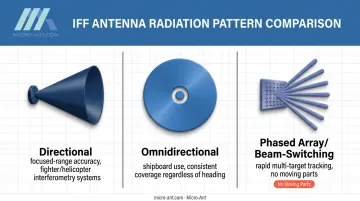
Radiation Pattern Selection
- Directional antennas: better for focused-range accuracy, common in interferometry-based fighter and helicopter systems
- Omnidirectional antennas: preferred for shipboard use, providing consistent 360-degree coverage regardless of vessel heading
- Phased array/beam-switching antennas: enable electronically steered coverage for platforms needing rapid multi-target tracking without moving parts
Size, Weight, and Aerodynamic Profile
An antenna that adds drag or throws off a platform's balance defeats its own purpose. Compact, low-profile designs matter just as much on a UAV as they do on a fighter jet.
Durability and Environmental Ruggedization
IFF antennas have to survive vibration, temperature swings, moisture, and high-speed airflow without losing performance. MIL-STD-810H lays out the specific test methods a rugged design should withstand, including high temperature, low temperature, blowing rain, humidity, sand and dust, vibration, and shock. A vague "MIL-STD-810 compliant" claim isn't enough; ask which methods, procedures, and severities were actually tested.
Manufacturer Certification and Testing Support
Sourcing from an AS9100 and ISO 9001-certified manufacturer with in-house near-field test chambers reduces performance risk before a platform ever reaches the field. In-house testing also shortens the qualification loop, since engineers can retest a design change without shipping hardware to a third-party lab and waiting weeks for a slot to open.
Total Cost and Lifecycle Considerations
Budget matters, but so does warranty support and long-term reliability. A cheaper antenna that fails qualification testing twice usually costs more than a properly engineered one from the start.
Why Choose Micro-Ant for Your IFF Antenna Needs
Micro-Ant has spent more than 20 years designing bespoke antenna systems for defense, aviation, and maritime customers, and that experience shows up directly in how the company approaches frequency-critical, mission-specific hardware.
A few reasons this matters for organizations evaluating IFF-relevant antenna programs:
- AS9100:2016 and ISO 9001:2015 certification governs design, build, and test — from requirements traceability through 100% unit-level testing before delivery.
- In-house near-field chambers spanning 750 MHz to 40 GHz cover the L-band frequencies IFF systems use, along with S-band and C-band.
- A US-based Jacksonville, Florida facility cuts the travel time and scheduling delays of shipping hardware overseas for qualification testing.
- A track record with DoD, civil government, and aerospace & defense customers is backed by a 65,000-square-foot facility that handles machining, RF integration, and environmental screening in-house.
For engineering teams developing a custom IFF or IFF-adjacent antenna, that combination of frequency coverage, certification rigor, and domestic testing infrastructure is worth putting on the shortlist. If your platform has requirements that don't fit an off-the-shelf design, Micro-Ant's engineering team can walk through the specification from concept through qualification.
Frequently Asked Questions
What is an IFF antenna?
An IFF antenna is the physical component of the Identification Friend or Foe system that transmits interrogation signals and receives coded replies. It works alongside a transponder to confirm whether an aircraft, ship, or vehicle is friendly.
What frequency does IFF use?
Modern Mark X/XII systems interrogate on 1030 MHz and reply on 1090 MHz, both within the L-band range. These same frequencies also support civil Mode S transponders and much of the ADS-B infrastructure.
How does IFF differ from a transponder?
A transponder is the onboard hardware that physically receives an interrogation and sends a coded reply. IFF is the broader system and protocol that coordinates that hardware along with encryption and identification data.
What is the difference between IFF and SIF?
SIF is the coding scheme within IFF that lets a single reply carry multi-digit identification data, such as a squawk code, instead of a simple yes-or-no response. It operates as part of the IFF protocol rather than as a standalone system.
Is IFF the same as the transponder system used in civil aviation?
Not exactly, but they're closely related. Civil transponders using Mode A/C/S and ADS-B evolved from military IFF technology and share the same interrogation-response principle, though they serve air traffic control rather than combat identification.
What is Mode 5 and why does it matter for modern IFF antennas?
Mode 5 is the current NATO standard that replaced the older Mode 4, adding NSA-certified encryption to both interrogations and replies. It's now the baseline requirement for interoperability across allied military platforms.