The military antenna market reflects this pressure directly. It's valued at $4.33 billion in 2024 and is projected to reach $7.56 billion by 2033, according to Grand View Research. Engineers face a real tension: shrinking real estate against multi-band, high-gain performance in brutal environments.
This guide breaks down the design trade-offs, materials, frequency mapping, and manufacturing considerations that separate mission-ready miniature antennas from parts that simply look small on a datasheet.
Key Takeaways
- Miniaturization trades size against bandwidth, gain, and efficiency under the Chu-Harrington limit
- Higher-permittivity substrates shrink antennas but introduce bandwidth and durability trade-offs
- Varactors, PIN diodes, and MEMS switches enable multi-band agility, within power-handling limits
- AS9100/ISO 9001 certification, US manufacturing, and in-house testing cut defense program risk
What Is a Miniature Antenna?
Engineers classify an antenna as electrically small when it satisfies ka < 1, where k equals 2π divided by wavelength and a is the radius of the smallest sphere enclosing the antenna. In practical terms, that means the antenna's largest dimension sits below roughly λ/(2π), close to the commonly cited λ/10 threshold used across the industry.
Shrinking below this boundary doesn't just save space. It strains three performance parameters simultaneously, since the physics doesn't scale favorably with volume:
- Bandwidth narrows as electrical size decreases
- Radiation efficiency drops from higher ohmic losses
- Achievable gain falls, limiting range and signal margin
Not every compact-looking antenna qualifies as electrically small. Common defense and aerospace form factors include:
- Chip antennas: surface-mount, used in trackers and embedded sensor nodes
- Patch/microstrip antennas: low-profile, printed on dielectric substrates
- Embedded PCB antennas: integrated directly into circuit board layouts
- Conformal antennas: shaped to match aircraft skin or missile bodies
The term "micro antenna" gets used loosely across consumer electronics and military hardware. But the moment ruggedization, multi-constellation GNSS support, or wide-band SATCOM roaming enters the requirement, performance expectations diverge sharply from a phone's Bluetooth chip antenna.
Key Design Trade-Offs in Miniaturized Antennas for Defense & Aerospace
Every miniaturization effort runs into the same physics ceiling. The Chu-Harrington limit defines minimum achievable Q as Qmin = 1/(ka)³ + 1/(ka), and for small ka values, that cubic term dominates fast. Higher Q means narrower bandwidth. There's no way around it, only ways to manage it.
Size vs. Bandwidth vs. Gain
Meandering, folding (as seen in PIFA-style structures), and slot loading all extend an antenna's electrical length without growing its physical footprint. Each technique buys size reduction at a bandwidth cost.
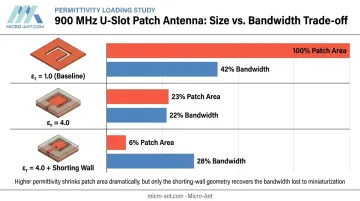
A documented 900 MHz U-slot patch study illustrates this well. Raising substrate permittivity from er = 1.0 to er = 4.0 cut patch area by 77%, but reduced VSWR ≤ 2 bandwidth from 42% down to 22%. Adding a shorting wall recovered some ground, achieving a 94% area reduction while retaining nearly 28% bandwidth. Bandwidth recovery techniques help, but they don't eliminate the underlying constraint.
Environmental & Ruggedization Considerations
Beyond the size-bandwidth trade-off, defense and aerospace antennas face stressors commercial parts never see:
- Thermal cycling across extreme temperature swings
- Vibration and shock during launch, flight, or transport
- Humidity and salt fog exposure on maritime platforms
- Radiation exposure for space-based hardware
Material selection and encapsulation directly affect detuning risk. An antenna mounted near metal airframe structures or worn against the human body shifts resonance unpredictably unless the design accounts for that proximity from the start.
Multi-Band Agility & Power Handling
Surviving harsh environments is only half the challenge. Defense platforms frequently need to roam across satellite operators or switch between tactical frequency bands without swapping hardware, a capability Micro-Ant's Ka-band SATCOM antennas are engineered to support. Active tuning components make this possible:
- Varactor diodes: voltage-tuned capacitance for frequency agility
- PIN diodes: RF switches for band or polarization changes
- MEMS switches: high isolation, low loss across broad frequency ranges
Power handling separates transmit from receive-only applications here. Varactor diodes can turn nonlinear well before hitting their physical dissipation rating, distorting impedance match and generating unwanted harmonics. A component's receive-band test data doesn't automatically qualify it for transmitter power levels, a distinction program managers should push their suppliers to clarify.
Materials & Construction Techniques for Miniature Antennas
Dielectric substrate choice is the single biggest lever engineers pull for miniaturization. Higher permittivity materials shorten the effective wavelength needed for resonance, letting an antenna shrink for a given frequency.
Dielectric & Ceramic Substrates
| Material | Typical Dielectric Constant | Trade-Off |
|---|---|---|
| PTFE/fiberglass laminate | 2.2 – 3.5 | Stable, easy to fabricate, moderate size savings |
| Alumina ceramic | 9.0 – 9.8 | Strong miniaturization, brittle mechanically |
| Anodized aluminum oxide | Process-dependent | Limited standardized microwave data available |
Ceramics deliver excellent electrical performance but come with a real durability penalty. Brittle substrates crack under vibration and shock unless engineered into composite or matrix constructions built for field deployment rather than lab benchtops.
Microstrip, Patch, and Chip Antenna Architectures
Substrate choice only tells half the story; the physical architecture built on top of it determines how much of that material advantage becomes usable size reduction. Microstrip and patch antennas dominate aircraft, missile, and vehicle-mounted applications for good reason. A metallic patch sits above a ground plane, separated by a dielectric layer, fabricated through photolithographic processes that keep the profile low and the mounting conformal.
PIFA (planar inverted-F) designs and chip antennas push miniaturization further. Ground-plane position materially shifts resonant frequency and bandwidth in these structures. That sensitivity is why PIFA designs show up most often in trackers, handheld radios, and embedded sensor nodes rather than high-gain platform arrays.
Ruggedized Manufacturing for Field Reliability
Commercial chip and flexible antennas rarely survive defense field conditions unmodified. Ruggedized miniature antennas typically require conformal coatings, radome protection, and hermetic sealing well beyond consumer-grade parts.
This is where in-house engineering matters. Micro-Ant designs, manufactures, and tests bespoke antennas at its 65,000-square-foot Jacksonville, Florida facility rather than modifying off-the-shelf commercial parts. This approach keeps ruggedization decisions tied directly to each program's mission profile from day one.

Frequency Bands and Real-World Defense & Aerospace Applications
Frequency band selection drives both antenna size and application fit. Higher frequencies generally allow smaller physical antennas for equivalent performance targets, which is why band choice comes early in any miniaturization program.
GNSS & High-Precision Positioning
Guided munitions, UAVs, and soldier navigation systems increasingly need miniature GNSS antennas capable of multi-constellation reception, spanning GPS, GLONASS, Galileo, and BeiDou signals, packed into compact form factors. Micro-Ant's proprietary high-precision GNSS designs target exactly this challenge: millimeter-level positioning accuracy without the bulk of legacy antenna assemblies.
SATCOM (Ka/Ku/X-Band)
Miniature Ka-band antennas let mobile and maritime SATCOM terminals roam across multiple satellite operators without losing connectivity. Micro-Ant's Ultra-Wide Band Ka Antenna System, which won Innovation of the Year honors in 2022, covers 17.7-21.2 GHz on receive and 27.5-31.0 GHz on transmit.
A 30cm airborne version completed certification testing in December 2021. The platform now supports man-pack terminals across Eutelsat and WGS programs, spanning LEO, MEO, and GEO orbits.
Tactical & Platform-Specific Applications
SWaP (size, weight, and power) constraints vary dramatically by platform:
| Platform | Documented Constraint |
|---|---|
| UAV conformal antenna | 6-24 GHz, fit within a 10-inch diameter, 5-foot cylinder |
| Soldier-worn radio + PDA | Combined weight under 2.2 lb |
| Missile telemetry (S-band) | Wraparound design around a 3-inch fuze diameter |
| Missile conformal depth | Under 0.7 inch for 9-21 inch diameter munitions |
| Maritime/shipboard | Low-profile system under 75 lb |
Each platform demands a genuinely custom trade-off between size, weight, bandwidth, and gain. No single antenna design solves every case.
How to Choose a Miniature Antenna Manufacturing Partner
Selecting a manufacturer for mission-ready miniature antennas comes down to a short list of verifiable criteria.
Certifications to check first:
- AS9100:2016 — confirms aerospace-grade quality management
- ISO 9001:2015 — confirms baseline quality system rigor
- Scalable production capacity — confirms the ability to support prototype runs through high-volume orders
Beyond certifications, in-house testing capability matters more than most buyers realize. A supplier running its own near-field and far-field chambers across a wide frequency range shortens qualification cycles significantly. Sending prototypes out to third-party test labs adds scheduling delays that stack up fast on program timelines.
Domestic, ITAR-compliant manufacturing rounds out the checklist. U.S.-based facilities with a valid CAGE code confirm eligibility for defense and government contracts before a single RFQ goes out. Skipping this verification step is a common and costly mistake.
Why Program Managers Choose Micro-Ant for Bespoke Miniature Antennas
Micro-Ant has spent over 20 years designing and manufacturing antennas, delivering more than a thousand bespoke products across defense, aviation, maritime, and land platforms. That track record shows up in the specific trade-offs this guide covers:
- Award-winning Ultra-Wide Band Ka Antenna System solves the size-versus-bandwidth problem discussed earlier, delivering wide-band coverage in a compact, mission-deployable package.
- Proprietary high-precision GNSS designs address the same multi-constellation positioning challenge facing guided munitions and UAV programs today.
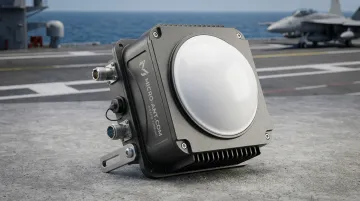
Those design trade-offs only matter once the hardware clears qualification. For program managers evaluating testing and qualification capacity, Micro-Ant's Jacksonville, Florida facility runs spherical and planar near-field chambers spanning 750 MHz to 40 GHz in-house. That range covers UHF through Ka-band without shipping hardware to a third-party lab, cutting travel time and accelerating qualification for time-sensitive defense programs.
Frequently Asked Questions
Do miniature antennas work?
Yes, when properly engineered. Miniature antennas trade some bandwidth and efficiency compared to full-size counterparts, especially at lower frequencies, but well-designed units meet mission requirements reliably.
What is a micro antenna?
A micro antenna is an electrically small radiating element, often chip-based or printed, built to fit space-constrained devices while holding acceptable RF performance for its application.
What can I use instead of an antenna?
No true substitute exists for antennas in wireless RF systems. Wired data links or optical communication sometimes serve as alternatives when RF miniaturization isn't feasible for a given platform.
What frequency bands do miniature defense antennas typically cover?
Miniature defense and aerospace antennas commonly operate from UHF through Ka-band, supporting SATCOM, radar, and tactical communications links. Multi-band designs consolidate several functions into one compact housing without sacrificing mission-critical performance.
What certifications should I look for in a miniature antenna manufacturer for defense applications?
Verify AS9100 and ISO 9001 certification, confirm U.S.-based manufacturing with a valid CAGE code, and check for demonstrated in-house testing capability before engaging a supplier.
How small can a miniature antenna be while still meeting defense-grade performance requirements?
Minimum practical size depends on frequency band, required bandwidth, and gain targets. Bespoke engineering is often necessary to hit aggressive SWaP goals without sacrificing mission performance.