Introduction: The Satellite Revolution Driving Flat Panel Antenna Demand
The ground segment of satellite communications is under pressure it has never faced before. LEO megaconstellations (SpaceX's Starlink, FCC-authorized for up to 7,500 next-generation satellites; OneWeb's 600+ across 12 orbital planes; Amazon Kuiper's 3,236-satellite constellation) have fundamentally changed what a user terminal needs to do.
Tracking a GeoSync satellite is straightforward. Tracking fast-moving LEO assets, handing off between them seamlessly, and doing it aboard a vessel in heavy seas or an aircraft at cruise altitude requires a fundamentally different antenna architecture.
Flat panel antennas (FPAs) are the hardware answer to that problem. Their low-profile form factor, electronic beam steering, and multi-orbit capability make them the natural fit for a world where the satellite is no longer sitting still.
This article covers what FPAs are, how they compare to parabolic designs, where the market is headed, and what separates a genuinely capable FPA from one that looks good on a datasheet.
Key Takeaways
- FPAs steer beams electronically — no motors, no gimbals, no moving parts
- Hitless handover between LEO satellites is a core differentiator, not a bonus feature
- The FPA market is projected to grow from $408M (2022) to $1.44B by 2027
- Defense, aviation, and maritime drive the highest-value FPA demand
- Credible manufacturers back claims with AS9100/ISO 9001 certification and measured test data, not simulations
What Is a Flat Panel Antenna and How Does It Work?
A flat panel antenna is a low-profile, directional antenna built from an array of radiating elements embedded in a flat surface. Where a parabolic dish focuses signals toward a single feed point, an FPA distributes that function across hundreds or thousands of coordinated elements — thin enough to mount flush against a vehicle roof, aircraft fuselage, or ship superstructure.
Electronic Beam Steering
The core technology enabling FPAs is phased array beam steering. By applying small, controlled phase shifts to the signals feeding each element, the antenna can constructively reinforce energy in a chosen direction — pointing its beam without any physical movement. This is what distinguishes FPAs from mechanically steered dishes, and it is what makes them viable for mobile and multi-orbit applications.
Full-Duplex vs. Half-Duplex
FPAs come in two operational modes:
- Full-duplex (FDX): Transmits and receives simultaneously. Essential for real-time video, voice, and high-bandwidth data. Higher design complexity and cost.
- Half-duplex (HDX): Alternates between transmit and receive. Lower cost and simpler architecture, but imposes latency and throughput trade-offs.
Hughes offers both FDX and HDX variants in its LEO ESA product line, demonstrating that duplex mode is a concrete procurement specification with direct cost and performance consequences.
Those trade-offs become more consequential when you factor in the tracking demands of LEO constellations.
Hitless Handover for LEO Tracking
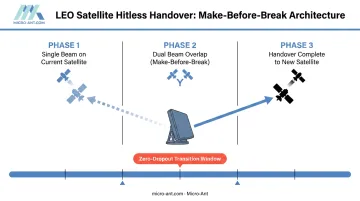
A LEO satellite crosses the sky in roughly 10 minutes. Without a hitless handover mechanism, every satellite transition causes a signal drop. NASA's research on make-before-break architecture describes how active phased arrays can form dual beams simultaneously — one tracking the receding satellite, one acquiring the incoming one — so the connection never drops. Conventional break-before-make handover can cause interruptions of tens to hundreds of milliseconds, degrading throughput and causing packet loss. For latency-sensitive applications, that is unacceptable.
Frequency Bands and Antenna Size
FPAs commonly operate across:
| Band | Frequency Range | Common Use |
|---|---|---|
| UHF | 300–1,000 MHz | Legacy military, IoT |
| Ku | 12–18 GHz | Broadband LEO (OneWeb uses 10.7–12.7 GHz downlink) |
| K | 18–27 GHz | Transition/overlap band |
| Ka | 27–40 GHz | High-throughput satellite, compact terminal design |
Higher frequencies offer a better gain-to-aperture-size ratio, meaning Ka-band FPAs can be physically smaller while maintaining useful link margins. This size advantage is why Ka-band has become the default for high-throughput FPA terminals across commercial and defense programs.
Flat Panel Antennas vs. Parabolic Antennas: Key Differences
The comparison between FPAs and parabolic antennas is not simply about which is newer. It is about which tool fits the job.
Form Factor and Installation
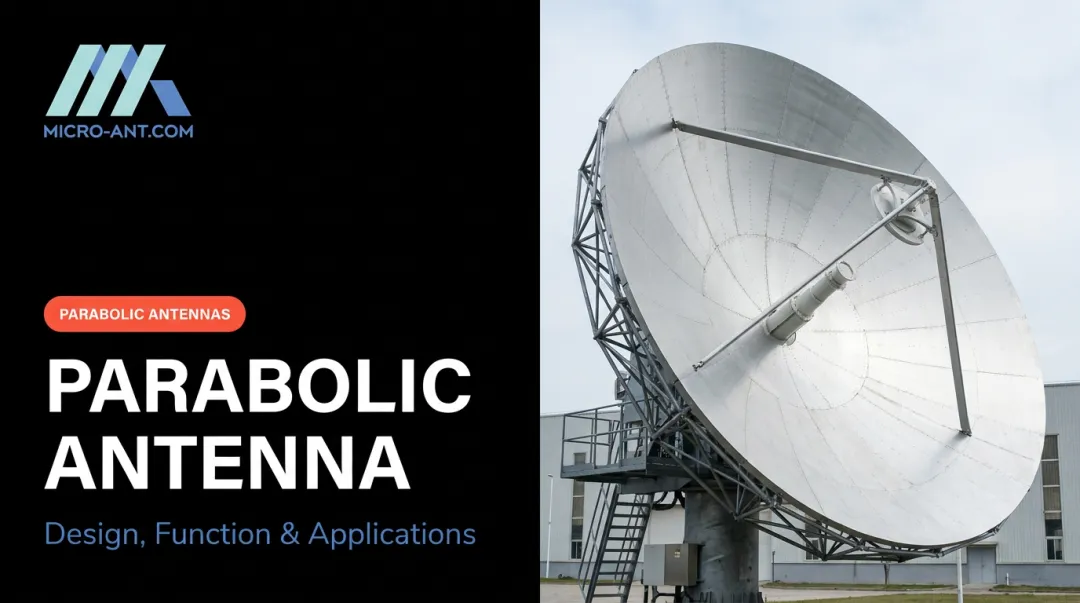
Parabolic antennas require structural support for the dish, a feed assembly, and a mechanical pointing system. On a ship or aircraft, that means radomes, mounting brackets, and clearance for the dish to rotate. FPAs mount flat, add minimal aerodynamic drag, and require no mechanical clearance. For aviation, that distinction is significant: a low-profile conformal antenna versus a dome directly changes the aerodynamics of the aircraft.
Mechanical vs. Electronic Steering
| Feature | Flat Panel (FPA) | Parabolic |
|---|---|---|
| Steering method | Electronic (phase shifting) | Mechanical (motors/gimbals) |
| Moving parts | None | Yes — motors, bearings, gimbals |
| Maintenance points | Fewer | More |
| Tracking speed | Near-instantaneous | Limited by mechanical speed |
| Multi-satellite capability | Yes (dual beams possible) | No (points to one target) |
Mechanically steered systems are mature and have established operator performance frameworks, including SOMAP (Satellite Operators' Minimum Antenna Performance requirements). That institutional familiarity is an advantage in environments where procurement teams want proven, standardized performance criteria.
The Multi-Orbit Advantage
SES markets its aviation ESA as the first commercially available antenna to operate between LEO and GEO, achieving speeds up to 275 Mbps. It is available for linefit installation on Boeing and Embraer aircraft. That multi-orbit capability is only possible with electronic steering. A parabolic antenna cannot simultaneously track satellites in different orbital regimes.
Where Parabolics Still Win
FPAs are not the right answer everywhere. Parabolic antennas retain real advantages in:
- Fixed-site, high-gain point-to-point links where the target does not move
- Very low frequency applications where aperture physics favor large dishes
- Cost-sensitive deployments where mobility and multi-orbit tracking are not required
- Environments where SOMAP-type operator certification is a hard requirement
The right procurement decision starts with the mission profile: if the platform moves, the satellite environment is mixed-orbit, or maintenance access is limited, FPAs offer a structural edge that parabolics cannot match.
The Growing Market for Flat Panel Satellite Antennas
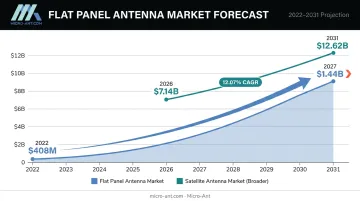
MarketsandMarkets estimated the flat panel antenna market at $408M in 2022 and projected $1.44B by 2027. The broader satellite antenna market, per Mordor Intelligence, is expected to grow from $7.14B in 2026 to $12.62B by 2031 at a 12.07% CAGR — driven significantly by LEO broadband, MilSATCOM, and in-flight connectivity demand.
Primary Market Drivers
The growth is not speculative. Specific, verifiable forces are accelerating FPA adoption:
- LEO constellation scale: Starlink, OneWeb, Kuiper, and others are deploying thousands of satellites that require ground terminals capable of continuous tracking
- Multi-orbit network strategies: Operators like SES and Intelsat are blending LEO and GEO services, demanding terminals that can bridge orbital regimes
- Maritime data surge: Inmarsat reported commercial maritime vessel data usage rose more than threefold since 2019 — a demand curve that parabolic systems with mechanical stabilization struggle to meet efficiently
- Satellite IoT growth: IoT Analytics reported 7.5M satellite IoT connections in 2024, expected to grow at 26% CAGR through 2030, expanding demand for compact, rugged terminal designs
Segment Dynamics
Those drivers play out differently across market segments:
- Consumer broadband: Largest volume segment by unit count, driven by LEO terminal proliferation
- Defense/government: Highest revenue per unit, with stringent technical specifications and mandatory certification requirements
- Aviation and maritime mobility: High revenue density and the most demanding operational environments — where independently tested, ruggedized designs are a procurement baseline, not a differentiator
For defense and mobility buyers in particular, a manufacturer's certifications and testing traceability carry direct procurement weight.
Key Applications Across Defense, Aviation, Maritime, and Land
Defense and Government
Military and intelligence organizations need mobile satellite communications that set up fast, fit on tactical vehicles, and keep working when the platform moves. FPAs check all three requirements. SpaceNews reported that the U.S. Army evaluated Kymeta flat satellite antennas for mobile connectivity networks — a concrete example of defense interest in FPA technology for comms-on-the-move.

With no motors or gimbals to fail in the field, FPAs reduce maintenance burden in austere environments. For ISR (intelligence, surveillance, and reconnaissance) applications, where continuous connectivity is operationally critical, the hitless handover capability of phased array designs — seamless beam switching without signal dropout — has clear tactical value.
Aviation
In-flight connectivity now means 4K streaming, multiple simultaneous devices, and office-grade reliability. Valour Consultancy notes that business aviation IFC requirements have expanded significantly, and smaller ESA form factors are expanding the addressable aircraft market. A low-profile FPA avoids the aerodynamic drag of a dome-enclosed dish while enabling continuous LEO satellite tracking across coverage zones. SES's multi-orbit aviation ESA — linefit for Boeing B737, B777, B787, and Embraer E2 aircraft — demonstrates what that capability looks like in a certified, commercial product.
Maritime
Electronically steered antennas compensate for vessel roll and pitch without the complex mechanical stabilization systems that parabolic maritime antennas require. On a commercial shipping vessel in open ocean, that mechanical simplicity translates directly into lower maintenance costs and higher system availability.
Land and IoT
Platforms that operate far from cellular infrastructure — and can't tolerate downtime — are where FPAs earn their place. Common land and IoT applications include:
- Autonomous vehicles: Low-profile mounting without protruding hardware that creates wind or clearance issues
- Oil and gas exploration: Ruggedized connectivity at remote sites where dish alignment and maintenance aren't practical
- Precision agriculture: Continuous GNSS-augmented communications across large, open terrain
- Logistics and fleet management: Always-on tracking and data links for vehicles in motion
Micro-Ant, based in Jacksonville, Florida, designs and manufactures custom FPAs across all four of these segments. Their customer list spans Intelsat, Inmarsat, and SES O3B mPower — and their AS9100:2016 and ISO 9001:2015 certified facilities support custom designs from prototype through full production, with in-house testing across the satellite frequency spectrum.
Technical Challenges and What to Look for in a Quality FPA
FPAs introduce engineering challenges that have no equivalent in parabolic antenna design. Understanding them is essential for procurement teams evaluating competing products.
Core Technical Challenges
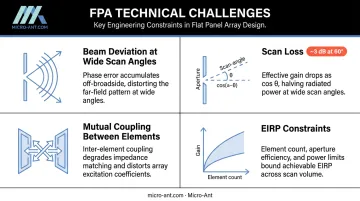
- Beam deviation at wide scan angles: As the beam steers away from boresight, pointing accuracy degrades. This is a physics constraint, not a manufacturing defect — but the degree of degradation varies significantly by design quality.
- Scan loss: Microwave Journal quantifies scan loss at approximately 10 log(cos θ), giving roughly 3 dB of loss at 60 degrees. For wide-angle LEO tracking, this loss directly affects link margin.
- Mutual coupling between elements: Adjacent radiating elements interact, creating scan-dependent impedance changes that conventional matching networks cannot fully compensate.
- EIRP constraints: Gain scales with element count (doubling transmit elements increases EIRP by 6 dB), meaning fewer active elements — due to cost cutting or thermal management — directly reduces uplink capability.
The Standards Gap
SOMAP defines minimum performance requirements for satellite operators' parabolic/VSAT antenna systems. IEEE 149-2021 covers general antenna measurement practice. Neither provides an FPA-specific equivalent that operators universally require. Rapid FPA commercialization has outpaced uniform testing procedures and standardized type approvals — creating real risk for procurement teams relying on simulation results rather than measured data.
What to Look for in a Quality FPA Manufacturer
Because no formal FPA testing standard exists yet, procurement teams must substitute verifiable evidence for the type approvals that parabolic systems enjoy. Focus on the following:
- AS9100:2016 and ISO 9001:2015 certification: These confirm quality management systems appropriate for aerospace and defense procurement — not just a baseline, but a signal that production processes meet documented, audited standards
- Radiation pattern data across multiple scan angles: Boresight gain from simulation is insufficient. Demand measured data at the scan angles relevant to your orbit regime
- In-house near-field test chambers: Testing infrastructure covering 750 MHz to 40 GHz (UHF through Ka) indicates the supplier can validate performance across the full relevant frequency range without outsourcing
- Satellite operator acceptance: Operator certification is the closest current proxy for the formal FPA framework that doesn't yet exist — it means a real network staked its link budget on the result
- Bespoke design capability: Generic catalog designs rarely satisfy the environmental, form-factor, and performance requirements of defense, aviation, or maritime deployments
Micro-Ant's spherical and planar near-field testing chambers operate from 750 MHz to 40 GHz and are accepted for FCC submissions. Certifications from major satellite operators — including SES O3B mPower, Intelsat, and Inmarsat — confirm that measured performance holds up under real network conditions, not just in simulation.
Frequently Asked Questions
What is a flat panel antenna?
A flat panel antenna is a low-profile, directional antenna composed of an array of radiating elements embedded in a flat surface. It uses electronic phase shifting to steer its beam without any moving parts, making it suitable for satellite communications on mobile platforms.
Are flat panel antennas any good?
For modern satellite applications — particularly LEO tracking and multi-orbit connectivity — FPAs are highly effective. Performance varies significantly between manufacturers, so procurement decisions should be grounded in certified, independently tested designs with documented real-world validation.
What is the difference between a flat panel antenna and a parabolic antenna?
The key differences are form factor (flat vs. dish), steering method (electronic vs. mechanical), and multi-orbit capability. FPAs can track multiple satellites simultaneously using electronic beam steering; parabolic antennas point mechanically to one target at a time and cannot bridge LEO and GEO orbits simultaneously.
How do you use a flat panel antenna for satellite communication?
FPAs are typically mounted on a flat surface — vehicle roof, vessel superstructure, aircraft fuselage, or building exterior — then connected to a modem or ground terminal. Once configured, the antenna electronically acquires and locks onto the designated satellite. No manual pointing is required.
What frequency bands do flat panel antennas support?
FPAs commonly operate across UHF, Ku, K, and Ka bands. Ka-band is especially prevalent for high-throughput satellite applications, partly because higher frequencies allow more compact antenna apertures. The appropriate band depends on the satellite network being accessed and the application's data rate requirements.
What are the main technical challenges with flat panel antenna technology?
Key challenges include:
- Scan loss at wide angles (approximately 3 dB at 60°)
- Mutual coupling between array elements
- EIRP limitations when fewer elements are active
- Absence of uniform FPA testing standards comparable to SOMAP frameworks
Rigorous manufacturer testing documentation is therefore essential for informed procurement decisions.