Introduction
A CubeSat can survive launch, deploy its solar panels, and run flawless onboard software. None of that matters if the ground station antenna can't lock onto its signal during the pass.
Many CubeSat teams discover this the hard way: telemetry drops mid-pass, a downlink window closes before the payload data finishes transferring, or the antenna simply can't hear a signal buried in noise. With only minutes of contact per orbit, there's no room for a weak link.
The pressure on ground infrastructure is only growing. The CubeSat market was valued at USD 426.6 million in 2024 and is projected to reach USD 1.65 billion by 2033, a 15.6% compound annual growth rate.
More satellites are now competing for the same limited ground contact windows, raising the stakes on every antenna choice. This guide breaks down the specs that matter: frequency band, gain, tracking method, and budget, so you can match an antenna to your mission's needs.
Key Takeaways
- Antenna type (Yagi, helical, parabolic, patch, phased array) sets achievable frequency, gain, and tracking performance
- Frequency band, polarization, and tracking speed must match your CubeSat's radio to establish any link
- Ruggedness and scalability determine if your ground station survives years of outdoor use and mission growth
- Standard COTS antennas often miss unique frequency, gain, or environmental specs—custom engineering fills that gap
What is a CubeSat Ground Station Antenna?
A CubeSat ground station antenna is a ground-based system that transmits commands to and receives telemetry or payload data from a CubeSat as it passes overhead in low Earth orbit.
Several antenna types serve this role, each suited to different budgets and mission goals:
- Yagi-Uda antennas — directional, moderate gain, common for VHF/UHF telemetry
- Crossed or quadrifilar helical antennas — circularly polarized, wide beamwidth, often used without a rotator
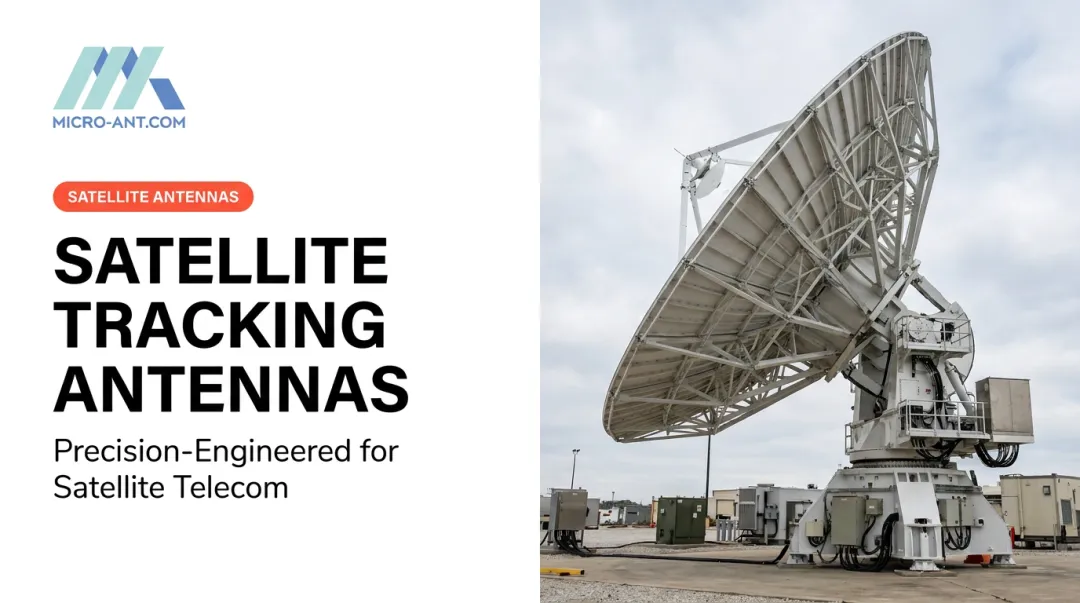
- Parabolic dish antennas — high gain for S-band or X-band links requiring higher data rates
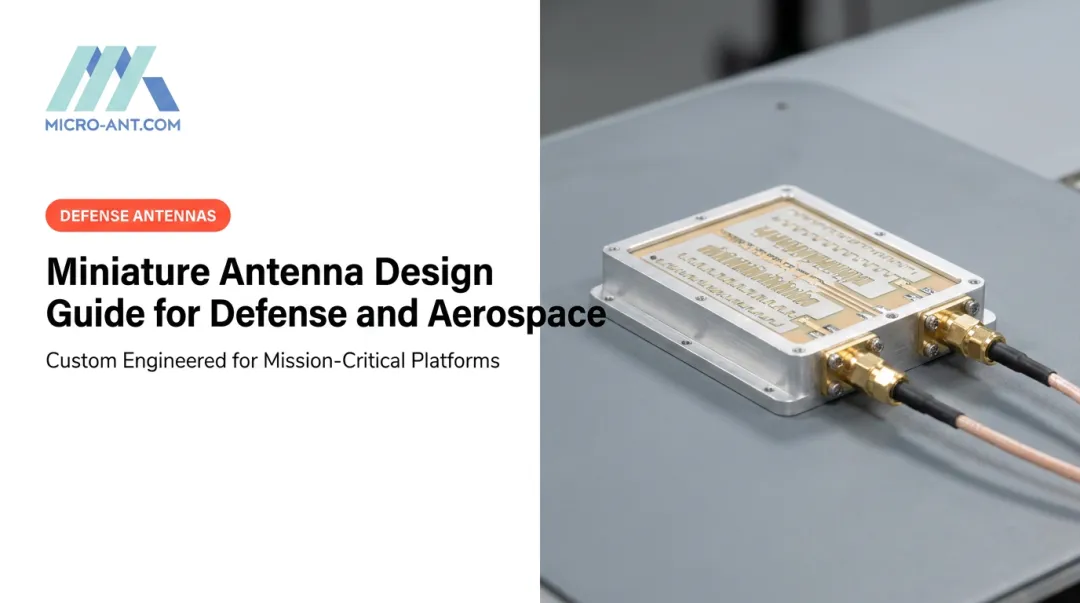
- Patch antennas — compact, often used as elements within larger arrays
- Phased array systems — electronically steered, capable of tracking multiple satellites without moving parts
Core Components of a CubeSat Ground Station Antenna System
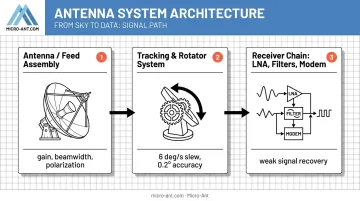
A complete ground antenna setup is more than the dish or Yagi itself. Three subsystems work together to capture a usable signal.
Antenna/Feed Assembly
This determines gain, beamwidth, and polarization, directly limiting everything downstream in the signal chain.
Tracking & Rotator System
An az-el rotator or motorized mount keeps the antenna pointed at a satellite moving across the sky in minutes, not hours.
A documented commercial ground kit specifies 6 deg/s slew speed and pointing accuracy of 0.2 degrees or better to keep pace with a LEO pass, according to ISISPACE's ground station datasheet.
Receiver Chain (LNA, Filters, Modem)
The low-noise amplifier and filtering stage recover a weak signal before it reaches the demodulator. CubeSat downlink power is limited, often just a few watts, so this stage decides whether usable data survives the trip from antenna to modem.
Why CubeSat Missions Rely on the Right Ground Antenna
Get the antenna wrong, and every other design decision on the spacecraft is compromised. Get it right, and the operational benefits compound across the mission lifetime:
- Stronger link margins that tolerate atmospheric loss, pointing error, and spacecraft tumble
- Higher successful pass rates, meaning fewer wasted contact windows
- More complete telemetry capture, reducing gaps in health and status data
- Reduced data loss on payload downlinks, which matters most for imaging and science missions
- Lower long-term maintenance costs from a system built for its actual operating environment
None of these benefits show up in a single number on a spec sheet. They show up in mission uptime, measured in successful contacts and complete data downloads over the life of the mission, and that's the real return on the antenna investment.
What to Consider When Choosing the Best CubeSat Ground Station Antenna
Antenna selection changes depending on mission type. A technology demonstration running low-rate UHF telemetry has very different needs than a commercial Earth observation mission pushing gigabytes of imagery through an X-band link. The following factors connect technical specs to real outcomes: data yield, mission cost, and operational reliability.
Frequency Band Compatibility
Matching the antenna to your CubeSat's radio band is the first gate. Get this wrong and there's no link at all, regardless of everything else.
| Band | Typical Use | Licensing Note |
|---|---|---|
| VHF/UHF | Low-rate telemetry, amateur/university missions | Amateur-satellite allocations (144-146 MHz, 435-438 MHz) common |
| S-band | Higher-rate TT&C, commercial missions | Some amateur-satellite use at 2400-2450 MHz, subject to coordination |
| X-band | High-data-rate imaging/science downlink | Requires specific service allocation and national authorization |
This choice also affects the achievable data rate and whether your operation falls under amateur licensing or a formal commercial allocation.
Antenna Gain and G/T Ratio
Higher gain concentrates more signal from a specific direction, but gain alone doesn't tell the full story. The gain-to-noise-temperature ratio (G/T) is the actual figure of merit for receive sensitivity, combining antenna gain with the noise performance of the entire receive chain.
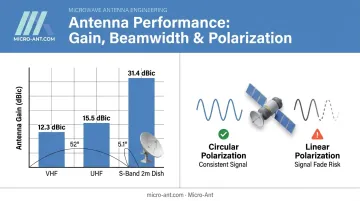
A documented ground station comparison shows just how much gain shifts with band and aperture: 12.3 dBic at VHF, 15.5 dBic at UHF, and 31.4 dBic for a 2-meter S-band dish, according to ISISPACE's published ground station specifications.
That gain jump comes with a narrower beam, dropping from 52 degrees down to just 5.1 degrees, which raises the bar on pointing accuracy.
This ratio ultimately governs link budget margin and bit error rate during a pass.
Polarization Matching
Most CubeSats tumble or spin, at least until an attitude control system stabilizes them. That tumbling causes unpredictable variation in the satellite's radiated polarization. Circular polarization (RHCP or LHCP) on the ground antenna handles this far better than linear polarization, which fades badly as the spacecraft rotates.
Some ground stations go a step further with polarization diversity, automatically selecting whichever received branch is stronger at any given moment. Mismatched polarization shows up fast in signal-to-noise ratio and downlink reliability, so this isn't a detail to skip.
Tracking Accuracy and Pass Duration
LEO CubeSat passes are short. A typical single-station contact runs about 10-12 minutes, with roughly four usable passes per day, according to UNOOSA's CubeSat operations training materials. That's often less than an hour of total daily contact time for one ground station.
Within that window, the satellite crosses the sky fast. The antenna and rotator have to track that angular velocity precisely, or you lose contact before the pass even peaks.
Tracking accuracy sets the percentage of usable contact time per pass, which in turn caps how much data you can downlink in a day.
Ruggedness and Environmental Durability
Outdoor-mounted antennas take a beating: wind loading, temperature swings, UV exposure, corrosion near coastal sites. Undersized builds fail early, and that's a bigger problem for remote or unmanned ground stations where a service visit isn't quick or cheap.
Published environmental limits vary by product. One commercial kit rates operation from -10°C to 50°C with a 120 km/h survival wind rating.
Standards like IP ratings and MIL-STD-810 describe testing methods for dust, water, and environmental stress, but citing a standard isn't the same as proof a specific unit passed it. Ask vendors for actual test data, not just a standard's name.
This factor drives system uptime and, over a multi-year deployment, total lifecycle maintenance cost.
Scalability for Multi-Mission or Constellation Use
A single CubeSat mission might get by with a fixed-purpose antenna. Teams planning a constellation, or a series of missions over several years, need something that can grow: upgraded frequency coverage, added gain, or new tracking software, without a full hardware replacement.
Scale matters at the network level too. KSAT LITE operates more than 100 antennas across 15-plus global sites and supported 1.5 million passes in 2023, according to NASA's Small Spacecraft Technology State of the Art report. That kind of scale only works with standardized, upgradeable ground infrastructure.
Scalability shapes cost per additional mission and the long-term return on your ground segment investment.
How Micro-Ant Can Help
Standard catalog antennas work fine until a mission's frequency plan, environmental requirements, or gain targets fall outside what a commercial off-the-shelf (COTS) product was designed for. That's the gap Micro-Ant fills, drawing on over two decades of bespoke antenna engineering for defense, satcom, and government ground station customers.
What sets this approach apart from off-the-shelf ground antenna vendors:
- AS9100:2016 and ISO 9001:2015-certified design and manufacturing, built for programs where traceability and quality control aren't optional
- In-house spherical and planar near-field testing chambers spanning 750 MHz to 40 GHz, validating antenna performance before a unit ever leaves the facility
- Proprietary Ultra-Wide Band and high-precision GNSS antenna technology, developed for missions where standard designs fall short
- A track record across defense, satcom, and government ground infrastructure, backed by a vertically integrated facility in Jacksonville, Florida

For CubeSat teams whose ground station requirements don't fit neatly into a catalog spec sheet, that combination of certified manufacturing and in-house testing means antenna performance gets validated before deployment, not discovered after a satellite is already on orbit.
Conclusion
The right CubeSat ground station antenna depends entirely on your mission's frequency plan, orbit profile, and budget rather than chasing a universal "best" pick.
Chasing the highest gain number or the most popular antenna type on a forum thread misses the point. Align specs with your actual data-return priorities instead, whether that's low-rate telemetry from a university technology demo or high-throughput imagery from a commercial constellation.
Revisit that alignment periodically. As mission requirements shift, satellite counts grow, or orbit parameters change, an antenna that fit perfectly two years ago might now be your bottleneck.
Frequently Asked Questions
How much does a CubeSat ground station cost?
Costs vary widely by antenna type and band. Complete VHF/UHF kits from established vendors run roughly $99,500, while combined VHF/UHF/S-band kits reach $139,500. Basic UHF-only antennas cost just a few hundred dollars, but that's hardware alone, not a complete station.
What frequency band is best for CubeSat communication?
VHF/UHF suits low-rate telemetry on amateur and university missions and remains the most mature CubeSat communications band. S-band and X-band serve higher data-rate commercial or imaging missions that need more throughput per pass.
Can I build my own CubeSat ground station antenna?
DIY Yagi or helical antennas work well for hobbyist and UHF receive-only projects. Higher-performance or licensed commercial missions generally need engineered, tested antenna systems to meet link budget and regulatory requirements.
What is the difference between a Yagi and a parabolic antenna for CubeSat tracking?
Yagi antennas cost less, mount easier, and deliver moderate gain (roughly 12-15 dBic in typical VHF/UHF configurations). Parabolic dishes deliver significantly higher gain, over 30 dBic in S-band setups, but need tighter pointing accuracy and cost more.
Why does tracking accuracy matter so much for LEO CubeSats?
CubeSats move fast across the sky during passes lasting only 10-12 minutes. Poor tracking accuracy directly cuts usable contact time, which reduces how much telemetry and payload data you actually downlink per pass.
Do I need a license to operate a CubeSat ground station antenna?
Yes. Frequency use is regulated internationally by the ITU and nationally by agencies like the FCC. Operators must register their frequency allocation and confirm authorization before transmitting, even on amateur-coordinated bands.