Introduction
When satellite links go dark, forward-deployed forces still need a way to move data over the horizon. A troposcatter antenna solves this by scattering microwave signals off the troposphere itself, creating a beyond-line-of-sight (BLOS) link that needs no satellite and no relay chain.
This explainer targets defense communications planners, program managers, and RF/systems engineers evaluating BLOS options in SATCOM-denied or degraded environments.
Troposcatter shows up constantly in modernization discussions, particularly around the Next-Generation Troposcatter (NGT) program. Yet the underlying antenna theory and engineering trade-offs often stay murky at the operational level.
Here's what you'll get:
- What a troposcatter antenna actually is
- Why defense forces still rely on it
- How the physics works
- Where it gets deployed
- The factors that determine whether a link succeeds or fails
Key Takeaways
- Troposcatter antennas bounce microwave signals off atmospheric turbulence, enabling BLOS links without satellites.
- These systems excel in SATCOM-denied, remote, or contested settings where other links fail.
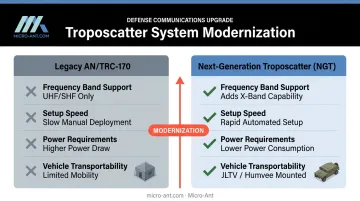
- NGT is actively replacing the decades-old AN/TRC-170, adding X-band operation and faster setup times.
- Link performance hinges on frequency choice, antenna gain, transmit power, and atmospheric conditions.
- Not every scenario needs troposcatter; short-range or fiber-available sites often have better options.
What Is a Troposcatter Antenna?
A troposcatter antenna is a high-gain directional antenna engineered to transmit and receive microwave signals that scatter off turbulence in the lower troposphere. That scattering effect is what carries a signal beyond the visual horizon, no orbital relay required.
ITU-R P.617-6 identifies tropospheric scatter as the permanent long-term mechanism for trans-horizon propagation above 30 MHz, distinct from surface diffraction or occasional ducting. That distinction matters for planners: troposcatter follows atmospheric physics, and system design must account for its real propagation limits.
The design goal is straightforward: extend secure, reliable range without building relay towers, launching satellites, or laying fiber.
Antenna Forms, Old and New
Troposcatter hardware has evolved considerably:
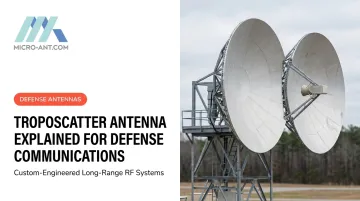
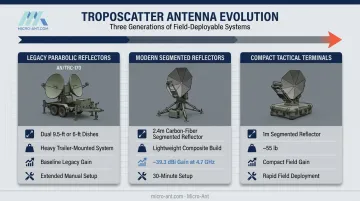
- Legacy parabolic reflectors — the AN/TRC-170(V)2 used dual 9.5-foot (2.9 m) dishes; the V3 variant used dual 6-foot (1.8 m) dishes.
- Modern segmented reflectors — Comtech's current 2.4 m carbon-fiber antenna delivers roughly 39.3 dBi of gain at 4.7 GHz and sets up in about 30 minutes with a two-person crew.
- Compact tactical terminals — smaller 1 m segmented-reflector systems now weigh around 55 lb in operational configuration, trading some range for portability.
Here's the trade-off nobody skips: propagation losses in troposcatter are enormous. A 1990 DoD field test over a 161 km path measured median transmission losses of 144 dB at 5 GHz and 157 dB at 15.73 GHz.
Only a tiny fraction of transmitted power ever reaches the receiver. That's exactly why these systems need extremely high gain and precise alignment to work at all.
How It Differs from Related BLOS Technologies
| Technology | How it achieves BLOS | Key limitation |
|---|---|---|
| Troposcatter | Scatters signal off tropospheric turbulence | High path loss; needs large antennas and power |
| SATCOM | Relays through an orbital satellite | Vulnerable to jamming, denial, or orbital disruption |
| Microwave LOS relay | Direct line-of-sight, hop to hop | Needs repeater towers to beat horizon limits |
| HF skywave | Refracts off the ionosphere | Unpredictable, weather- and time-of-day dependent |
Troposcatter occupies its own lane. It skips the spacecraft that SATCOM depends on and the tower chains LOS relay requires, and it isn't tied to the ionospheric conditions that make HF skywave unpredictable. It works by exploiting the lower troposphere directly.
Why Troposcatter Antennas Are Critical for Defense Communications
Satellite bandwidth isn't always there when you need it. Between jamming, denial, and simple unavailability in remote theaters, defense forces increasingly need SATCOM-independent options — a shift reflected directly in the Marine Corps' NGT program design.
Specific demands troposcatter addresses:
- Forward operating bases in areas with no ground infrastructure
- Contested or anti-access environments where SATCOM is actively targeted
- Terrain gaps — mountains, jungle canopy, or open ocean crossings that block conventional microwave relay
What Happens Without It
Skip troposcatter capability, and forces face two bad options. Either they become fully dependent on satellite links that adversaries can jam or deny, or they build extensive relay chains across difficult terrain. The second option burns manpower, equipment, and logistics capacity that most expeditionary units don't have to spare.
The Marine Corps' decision to field NGT as a replacement for the AN/TRC-170 shows the capability remains operationally prioritized, funded and modernized decades after the original system entered service. That modernization push has a security rationale too, one rooted in how troposcatter signals actually travel through the atmosphere.
The Security Angle
Troposcatter's narrow-beam, high-precision transmission makes interception far harder than broadcast radio or satellite downlinks. This holds especially true across open water, where there's no terrain to reflect or leak the signal laterally.
Manufacturers like Comtech state their systems are designed to reduce probability of detection and intercept. That's a vendor claim worth noting, not proof the technology is unhackable, but it explains why troposcatter remains a preferred choice for sensitive tactical links.
How Troposcatter Antennas Work (Conceptual Flow)
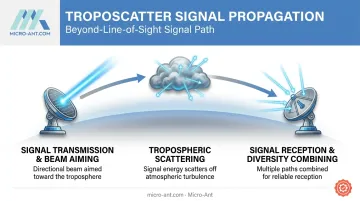
At a high level: a high-power transmitter aims a narrow microwave beam at a shallow angle above the horizon, toward the receiving station. A small slice of that energy scatters off turbulence in the upper troposphere and bends back down toward the receiver, arriving despite the Earth's curvature blocking a direct path.
Three variables control link reliability:
- Frequency selection: most fielded systems operate somewhere in the 1–10 GHz range, with many legacy and current terminals (AN/TRC-170, Comtech's antennas) concentrated around 4.4–5.0 GHz
- Antenna gain: directly tied to reflector size; Micro-Ant's composite reflector antennas maximize gain while minimizing weight for manpack and flyaway terminals
- Transmit power: ranges from roughly 10-50 W in compact terminals up to 1,000 W in longer-range systems like Ultra's Archer
Step 1: Signal Transmission and Beam Aiming
Operators align high-gain antennas with a precise elevation angle, pointed just above the horizon toward the distant receiving station. Even small aiming errors can cost significant link margin, which is why setup precision matters as much as raw hardware.
Step 2: Tropospheric Scattering
As the beam passes through turbulent, moist layers of the lower troposphere, countless tiny scattering centers redirect a portion of that energy back toward Earth. Some of it lands right where the receiving antenna is listening.
Step 3: Signal Reception and Diversity Combining
Receiving stations use sensitive receivers plus diversity techniques (multiple antennas, frequencies, or polarizations) to capture several scattered signal paths at once. ITU-R identifies several proven methods for reducing outage time:
- Horizontal and vertical space diversity
- Frequency diversity
- Vertical-angle diversity
Combining these paths and correcting phase differences reconstructs a clean, usable signal even as atmospheric fading comes and goes.
Where Troposcatter Antennas Are Deployed & Key Performance Factors
Troposcatter shows up across three general system classes:
- Tactical transportable terminals — NGT, legacy AN/TRC-170, and commercial equivalents like Comtech's COMET or Ultra's Archer
- Fixed strategic networks — longer-standing installations built for sustained regional links
- Hybrid SATCOM/troposcatter architectures — used for redundancy, as Marine units did during Desert Shield and Desert Storm to relieve pressure on congested satellite bandwidth
Deployment is generally mission-triggered, not a default. It gets activated when SATCOM is denied, when basing is remote, or when infrastructure simply doesn't exist.
Range varies sharply by system:
- Comtech's compact COMET terminal — rated up to 60 km
- Ultra's Archer — reaches 200+ km
- Historical AN/TRC-170 variants — covered roughly 100-300 km depending on configuration and terrain
Key Factors Affecting Performance
- Frequency and antenna size/gain trade-offs — bigger reflectors and higher gain improve range and reliability but cost portability
- Atmospheric and climate conditions — humidity, turbulence, and terrain roughness affect scattering efficiency; ITU-R data shows winter losses running 10-15 dB higher than summer on temperate paths
- Transmit power and diversity configuration — needed to hit reliability targets when fading gets severe
For teams engineering or customizing troposcatter antenna components, or building hybrid BLOS/SATCOM systems, bespoke antenna partners matter. Micro-Ant designs and tests custom antennas across UHF through Ka-band, using spherical and planar near-field chambers spanning 750 MHz to 40 GHz at its Jacksonville, Florida facility.
That range covers the C-band and X-band frequencies most tactical troposcatter systems operate within — relevant for programs needing custom reflector or feed designs validated before fielding.
Common Misconceptions & When Troposcatter May Not Be the Right Fit
A few misunderstandings persist, and they're worth clearing up before they shape a bad procurement decision.
Troposcatter differs fundamentally from SATCOM and HF skywave. It depends entirely on scattering off tropospheric turbulence, not orbital relays or ionospheric refraction. Confusing these mechanisms leads to wrong assumptions about vulnerability and coverage.
More power alone won't guarantee a reliable link. Scattering efficiency and alignment precision matter just as much as raw transmit wattage, and diversity engineering adds another layer of resilience. A poorly aligned high-power system can still underperform a well-tuned lower-power one.
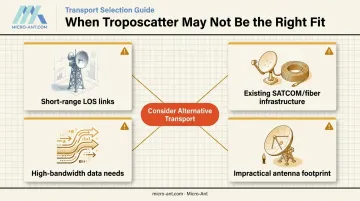
Troposcatter also isn't always the best answer:
- Short-range line-of-sight links that are cheaper and simpler to deploy
- Sites with existing secure SATCOM or fiber connectivity already in place
- Data requirements exceeding tropo bandwidth limits, pushing you toward other transport
- Locations where a large transportable antenna simply isn't practical
Troposcatter fills a specific role: a resilient, SATCOM-independent BLOS option. Understanding that role helps planners apply it where it actually fits, instead of defaulting to it out of habit or dismissing it as outdated.
Frequently Asked Questions
What is a troposcatter antenna?
A high-gain directional antenna used to transmit and receive microwave signals scattered off tropospheric turbulence, enabling beyond-line-of-sight communication without satellites.
What is tropospheric scatter?
This is the phenomenon where UHF/SHF radio waves get randomly scattered by turbulence and moisture in the upper troposphere, redirecting a portion of the signal back toward Earth beyond the horizon.
What is tropospheric scatter propagation and how is it different from duct propagation?
Tropo-scatter relies on turbulent scattering across a wide beam path and is a permanent atmospheric mechanism. Ducting relies on temperature-inversion layers trapping signals, producing less power loss but far less predictability.
How far can a troposcatter antenna transmit signals?
Range varies by system: compact terminals like COMET reach up to 60 km, while larger systems like Archer are rated for 200+ km. Legacy long-haul variants have historically covered up to 300 km under favorable conditions.
Is troposcatter communication secure for military use?
Narrow-beam, precisely aligned transmission makes interception considerably harder than broadcast or satellite links, especially over open water. This resistance to interception has made troposcatter a favored tactical option historically.
What is replacing legacy troposcatter systems like the AN/TRC-170?
The Next-Generation Troposcatter (NGT) program is replacing it, offering faster setup, added X-band operation, lower power requirements, and better transportability on vehicles like JLTVs and Humvees.