Introduction
Every satellite call, ship-tracking signal, and GPS-guided tractor pass relies on a piece of hardware most people never see: the antenna. Communications antennas form the critical link between defense networks, satcom operators, maritime fleets, and aviation systems worldwide.
Demand is climbing fast. The global military antenna market alone was valued at $4.5 billion in 2024 and is projected to reach $5.6 billion by 2029, a 4.6% CAGR, according to MarketsandMarkets' 2024 military antenna market report.
Yet selecting the right antenna is rarely simple. Engineers and procurement teams often struggle to navigate frequency bands, gain trade-offs, and ruggedization specs that don't fit neatly into a catalog.
This guide breaks down antenna fundamentals, major types, selection criteria, and when bespoke engineering solves problems off-the-shelf hardware can't touch.
Key Takeaways
- Communications antennas convert electrical signals into electromagnetic waves, powering satcom, radar, and GNSS connectivity.
- Antenna types range from parabolic dishes to phased arrays, matched to specific bands and environments.
- Frequency compatibility, gain, ruggedization, and SWaP constraints drive antenna selection decisions.
- Bespoke antenna design frequently outperforms off-the-shelf options for mission-critical or unusual applications.
What Are Communications Antennas and How Do They Work?
A communications antenna converts electrical signals into electromagnetic waves for transmission, then reverses the process on reception. That two-way behavior, known as reciprocity, means most antennas perform the same electrical role whether they're sending or receiving.
Three concepts define antenna performance:
- Radiation pattern: the shape and direction of energy the antenna sends or captures
- Gain: how tightly the antenna focuses signal strength in one direction versus spreading it evenly
- Polarization: the orientation of the wave, which can be linear or circular depending on design
These properties determine whether an antenna belongs on a satellite ground station, a ship's mast, or a GPS receiver.
From Satellite Uplink to GPS Fix
Consider a satellite uplink. A ground antenna transmits a signal skyward; the satellite receives it, processes it, and sends a downlink back to Earth. NASA notes that S-band frequently handles telemetry, tracking, and command, while X- and Ka-band carry high-rate downlink data. That single exchange depends on antennas engineered for precise frequency, gain, and pointing accuracy on both ends. The same reciprocity principle plays out closer to home: a GPS receiver antenna captures faint L-band signals from multiple satellites simultaneously, feeding the calculations that produce a position fix.
Frequency Bands Shape Everything
Band selection is the first, and most consequential, design constraint in any antenna project. Here's how the common bands break down:
| Band | Range | Typical Use |
|---|---|---|
| L | 1–2 GHz | GNSS, aviation surveillance |
| S | 2–4 GHz | Telemetry, mobile satellite links |
| C | 4–8 GHz | Large earth stations |
| X | 8–12 GHz | Government and defense downlinks |
| Ku | 12–18 GHz | Fly-away satcom, mobility terminals |
| Ka | 27–40 GHz | High-throughput satellite links |
These are broad IEEE designations. Actual transmit and receive channels are narrower service allocations, so confirming the specific regulatory band for your satellite operator and geography still matters before finalizing a design.
Types of Communications Antennas
No single antenna type wins every application. The right choice depends entirely on frequency, environment, and how much gain versus coverage a mission demands.
Parabolic Reflector Antennas
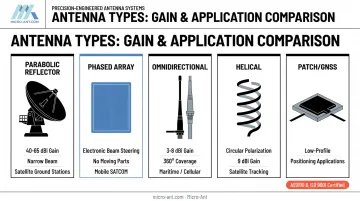
Parabolic dishes focus RF energy into a narrow, high-gain beam using a curved reflector surface. Published examples show the trade-off clearly: a 0.98-meter Ku reflector delivers roughly 39.8 dBi of gain with a 1.8-degree beamwidth. A 13.1-meter earth-station dish, by contrast, reaches 65.2 dBi with a beamwidth as narrow as 0.09 degrees. Bigger aperture and higher frequency both push gain up and beamwidth down.
These antennas dominate:
- Satellite ground stations requiring maximum signal strength
- Point-to-point backhaul links over long distances
- Manpack and flyaway terminal deployments for expeditionary field operations
Phased Array Antennas
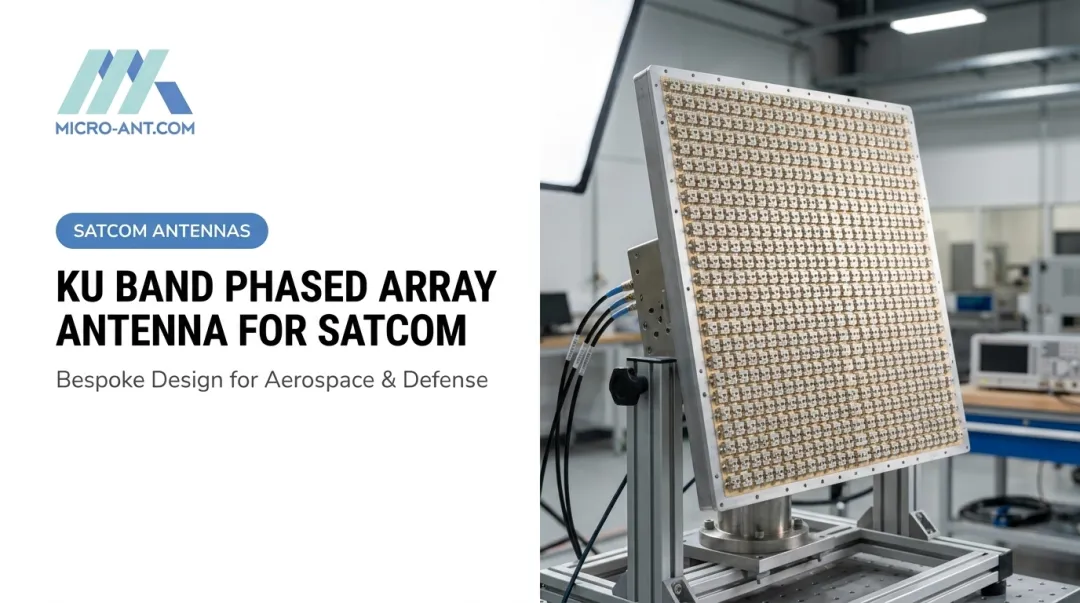
Phased arrays steer their beam electronically by adjusting the relative phase across multiple radiating elements. No moving parts, no mechanical gimbal. That makes them ideal for platforms that need to track a satellite while moving.
Micro-Ant's Ultra-Wide Band (3.5 GHz) Ka Antenna System is a real-world example of this approach, engineered to maintain connectivity across a wide swath of Ka-band spectrum for satcom-on-the-move applications. Industry momentum backs the category too: Viasat secured a $33.6 million U.S. Air Force contract for low-SWaP AESA technology supporting multiband, multiorbit communications on tactical aircraft.
Omnidirectional Antennas
An omnidirectional antenna radiates in a full 360-degree pattern around its axis. Gain sacrifices for coverage here, which is exactly the point. When a vessel, vehicle, or broadcast tower doesn't know which direction a signal will arrive from, omnidirectional coverage wins over a narrow, high-gain beam. Maritime VHF whip antennas and cellular base-station arrays illustrate the type well, typically delivering 3 to 8 dBi gain across the full azimuth.
Helical Antennas
Helical antennas wind a conductor around a central axis, producing circular polarization in axial mode. That polarization matters for satellite links because it stays usable even as the relative orientation between spacecraft and ground terminal shifts. NASA's deployable SmallSat helix, for instance, achieves roughly 9 dBi peak gain with an axial ratio below 3 dB.
GNSS and Patch (Microstrip) Antennas
Patch antennas are flat, low-profile designs mounted over a ground plane, typically receiving circularly polarized signals from GNSS satellites overhead. Micro-Ant engineers high-precision, multi-constellation GNSS antennas for positioning applications where compact form factor and phase-center stability both matter. Ground-plane size directly affects gain and center frequency, so final installation testing isn't optional.
How to Choose the Right Communications Antenna for Your Application
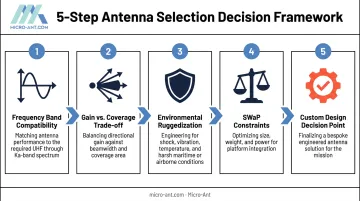
Selecting an antenna comes down to five filters, applied in roughly this order.
1. Frequency band compatibility. The antenna must match your target network or satellite operator's operating frequency. This is the first and most non-negotiable filter — there's no workaround for a mismatched band.
2. Gain versus coverage. High-gain, narrow-beam antennas (like large parabolics) maximize signal strength but require precise pointing. Lower-gain, wide-coverage designs sacrifice reach for flexibility. Your link budget, not a generic rule of thumb, should determine which side of that trade-off you need.
3. Environmental and ruggedization requirements. MIL-STD-810H governs environmental tailoring for materiel across its service life, while MIL-STD-461 controls electromagnetic interference emissions and susceptibility. Neither title alone guarantees an antenna is qualified for your platform: procurement documentation should specify the exact methods, procedures, and limits required.
4. Size, weight, and power (SWaP) constraints. Airborne, man-portable, and mobile platforms can't accommodate bulky hardware. SWaP-C (adding cost to the equation) has become a standard DARPA and defense procurement priority for antenna innovation programs.
5. When to go custom. Standard antennas fall short when:
- Frequency requirements fall outside catalog offerings
- Form factor must fit a non-standard airframe, vessel hull, or vehicle
- Performance specs (axial ratio, beamwidth, gain) exceed off-the-shelf capability
Micro-Ant's bespoke design process exists for exactly these scenarios, tailoring antenna systems for defense and aerospace clients whose requirements simply don't fit a data sheet. That flexibility spans prototype runs as small as five units through production volumes exceeding 200,000 units annually, with the same testing rigor applied at every scale.
Industries That Rely on Communications Antennas
Communications antennas aren't a niche technology. They're embedded across sectors where connectivity failure has real consequences.
Defense and intelligence. Secure, ruggedized comms and interoperability across satellite operators are non-negotiable in the field. The GAO reports that U.S. Space Command already supports nearly 3,000 users on commercial LEO satellite services, with the Navy deploying commercial small antennas and terminals directly onto ships.
Maritime and aviation. Vessels above certain tonnage thresholds are required by the IMO to carry AIS transponders with vertically polarized omnidirectional antennas. In aviation, EUROCONTROL's 2024 assessment found strong SATCOM continuity and availability, particularly for oceanic operations where terrestrial datalink simply isn't an option.
Emerging sectors. Autonomous vehicles, agriculture, mining, and logistics increasingly depend on GNSS and communications antennas for precision positioning. The USDA notes that GPS-based tractor autosteer can achieve accuracy within 1 centimeter, enabling far more precise input placement across large fields.
Why Partner With Micro-Ant for Bespoke Communications Antenna Solutions
Off-the-shelf antennas work until they don't. When frequency, form factor, or environment fall outside standard offerings, custom engineering becomes the only path forward.
Micro-Ant has spent over 20 years building that path for defense, aviation, maritime, and land customers. What sets the approach apart:
- Certified manufacturing under AS9100:2016 and ISO 9001:2015, ensuring documentation and process consistency across every production run
- In-house testing chambers with spherical and planar near-field measurement capability spanning 750 MHz to 40 GHz, cutting reliance on third-party test facilities
- Proprietary technologies, including the Ultra-Wide Band Ka antenna system, high-precision GNSS antenna designs, and Tri-Band Segmented Reflectors and Feeds developed with Kore Composites
- Trusted relationships with major satcom operators including Intelsat, Inmarsat, and Iridium

Fast, US-based testing turnaround means fewer shipping delays and faster iteration cycles for engineering teams under deadline pressure.
Production scale flexibility adds another layer of value, spanning five-unit defense prototypes to six-figure commercial orders. Micro-Ant builds its model around one idea: the same rigor applies whether you need one antenna or two hundred thousand.
Frequently Asked Questions
Which antenna is best for satellite communication?
Parabolic reflectors and phased arrays are the most common choices for satellite links. The right pick depends on mobility needs, frequency band, and how much gain your link budget requires.
What is the difference between a single antenna and an antenna array?
A single antenna radiates in a fixed pattern determined by its physical shape. An array, like a phased array, combines multiple elements to electronically steer the beam without moving parts.
How much gain do I need for reliable satellite communication?
Gain requirements depend on distance, frequency band, and desired signal strength. Longer-range or weak-signal links typically need higher gain to maintain a stable connection.
What frequency bands are commonly used in communications antennas?
L, S, C, X, Ku, and Ka bands cover most applications, from GNSS and mobile links (L, S) to high-throughput satcom (Ku, Ka). Each band trades range and penetration for bandwidth and gain potential.
Can communications antennas withstand extreme environments?
Yes. Ruggedized antennas built to MIL-STD-810 and MIL-STD-461 standards are specifically designed for extreme weather, marine exposure, and military field use.
How long does it take to design and manufacture a custom communications antenna?
Timelines vary based on complexity, frequency requirements, and testing needs. Bespoke manufacturers with in-house testing, like Micro-Ant, can shorten development cycles compared to firms that outsource validation.