Introduction
Defense platforms, commercial aircraft, ships, and ground vehicles all need one thing: a connection that doesn't drop when the platform moves. As LEO and MEO constellations multiply alongside established GEO fleets, that demand is only intensifying.
The satellite industry deployed 2,781 commercial satellites in 2023, a 20% jump over 2022, according to the Satellite Industry Association's State of the Satellite Industry Report. More satellites means more handovers, more orbital diversity, and more strain on legacy antenna hardware.
Traditional parabolic dishes struggle here. They're bulky and mechanically steered, costing precious seconds to reacquire lock whenever a platform banks, rolls, or changes heading. That's why Ku-band phased array antennas have become the go-to solution for mobile SATCOM.
This guide breaks down what these antennas are, how they work, how Ku stacks up against C-band and Ka-band, and how to pick the right manufacturing partner.
Key Takeaways
- Ku-band (12-18 GHz) offers a mature global ecosystem with moderate rain-fade risk, unlike Ka-band.
- Phased arrays steer beams electronically, with no moving parts, for faster tracking on moving platforms.
- Band selection hinges on bandwidth needs, mobility, weather exposure, and operator availability.
- Real-world reliability depends on rigorous engineering and in-house RF testing, not simulated performance.
What Is a Ku-Band Phased Array Antenna?
Ku-band sits in the 12-18 GHz range under IEEE's engineering designation. In practice, most commercial Ku fixed-satellite service traffic runs narrower: 11.7-12.2 GHz for downlink and 14.0-14.5 GHz for uplink in the US, per FCC allocations. When specifying a system, the exact sub-band, region, and satellite network matter more than the generic "Ku-band" label.
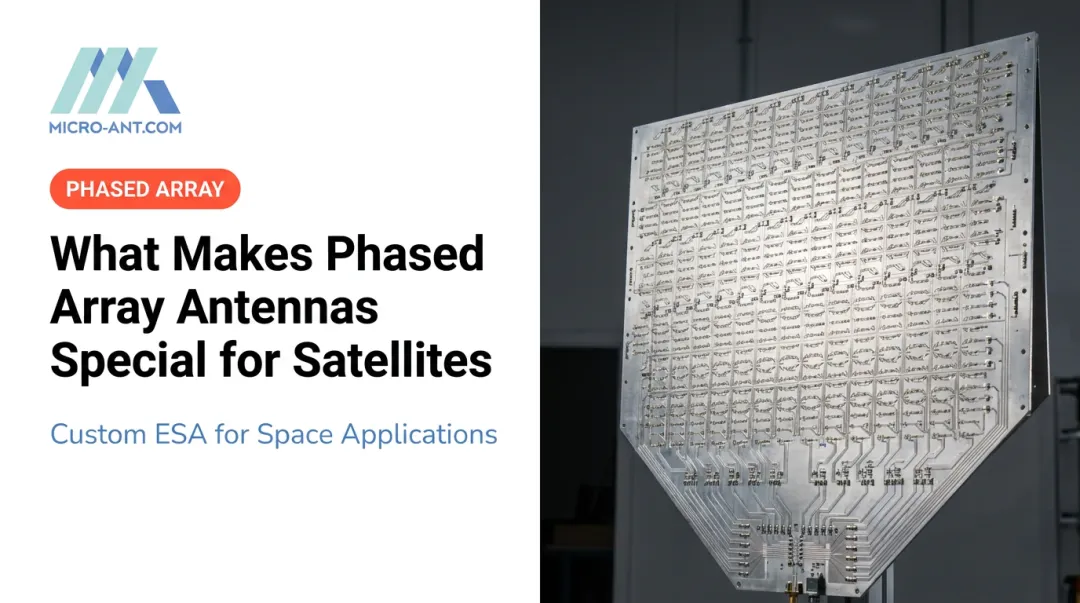
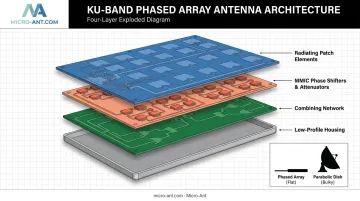
Once the frequency plan is set, the antenna's architecture determines how it forms and steers a beam. A phased array antenna replaces the single reflector of a parabolic dish with many small radiating elements — often patch antennas arranged in a grid. Each element's signal phase is adjusted electronically, so the combined wavefront points wherever it needs to, without a motor, gimbal, or mechanical actuator ever moving.
A typical Ku-band phased array is built from:
- Radiating patch elements arranged in subarrays on a roughly half-wavelength grid
- MMIC-based phase shifters and attenuators that control signal timing and amplitude per element
- Combining networks that merge subarray outputs into a single RF signal
- A flat, low-profile housing instead of a protruding dish, cutting drag and weight on aircraft and vehicles
Real-World Performance Benchmarks
Published research gives a useful reference point. A 256-element Ku-band transmit array documented in IEEE research on polarization-agile SATCOM phased arrays achieved 36.5 dBW saturated EIRP per polarization, scanning to ±60 degrees while holding 27 dB cross-polarization discrimination through ±45 degrees. Numbers like these matter more than a single boresight gain figure, since performance always degrades somewhat as the beam scans off-center.
How Ku-Band Phased Array Antennas Work
Electronic beam steering is the core trick. Each radiating element transmits (or receives) the same signal, but with a slightly different phase delay. Line those delays up correctly, and the wavefronts combine constructively toward the desired satellite while cancelling elsewhere.
Change the phase pattern, and the beam moves instantly. This happens in microseconds, not the seconds or minutes a mechanical gimbal needs to swing a dish.
Key Components
The array depends on four coordinated pieces:
- Radiating elements: the patches or slots that actually send and receive RF energy
- Beamforming RFICs: chips that set phase and amplitude for each element or subarray
- RF front end: filters, amplifiers, and combiners that condition the signal path
- Beam-control firmware: software that recalculates steering angles in real time as the platform moves and the satellite shifts
Active vs. Passive Architectures
Active arrays place amplification (power amplifiers on transmit, low-noise amplifiers on receive) at or near each element. Passive arrays centralize amplification and only distribute phase control.
Active designs generally win for Ku-band SATCOM: per-element amplification offsets losses in feed networks and combiners, preserving link margin. The tradeoff is added cost, complexity, and thermal load, a fair price for the performance gained.
Published figures worth knowing:
| Metric | Reported Result |
|---|---|
| Transmit EIRP | 34.5 dBW at P1dB, 36.5 dBW saturated |
| Transmit scan range | ±60 degrees |
| Receive scan range | ±70 degrees |
| Cross-polarization rejection | 27 dB |
Before any array ships, it needs calibration to verify that every element's phase and amplitude match the design intent, followed by near-field range testing to confirm beam pointing accuracy, gain, and cross-pol performance. Skipping this step is how good designs turn into unreliable field hardware.
Ku-Band vs C-Band vs Ka-Band: Which Frequency Is Right for Your SATCOM Application?
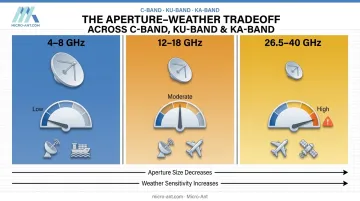
Frequency choice comes down to a tradeoff between aperture size, weather resilience, and available bandwidth.
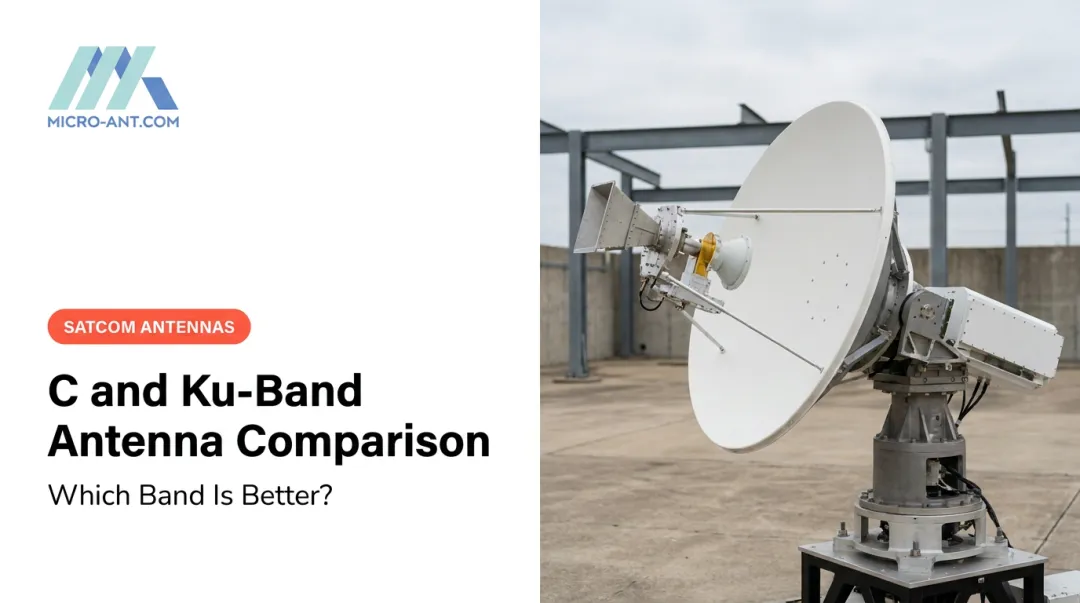
C-band (4-8 GHz) requires the largest antennas but resists rain fade best. Ku-band (12-18 GHz) allows a much smaller aperture, at the cost of more weather sensitivity. Ka-band (27-40 GHz) shrinks the aperture further and unlocks high-throughput satellite capacity, but rain fade and pointing precision requirements both get considerably tighter.
That weather tradeoff isn't subtle. SES reports that rain's impact on Ku-band links is more than four times its impact at C-band — a figure worth building into any site-specific availability analysis.
| Factor | C-Band | Ku-Band | Ka-Band |
|---|---|---|---|
| Frequency range | 4-8 GHz | 12-18 GHz | 27-40 GHz |
| Antenna aperture | Largest | Moderate | Smallest |
| Rain-fade sensitivity | Lowest | Moderate | Highest |
| Common applications | High-rainfall regions, broadcast | Maritime, aviation, land-mobile, VSAT | High-throughput fixed/mobile broadband |
Making the Choice
- Ku-band suits mobility-heavy applications: maritime vessels, aircraft, and land-mobile units that need a resilient, widely available operator ecosystem.
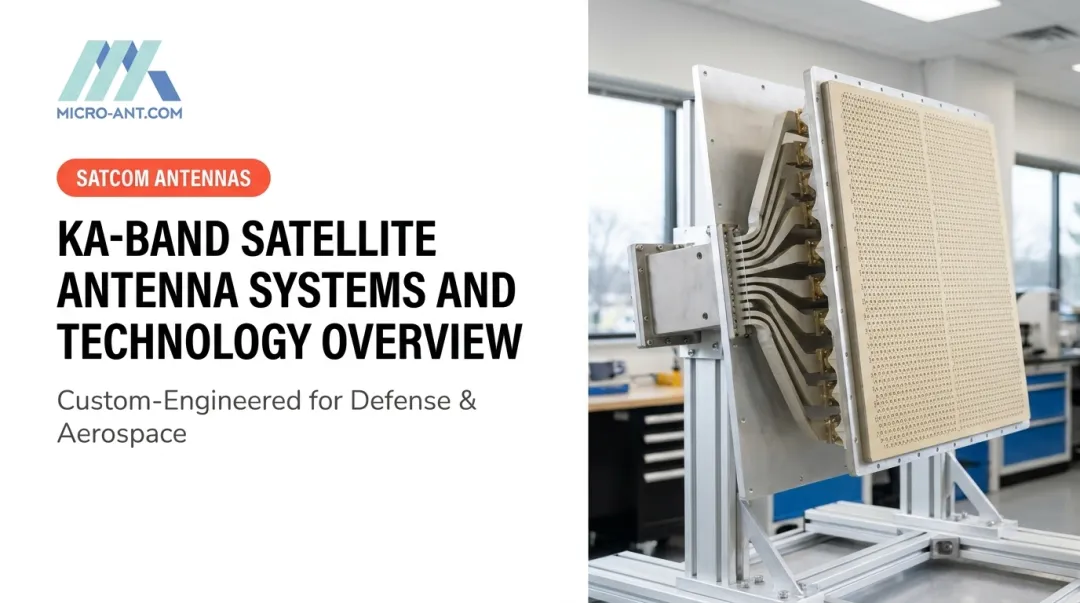
- Ka-band fits high-throughput scenarios where raw capacity outweighs weather risk.
- C-band remains the right call in tropical or high-rainfall regions where availability trumps aperture size.
Many newer terminal designs, including Micro-Ant's multi-band phased arrays, now span Ku and Ka in a single wideband aperture, letting a platform roam across multiple satellite operators and orbital regimes without swapping hardware.
Key Advantages & Applications of Ku-Band Phased Arrays in SATCOM
Advantages for Mobile and Fixed SATCOM
Ku-band phased arrays solve problems that parabolic dishes simply can't:
- Low-profile, aerodynamic form factor that cuts drag and weight versus a protruding dish
- Fast electronic beam steering that supports seamless handovers between satellites, essential for multi-orbit LEO/MEO/GEO operations
- No moving parts, which means less maintenance and longer service life in high-vibration field environments
Real-World Applications
These technical strengths translate directly into mission-critical deployments across several sectors:
- Defense and government: on-the-move tactical communications and ISR platforms that can't afford a connectivity gap
- Aviation: low-profile inflight connectivity for commercial and military aircraft, where every pound and every inch of drag counts
- Maritime and land-mobile: vessels, autonomous vehicles, and mobile command units that need an uninterrupted link while underway

Why Choose Micro-Ant for Ku-Band Phased Array Antenna Solutions
Micro-Ant has spent over 20 years designing and manufacturing bespoke antennas for defense, aviation, maritime, and land applications, all from AS9100:2016 and ISO 9001:2015 certified facilities in Jacksonville, Florida.
That experience shows up in the details:
- In-house spherical and planar near-field test chambers covering 750 MHz to 40 GHz, giving full Ku-band validation without shipping hardware overseas for testing
- Certifications earned across major operators, including Intelsat, Intelsat Flex, Inmarsat CAT-3/CAT-4, Eutelsat, SES O3B, and Thuraya, plus ARSTRAT qualification for military SATCOM terminals
- Industry recognition, including the 2022 Innovation of the Year and SatCom Technology of the Year awards for its Ultra-Wide Band Ka Antenna System
This same testing infrastructure and certification track record — built around flat-panel and phased array programs — carries directly into Ku-band phased array development, where rigorous multi-orbit validation is non-negotiable.
If your platform needs a Ku-band phased array antenna built to survive real-world vibration, thermal swings, and multi-orbit tracking demands, Micro-Ant's engineering team can talk you through a custom design consultation.
Frequently Asked Questions
What is a Ku band antenna?
A Ku-band antenna transmits and receives satellite signals in the 12-18 GHz range (commonly 11.7-14.5 GHz for commercial service). It's used for VSAT, broadcast, and mobile SATCOM in both fixed-dish and phased array systems.
What is the difference between C band and Ku band antenna?
C-band antennas operate at 4-8 GHz, needing larger apertures but resisting rain fade well. Ku-band antennas run at 12-18 GHz, offering a smaller footprint at the cost of greater weather sensitivity.
What is a phased array antenna in satellite communication?
A phased array steers its beam electronically by adjusting the signal phase across many small elements. There's no gimbal or motor involved, just electronic control.
What are the advantages of phased array antennas over parabolic dish antennas for SATCOM?
Phased arrays offer a lower profile, faster beam steering for satellite handovers, and no moving parts to maintain. Fewer moving parts mean less drag and a longer service life in the field.
Can Ku-band phased array antennas support multi-orbit (LEO/MEO/GEO) connectivity?
Yes. Modern Ku-band arrays, especially wideband or multi-band designs, can track across LEO, MEO, and GEO satellites, supporting fast handovers as constellations shift overhead.
How is Ku-band different from Ka-band for satellite communication?
Ka-band offers higher throughput but is more sensitive to rain fade and demands tighter pointing accuracy. Ku-band trades some capacity for a more forgiving, widely available operator infrastructure.