Traditional mechanically steered dish antennas were engineered for a different era — one dominated by fixed GEO satellites and stationary terminals. In mobile, multi-orbit environments, their limitations are operational liabilities: slow repointing, mechanical wear, and zero ability to reject interference.
Phased array antennas solve these problems at the hardware level. This article walks through exactly how — not in theoretical terms, but in terms of what changes on actual platforms in real operating conditions.
Key Takeaways
- Phased arrays steer beams electronically in microseconds, maintaining satellite lock through continuous platform motion
- Multi-orbit support enables seamless handovers across GEO, MEO, and LEO constellations from a single terminal
- Beam nulling actively suppresses interference and jamming, something mechanically steered dishes cannot do
- No moving parts means fewer failure points and lower lifecycle maintenance burden
- Design quality at manufacture determines field performance; match hardware specifications to mission requirements before procurement
What Are Phased Array Antennas?
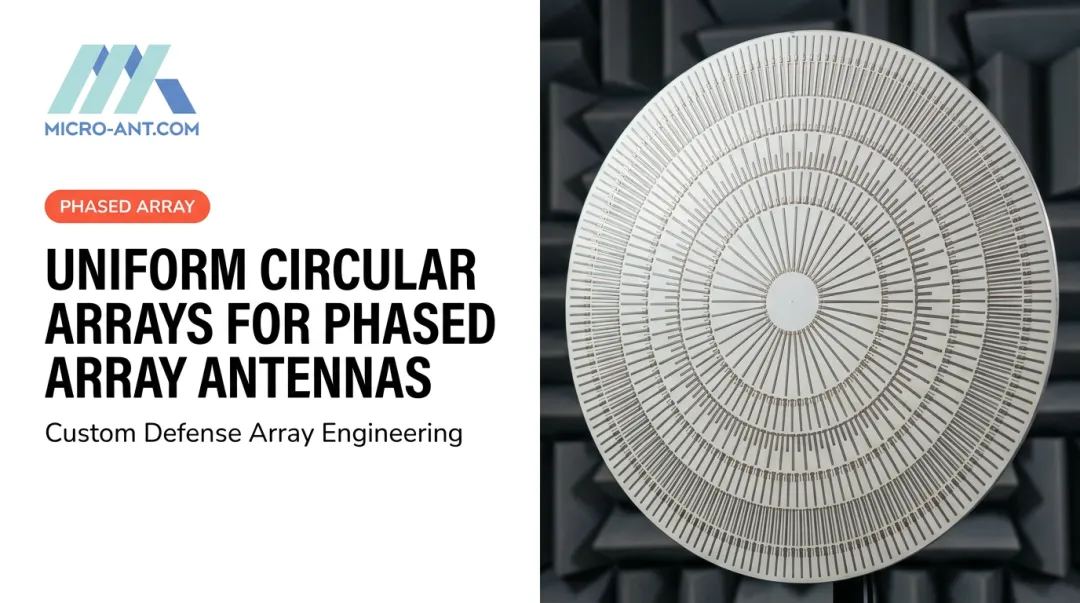
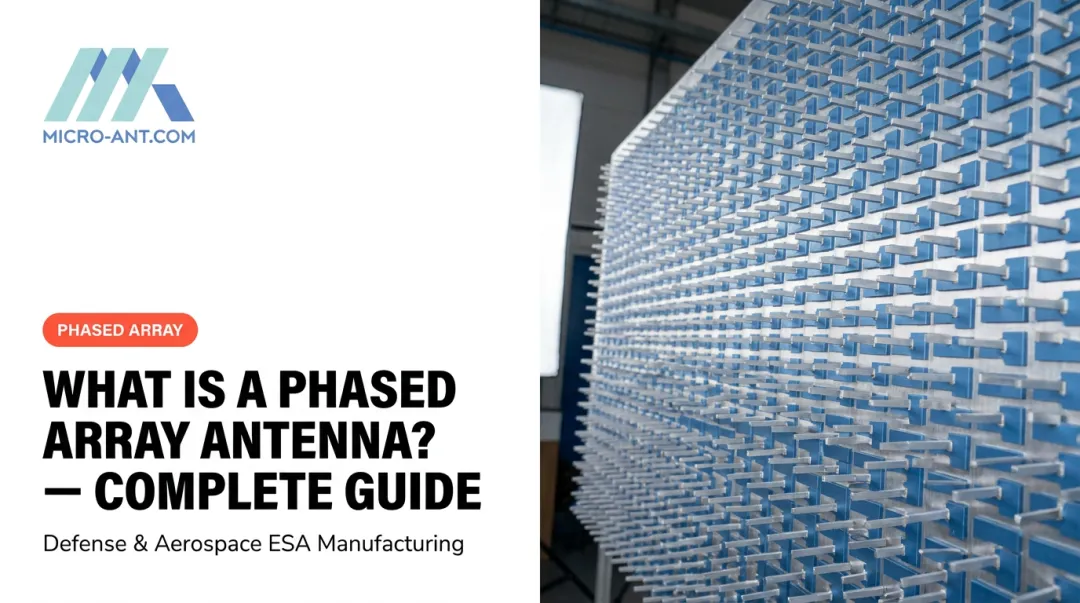
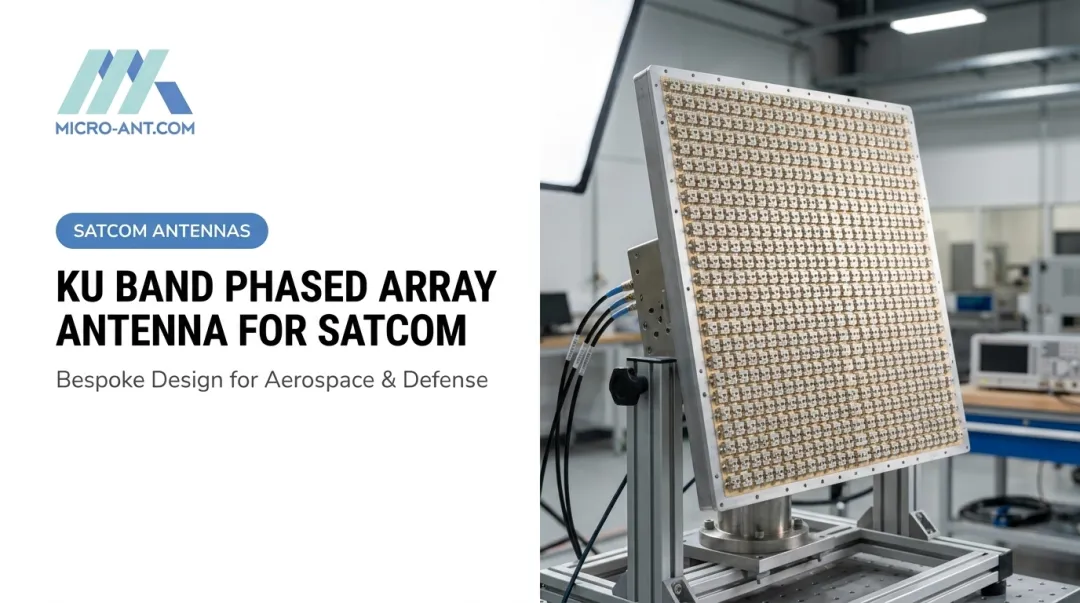
A phased array antenna is an array of individual radiating elements — often hundreds to thousands — that function collectively as a single, electronically controlled aperture. The key distinction from a dish antenna: beam direction is controlled by adjusting the phase of the signal at each element, not by physically rotating hardware.
That architecture translates directly into operational capability. In satellite applications, phased arrays appear on both ends of the link — aboard the satellite itself and at ground terminals, airborne platforms, and maritime vessels. Across all of these, the role is the same: establish and maintain a high-gain, directional link to a target satellite with speed and precision that mechanical systems cannot approach.
Three characteristics define the phased array's operational value:
- Beam steering is entirely electronic — no moving parts to fail or maintain
- Beam repointing occurs in microseconds, not seconds
- A single aperture can cover wide frequency ranges and multiple orbital geometries
These properties determine whether a satellite terminal stays connected when the platform is maneuvering, the spectrum is congested, or the operational environment is adversarial.
Key Advantages of Phased Array Antennas for Satellites
Electronic Beam Steering Without Mechanical Movement
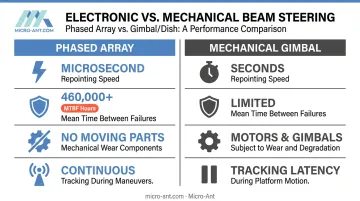
The most direct advantage is the elimination of moving parts. Phased arrays adjust beam direction by applying precise phase delays across antenna elements — a process SATCOM AESA antennas accomplish in microseconds, according to Qorvo. A mechanically driven dish accomplishes the same repositioning in seconds, through motors, gimbals, and drive systems that wear over time.
On a moving platform, this difference is decisive. An aircraft or naval vessel in motion constantly changes its attitude relative to any satellite in view. The antenna must compensate continuously. A mechanical gimbal system introduces tracking latency, has angular rate limits, and — eventually fails. A phased array adjusts in real time, with no mechanical lag and no components subject to lubrication cycles or actuator wear.
Why this matters operationally:
- Continuous link integrity during platform maneuvers — no dropouts during attitude changes, turns, or rough seas
- No mechanical components to maintain, lubricate, or replace on schedule
- Faster satellite acquisition when repointing to a new orbital target
When this advantage is most pronounced:
The impact is highest on fast-moving or maneuvering platforms — military aircraft, naval vessels in heavy weather, ground vehicles in contested terrain. It's also critical for LEO satellite tracking, where a satellite moves rapidly across the sky and the acquisition window between handovers is narrow.
For reference: Kymeta's published MTBF white paper documents calculated MTBF figures above 460,000 hours for ESA terminals — a reliability ceiling that mechanical gimbals, with their inherent wear mechanisms, cannot approach.
Multi-Orbit and Wideband Satellite Connectivity
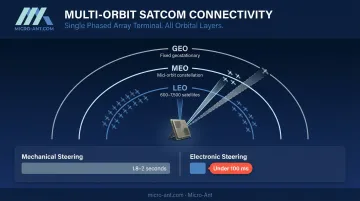
The satellite landscape is no longer defined by a handful of GEO operators. Three constellations alone illustrate the scale of change: Amazon Kuiper (3,236 satellites), SpaceX Gen2 Starlink (up to 7,500 FCC-authorized), and Eutelsat OneWeb (600+ LEO satellites currently operational).
The U.S. Army explicitly states it is leveraging multiple orbital regimes to enhance throughput, low latency, and resilience for large-scale combat operations — and that earlier equipment was limited to GEO.
A phased array can be engineered to operate across wide frequency ranges and steer its beam toward any point in the sky. This means a single terminal can track and communicate with satellites across different orbits and different operators without hardware changes. According to SES Space & Defense, electronically steered array antennas can reduce satellite handover time from approximately 1.8–2 seconds for mechanical steering to less than 100 milliseconds.
That handover speed matters. In LEO operations, satellites cross the sky quickly — slow handovers mean service gaps. Sub-100ms electronic switching means continuity.
Practical implications:
- Single-terminal multi-operator access — no separate hardware per satellite network
- Automated handover management — electronic switching happens without operator intervention
- Reduced infrastructure cost — one terminal covers orbital regimes that previously required separate antennas
Micro-Ant's Ultra-Wide Band Ka Antenna System, which earned the 2022 Innovation of the Year Award, addresses this challenge directly — providing 3.5 GHz of Ka-band coverage to enable connectivity across multiple satellite operators from a single terminal.
The GAO confirmed in 2025 that DoD is moving toward hybrid SATCOM architectures specifically because terminals capable of connecting to multiple satellite systems add connections to new satellites as networks evolve. This isn't a future requirement — it's a current procurement priority.
Interference Rejection and Signal Security Through Beam Nulling
A mechanically steered dish focuses energy in one direction. It cannot selectively suppress signals arriving from other directions — that's a physical constraint of the aperture design, not a configuration issue.
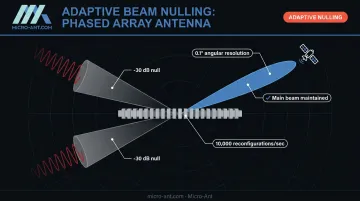
The same phase-control system that steers the main beam can simultaneously place signal nulls — deliberate suppression zones — in the direction of interference sources or jamming transmitters. The antenna maintains a clean, high-SNR link to the target satellite while actively rejecting signals from known threat azimuths.
MIT Lincoln Laboratory's foundational research on adaptive nulling for military SATCOM documented nulls at least 30 dB deep, with approximately 0.1-degree angular resolution and reconfiguration rates of 10,000 times per second.
The Defense Intelligence Agency and CSIS Space Threat Assessment both document jamming and interference as active threats to satellite communications in contested environments. The Space Systems Command is accelerating Protected Tactical SATCOM capabilities specifically to enable warfighter operations in electronically contested environments.
The security dimension extends beyond jamming resistance:
- Phased array transmissions are tightly focused beams with reduced sidelobe energy — less RF emissions scattered in unintended directions
- Reduced sidelobes lower the probability that platform location can be detected through RF emissions analysis
- For intelligence and government users, both link protection and emissions security are mission requirements, not nice-to-haves
When nulling capability matters most:
- Military operations in electronically contested environments
- Maritime hubs with dense spectrum congestion
- Government and intelligence users where emissions security is as important as signal integrity
What Happens When Phased Array Antennas Are Absent
Operating mobile satellite terminals with mechanically steered or fixed parabolic antennas in today's multi-orbit environment creates concrete operational problems:
- Link dropouts during maneuvers — mechanical gimbals cannot track fast enough during aggressive platform motion, interrupting command and control, data links, or crew communications
- Slow acquisition — the General Dynamics SATCOM-on-the-Move Model 20-20M specifies acquisition times of less than 5 seconds (hot start) and up to 5 minutes (cold start)— delays that compound quickly when orbital geometry is shifting
- No jamming resistance — fixed apertures have no mechanism to suppress interference; link degradation in a congested or contested environment is unavoidable
- Single-orbit dependency — organizations locked to one GEO operator have no recourse when that operator's coverage fails, pricing changes, or the satellite has an outage
As LEO constellations scale and multi-orbit architectures become standard, the performance gap between phased array-equipped platforms and legacy systems will only grow. U.S. Army doctrine already treats multi-orbit SATCOM as a resilience requirement for large-scale combat operations — platforms still dependent on single-orbit, mechanically steered terminals carry a measurable operational liability.
How to Get the Most Value from Phased Array Antennas
Phased array performance is largely fixed at the design stage. Beam steering angle, frequency coverage, sidelobe suppression, and element count are hardware parameters — they cannot be meaningfully upgraded in the field. This means procurement decisions require clear, specific operational requirements upfront.
Key parameters to define before procurement:
- Which frequency band and bandwidth the terminal must support across satellite operators and orbital regimes
- What size, weight, and power (SWaP) limits the platform imposes, and what environmental exposure the antenna will face
- What azimuth and elevation coverage the platform's operational profile requires
- Whether nulling capabilities are required and how many simultaneous nulls the interference environment demands
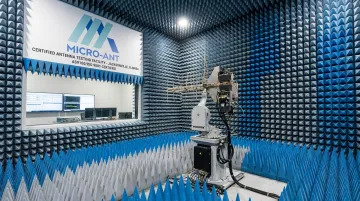
For defense and aviation applications, failures in the field carry direct operational consequences — which is why pre-deployment testing across the full frequency range is a hard requirement, not an optional step. Spherical and planar near-field testing validates gain, pattern, and beam steering accuracy before an antenna ever reaches the platform. NIST confirms that near-field scanning supports frequencies up to 110 GHz and is the standard method for transforming near-field measurements into far-field performance predictions.
That testing requirement is where in-house capability matters. Micro-Ant's AS9100:2016 and ISO 9001:2015 certified facilities in Jacksonville, Florida include spherical and planar near-field testing chambers, cutting the cost and scheduling delays that come with third-party test ranges.
Every antenna is designed from the ground up to match the specific platform and mission — not adapted from a catalog product to a specialized application.
Conclusion
Phased array antennas are special for satellite communications not because of any single feature, but because they solve the three core limitations of mechanical antenna systems simultaneously: they track satellites without latency, adapt to multi-orbit environments without hardware changes, and resist interference without sacrificing signal quality.
These advantages compound in the conditions where defense, aviation, maritime, and government operators actually work — moving platforms, congested spectrum, adversarial RF environments. In those contexts, the gap between phased array performance and mechanically steered alternatives isn't incremental. It determines mission success.
Antenna selection is an engineering commitment that extends well beyond initial procurement. As satellite architectures evolve and LEO constellations reshape what terminals must do, the quality of the original design — and the manufacturer's ability to support it through testing, iteration, and production — determines whether performance holds over the platform's operational life. For programs where that lifespan spans years or decades, that depth of capability matters as much as the antenna specification itself.
Frequently Asked Questions
How do phased array antennas differ from traditional parabolic dish antennas for satellite use?
Parabolic dishes use mechanical rotation to point at satellites — a slow, failure-prone process that degrades performance on moving platforms. Phased arrays steer electronically in microseconds with no moving parts, making them the right choice for mobile and dynamic satellite environments where continuous link integrity is non-negotiable.
Can phased array antennas connect to multiple satellites at the same time?
Advanced phased array designs — particularly active electronically scanned arrays and digital beamforming architectures — can generate multiple simultaneous beams, enabling connections to more than one satellite concurrently. This supports LEO handover management, multi-operator redundancy, and multi-orbit operations from a single terminal.
Are phased array antennas suitable for satellite communications on ships and aircraft?
Mobile platforms are among the primary use cases for phased arrays. They hold continuous satellite lock through constant movement and attitude changes — making them the standard for maritime SATCOM, in-flight connectivity, and vehicle-mounted terminals where mechanical systems simply can't keep pace.
What is beamforming and why does it matter for satellite links?
Beamforming adjusts the phase and amplitude of signals across individual antenna elements to create a focused, directional beam. For satellite links, this produces higher gain toward the target satellite, reduced pickup from interfering directions, and the ability to steer the beam electronically without any physical movement.
How do phased array antennas handle jamming or interference in satellite communications?
Phased arrays can be programmed to place signal nulls — suppression zones — in the direction of interference or jamming sources while maintaining the main beam toward the satellite. MIT Lincoln Laboratory documented nulls at least 30 dB deep with 0.1-degree resolution, a capability that mechanically steered dishes cannot replicate.
What frequency bands do phased array antennas support for satellite communications?
Phased arrays are designed across L, S, C, X, Ku, Ka, and higher bands — with wideband apertures covering multiple gigahertz in a single unit. That means multi-operator and multi-orbit satellite access without separate hardware per frequency.