Introduction
A passenger boarding a business jet today expects the same internet speed they get at their kitchen table. That expectation now drives booking decisions. Airlines and operators that can't deliver fast, reliable Wi-Fi risk losing loyalty to competitors who can.
Ka-band has become the technology making that possible, packing more data into smaller, lighter antennas than older systems ever could.
The problem? Selecting the right hardware means wading through overlapping frequency bands, LRU architectures, and a growing list of satellite constellations, each with different coverage promises. Operators and OEMs often find themselves comparing specs without a clear framework for what actually matters.
This guide breaks down what Ka-band is, how the antennas work, how it stacks up against Ku-band, where it's already flying successfully, and what separates a dependable antenna manufacturer from the rest.
Key Takeaways
- Ka-band (26.5–40 GHz) outperforms Ku-band, powering in-flight streaming, calls, and flight-ops data
- Modern systems use compact two-LRU architectures validated through aircraft-specific STCs before commercial rollout
- Growth across GEO, MEO, and LEO satellites is fueling demand for wideband, roaming antennas
- Choosing a certified, rigorously tested antenna manufacturer matters as much as the satellite network itself
What Is Ka-Band Technology and Why It's Transforming Aircraft Connectivity
Ka-band sits at 26.5 to 40 GHz on the spectrum, well above Ku-band's range. That higher frequency matters for one practical reason: shorter wavelengths let engineers pack more gain into a smaller antenna aperture.
Smaller antenna, same or better performance. That's the trade that's reshaping aircraft connectivity.
What This Means for Passengers
Real-world speeds back this up. Viasat's Select Ka-band service for business aviation typically delivers more than 20 Mbps, with some operators reporting speeds above 80 Mbps. Honeywell's newer JetWave X terminal lists throughput of up to 200 Mbps on its multi-network Ka platform.
Those numbers translate directly into what passengers actually do onboard:
- Stream video without buffering
- Join video conferences mid-flight
- Send large files for work without delay
- Keep multiple devices connected simultaneously
Passenger expectations back up these numbers. In a 2023 survey of 11,053 air travelers, Viasat found that 81% said Wi-Fi quality was important to their onboard experience, and 83% said they'd be more likely to rebook an airline offering quality Wi-Fi. That's a direct line between connectivity and revenue, not just a nice-to-have feature.
The Expanding Ka-Band Satellite Ecosystem
Ka-band antennas don't operate in isolation. They're built to talk to a specific mix of satellites, and that mix keeps growing.
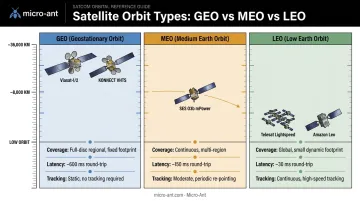
GEO satellites remain the backbone. Viasat-1 and Viasat-2 cover North America, the Caribbean, and North Atlantic routes with dedicated Ka spot beams. Eutelsat's KONNECT VHTS, positioned at 2.7 degrees East, entered service in October 2023 with 500 Gbps of Ka-band capacity, purpose-built to support European broadband and inflight connectivity.
MEO constellations are changing the tracking equation. SES's O3b mPower runs 11 satellites at roughly 8,000 km altitude, offering a service-level latency target of 150 ms round-trip or less. Antennas built for MEO need to track satellites moving through the sky, not fixed points, which demands more sophisticated beam-steering.
LEO Ka-band networks are the next wave. Telesat's Lightspeed project targets a 198-satellite Ka-band constellation with aviation service expected in Q4 2027. Amazon's Leo (formerly Project Kuiper) has already unveiled a full-duplex Ka phased-array terminal, with JetBlue named as a launch partner for 2027.
The upshot: aircraft flying global routes increasingly need antennas that can roam across GEO, MEO, and LEO without a hardware refit every time the satellite landscape shifts. Micro-Ant engineers its Ka-band antennas for this kind of extended frequency roaming, so operators aren't locked into a single satellite network as new constellations come online.
How Ka-Band Antennas Work: Components and Aircraft Integration
Most current business aviation Ka-band systems run on a simple two-piece architecture: a tail-mounted antenna and a separate modem unit. Satcom Direct's Plane Simple Ka prototype, installed on a Gulfstream G550, is a documented example of exactly this design.
Fewer boxes mean fewer wiring runs, less weight, and a faster install for maintenance crews.
Mechanical vs. Electronic Steering
Antennas point at satellites in one of two ways:
| Steering Type | Advantages | Trade-offs |
|---|---|---|
| Mechanically steered (such as VICTS designs) | Mature technology, proven flight history, lower-profile flat-panel options exist | Moving parts require maintenance over time |
| Electronically steered (ESA) | No moving mechanisms, potentially lower drag | Higher cost, and as of 2021 reporting, adoption still faced reliability and airworthiness-validation hurdles |
Neither approach is universally "better." The right choice depends on aircraft type, mission profile, and how much risk an operator wants to take on unproven hardware.
Getting It Certified
No antenna flies commercially without an FAA Supplemental Type Certificate (STC). The FAA issues an STC when it approves a modification to an aircraft's original type design, and that approval is specific to the airframe it was tested on.
A Ka-band system certified on a Gulfstream G550 doesn't automatically clear for an Airbus A340. Each airframe needs its own certification path.
Ultra-Wide Band Ka Systems: Solving the Multi-Operator Roaming Challenge
Certification confirms an antenna is safe to fly on a specific airframe, but it says nothing about which satellites that antenna can actually reach. Here's a challenge that trips up a lot of global operators: an aircraft flying from the US to Europe to Asia may cross the coverage footprints of several different Ka-band satellite operators. A narrowband antenna locked to one operator's frequency slice simply can't roam.
The fix is a wider instantaneous bandwidth. Micro-Ant's Ultra-Wide Band (3.5 GHz) Ka Antenna System was built around this exact problem, extending coverage across a broader slice of Ka spectrum so the same physical antenna can hand off between operators without a hardware swap.
The system earned recognition in the "Most Innovative" category at the Satcoms Innovation Group awards in 2022, alongside a SatCom Technology of the Year honor the same year.
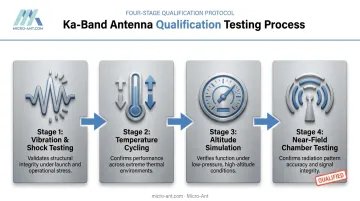
Before any wideband antenna reaches an aircraft, it goes through a battery of qualification testing:
- Vibration and shock profiles matching flight conditions
- Temperature cycling across extreme highs and lows
- Altitude simulation
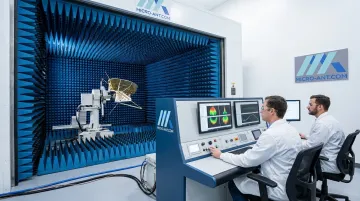
- Near-field chamber testing to validate radiation pattern and gain across the full operating band
That last step matters more than it sounds. A near-field chamber confirms the antenna performs as designed across its entire frequency range, not just at a handful of test points.
Ka-Band vs. Ku-Band: Which Is Right for Your Aircraft?
Neither band wins outright; each solves a different problem. Here's how they stack up in practice:
| Factor | Ka-Band | Ku-Band |
|---|---|---|
| Typical speeds | Downloads above 30 Mbps, peaks above 90 Mbps (Viasat dual-band data) | Up to 10 Mbps on the same comparative system |
| Coverage pattern | Concentrated high-capacity spot beams (North America, North Atlantic) | Broader legacy global footprint |
| Rain fade | More susceptible; requires added rain margin and adaptive coding | Comparatively more resilient in heavy weather |
Matching Band to Mission
Large-cabin, long-haul aircraft flying intercontinental routes often need broader coverage, making Ku-band or hybrid systems attractive for the legs Ka doesn't cover. Light and mid-size jets on regional routes, by contrast, can lean on Ka's higher throughput without worrying as much about coverage gaps.
The Hybrid Trend
Rather than picking a side, many operators are moving toward dual-band systems. Viasat's GAT-5530, a second-generation hybrid Ka/Ku terminal, is designed to roam across whichever network offers the best signal at any given point in the flight.
According to ThinKom's CTO, Ka's higher rain-fade susceptibility can be managed through added rain margin and adaptive coding and modulation, though that mitigation can reduce data rate during severe weather. Hybrid designs sidestep the issue by switching bands entirely when conditions call for it.
Real-World Ka-Band Antenna Deployments in Aviation
Theory is one thing. Here's where Ka-band is already flying.
Three programs show how far the technology has come:
| Program | Aircraft / Network | Milestone |
|---|---|---|
| Satcom Direct's Plane Simple Ka | Gulfstream G550, Inmarsat Jet ConneX (Global Xpress Ka-band) | Prototype testing began January 2023 with a two-LRU design: tail-mount antenna plus SD Modem Unit |
| AMAC Aerospace | Airbus A340 | Completed installation in May 2024, part of a track record of more than 45 Ka-band installations across its maintenance and completions business |
| Honeywell JetWave | Inmarsat Jet ConneX network | More than 100 business jets flying with JetWave hardware by October 2017 |
For passengers, the payoff is broadband speeds that feel close to what they get on the ground. Honeywell's climb from prototype to over 100 aircraft in under a decade remains the clearest proof that Ka-band can scale beyond pilot installs into mainstream business aviation.
Choosing the Right Ka-Band Antenna Manufacturer
Picking a satellite network is only half the equation. The antenna itself has to hold up across thousands of flight hours, temperature swings, and years of service.
Certifications That Actually Matter
Look for AS9100:2016 and ISO 9001:2015 certifications. AS9100 builds on the ISO 9001 quality management baseline and adds requirements specific to aviation, space, and defense supply chains. A supplier without it hasn't been audited to the standard aerospace programs expect.
Testing Infrastructure Is Not Optional
Ruggedized design only means something if it's been proven. Micro-Ant runs its Ka-band products through spherical and planar near-field testing chambers covering 750 MHz to 40 GHz at its Jacksonville, Florida facility. That range validates its Ultra-Wide Band Ka Antenna System across the full extended frequency span operators need for multi-network roaming.
Key things to check with any manufacturer:
- Do they test in-house, or outsource to third-party labs?
- Can they validate performance across the aircraft's full operating environment, not just at room temperature?
- Do they have a documented history of extended-bandwidth Ka products, not just single-frequency designs?
Why Domestic Manufacturing Matters
A Made in USA supplier with its own CAGE code (Micro-Ant's is 6XJFO) simplifies government and defense-adjacent procurement and cuts the logistics chain down to one country. For aviation integrators working against tight installation schedules, that usually means shorter lead times and fewer customs delays than sourcing from overseas suppliers.
Frequently Asked Questions
What is Ka-band frequency used for in aviation?
Ka-band (26.5–40 GHz) powers high-throughput satellite broadband on aircraft, enabling inflight Wi-Fi, video streaming, and teleconferencing for passengers and crew.
How fast is Ka-band internet on airplanes?
Current business aviation Ka-band systems typically deliver 20 to 30+ Mbps, with peak speeds reported above 80-90 Mbps on some networks. Actual speed depends on the data plan and satellite operator.
What's the difference between Ka-band and Ku-band for aircraft connectivity?
Ka-band offers higher throughput and antenna gain but is more prone to rain fade. Ku-band offers broader legacy global coverage with comparatively better weather resilience.
How is a Ka-band antenna installed on an aircraft?
Installation typically uses a two-LRU setup: a tail-mounted antenna and a separate modem unit. The installation requires an aircraft-specific FAA Supplemental Type Certificate (STC) before commercial use.
Which aircraft typically use Ka-band connectivity?
Ka-band is most common on mid- to large-cabin business jets and commercial aircraft, since high-gain antennas need adequate mounting space and power onboard.
Is Ka-band internet available worldwide?
Coverage depends on the satellite constellation and operator, GEO, MEO, or LEO. Micro-Ant's multi-orbit, wideband Ka antennas close these gaps by letting aircraft roam between networks without a hardware change.