Introduction
Connectivity in a remote firebase, a moving convoy, or a ship far from shore often determines whether a mission succeeds or stalls.
During the Gulf War, satellite links carried more than 80% of all messages into and out of the U.S. Central Command area of responsibility. Yet deploying units still lacked electronic ordering systems, and some troops weren't even trained on email before it became their primary way to reach headquarters back home.
Fast forward to today. Systems like the Army's CAISI/CSS VSAT feed near-real-time data into sustainment platforms like GCSS-Army. The gap between "we'll find out eventually" and "we know right now" has closed dramatically.
This guide breaks down what military VSAT systems are, how they work, where they're deployed today, and what to look for when choosing an antenna technology partner.
Key Takeaways
- Military VSAT terminals combine ruggedized antennas, encryption, and rapid setup for secure connectivity anywhere
- CAISI/CSS VSAT systems deploy from packed to transmitting in 20-30 minutes without a dedicated technician
- Multi-band, multi-operator antenna design lets units roam across commercial and government satellites without dropping connectivity
- GEO-based VSAT remains a trusted layer even as DoD adds LEO and MEO constellations to its mix
- Antenna quality, not just terminal software, determines how reliably a system performs in the field
What Is a Military VSAT System?
A VSAT, or Very Small Aperture Terminal, is a private earth station that uses a small reflector antenna for two-way satellite communication. The ITU-R defines VSAT apertures as staying under 3.8 meters for Ku-band operation and under 1.8 meters for higher Ka-band frequencies. Small dish, big job.
VSATs started life in commercial settings. Hughes built the first two-way Ku-band VSAT network in the mid-1980s, connecting Walmart stores with voice, data, and video. The military took that same core concept and rebuilt it for field conditions.
What separates military-grade VSAT from its commercial cousin:
- Ruggedization for shock, vibration, dust, and extreme temperatures
- Built-in encryption, often meeting FIPS 140-2 security standards
- Man-portable or vehicle-mounted mobility, not fixed installation
Outdoor Unit (ODU) vs. Indoor Unit (IDU)
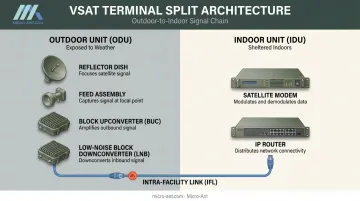
Every VSAT terminal splits into two physical halves.
The ODU sits outside, exposed to weather and combat conditions. It includes the reflector dish, the feed assembly, a block upconverter (BUC) for transmission, and a low-noise block downconverter (LNB) for receiving signals.
The IDU stays protected indoors or in a shelter. It houses the satellite modem and IP router that process incoming data and push it out to end users. An Intra-Facility Link cable connects the two halves, letting the ODU sit well away from the operators using the network. This separation keeps the dish's radar and thermal signature away from personnel and equipment, a modest but meaningful edge in contested environments.
Network Architecture: Star vs. Mesh Topology
Terminals talk to each other in one of two ways.
| Topology | How It Works | Key Trade-off |
|---|---|---|
| Star | Remote terminals route traffic through a central hub | Hub manages bandwidth and can fail over to a redundant hub if needed |
| Mesh | Terminals communicate directly with each other over satellite | Cuts the double-hop delay, roughly halving latency for site-to-site traffic |
Most military networks run hybrid architectures, keeping centralized hub control for management while layering in mesh links for time-sensitive tactical traffic.
How Military VSAT Systems Work: Components & Core Technology
Frequency band selection shapes everything about a VSAT's performance. The DoD classifies X, Ku, and Ka bands as wideband SATCOM resources, and Army-certified terminals can tap military-owned Ka and X-band capacity without paying commercial transponder fees.
| Band | Role in military SATCOM |
|---|---|
| X-band | Military-owned wideband capacity for certified terminals like SNAP and DKET |
| Ku-band | Commonly leased commercial capacity, with government paying bandwidth costs |
| Ka-band | Higher-speed emerging services, increasingly used for data-intensive missions |
Antenna Design for Multi-Operator Roaming
Military users rarely stay tied to one satellite. A unit might start a mission on a government Ka-band bird and need to hand off to a commercial operator mid-deployment without losing the link.
That's where extended-frequency, ultra-wideband antenna design earns its keep. Micro-Ant's Ultra-Wide Band (3.5 GHz) Ka Antenna System was built around this exact problem. It lets a single antenna maintain connectivity across multiple satellite operators and network types, rather than requiring a swap-out every time the mission shifts satellites.
Ruggedization, Security, and Field Autonomy
Beyond the antenna itself, several design features define a field-ready military VSAT:
- Shock and vibration resistance built for transport in tactical vehicles
- Rapid pack-up and setup designed for expeditionary operations
- Layered encryption, with CAISI/CSS VSAT systems built around FIPS 140-2 Level 2 cryptographic security
- Integrated VoIP, routed through a centrally managed call system for classified sustainment traffic
- Unit-owned, user-operated design, meaning soldiers set up and strike the system without a specialized MOS technician on hand
Behind the scenes, satellite access management and bandwidth allocation keep everything running. Army units also rely on Sustainment Automation Support Management Office (SASMO) teams, typically staffed with around 10 system specialists, to keep CAISI/CSS VSAT networks operational across garrison and contingency environments.
Real-World Military Applications & Deployments
The Army's CAISI and CSS VSAT programs show what field-ready connectivity looks like in practice. These systems connect sustainment platforms like GCSS-Army to satellite backhaul across combat training centers, garrison operations, and deployed missions.
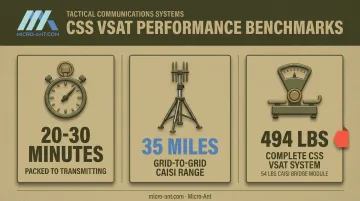
Documented performance benchmarks include:
- Setup time of 20 to 30 minutes from fully packed to actively transmitting sustainment data
- Extended terrestrial range of up to 35 miles using grid-to-grid CAISI configurations
- A complete CSS VSAT system weighing roughly 494 pounds, with the separate CAISI bridge module at just 54 pounds
Special Operations Forces have their own connectivity demands. NIC4 and Get SAT teamed up to deliver VSAT Comms-on-the-Move service to U.S. Special Forces stationed in Europe. The partnership pairs NIC4's MAVERICK guaranteed-bit-rate service with Get SAT's MilliSAT W terminal, which supports data rates up to 20 Mbps on the move.
Beyond ground sustainment and SOF, VSAT terminals show up across:
- Airborne ISR platforms streaming high-definition video to ground command posts
- Command posts needing independent connectivity separate from host-nation infrastructure
- Maritime vessels running C4ISR and search-and-rescue operations
- Disaster and humanitarian response missions, where the Army Reserve specifically fields VSAT kits for situations where civilian networks go down
These deployment profiles show why manpack and flyaway VSAT terminals need antennas built for rugged, repeatable field use. Micro-Ant designs composite reflector antennas to meet that same demand across Army and coalition programs.
Allied governments and coalition partners depend on these same terminals for a similar reason: independent, secure satellite infrastructure that doesn't rely on a host nation's network staying online.
Is VSAT Still Relevant in Modern Military Communications?
Low Earth Orbit constellations have changed the conversation around military satcom, and it's a fair question to ask whether traditional GEO-based VSAT still has a place.
Proliferated LEO adoption is real. Breaking Defense reported a $13 billion contract pool for PLEO services in 2025, with SpaceX's Starshield receiving the majority of task orders. The Department of Defense has also awarded SES Space & Defense a five-year Medium Earth Orbit managed-service contract with a $270 million ceiling, covering gateways, managed service, and terminal leasing.
But none of this replaces VSAT. It layers alongside it.
- Established coverage across decades of GEO satellite infrastructure
- Security certification history, including FIPS 140-2 validation already baked into fielded systems
- Multi-band flexibility across X, Ku, and Ka that newer constellations are still building toward
Micro-Ant builds that multi-band flexibility directly into its composite reflector antennas, letting a single terminal roam across X, Ku, and Ka operators without a hardware swap.
Defense programs increasingly pursue hybrid architectures, blending GEO VSAT with LEO and MEO options like SES O3b mPower for resilience and bandwidth diversity. The Army's own SATCOM-as-a-Managed-Service pilot with SES, supporting NORTHCOM, EUCOM, and INDOPACOM, reflects this multi-orbit direction directly.
VSAT's ruggedized track record and existing accreditation history make it the dependable backbone commanders already trust, while LEO and MEO constellations mature around it.
Choosing a Reliable Antenna Partner for Military VSAT Systems
A VSAT terminal's electronics only perform as well as the antenna feeding them. Bandwidth range, field durability, and connection reliability all trace back to antenna design and build quality before they ever reach a modem or router.
When evaluating an antenna manufacturer for military VSAT applications, defense buyers and integrators should look for:
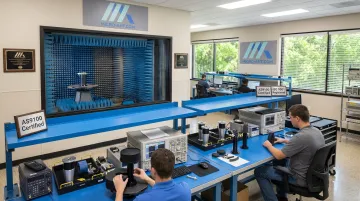
- Quality certifications, specifically AS9100:2016 and ISO 9001:2015, confirming documented process control from design through delivery
- U.S.-based manufacturing with an active CAGE code, important for defense procurement and supply chain requirements
- Proven testing infrastructure, such as near-field test chambers covering a wide frequency range for RF characterization
- Multi-band, multi-operator interoperability, so terminals can roam across commercial and government satellites without losing connection
Micro-Ant fits this profile as a bespoke antenna manufacturer operating out of a 65,000-square-foot facility in Jacksonville, Florida:
- AS9100:2016 and ISO 9001:2015 certified, with an active CAGE code (6XJFO)
- In-house near-field testing spanning 750 MHz to 40 GHz
- Over two decades designing custom antennas for defense, aviation, maritime, and land applications
Its Ultra-Wide Band (3.5 GHz) Ka Antenna System, recognized as SatCom Technology of the Year in the Most Innovative category, addresses the exact multi-operator roaming challenge field commanders face when switching satellites mid-mission.
Micro-Ant's testing experience also spans certification work with satellite operators such as Eutelsat, Intelsat, Inmarsat, SES O3B, Iridium, and Thuraya. That track record gives integrators a manufacturer already familiar with the interoperability standards VSAT programs demand.
Frequently Asked Questions
What is a VSAT in the military?
A military VSAT is a small satellite earth station used for secure, mobile, two-way communication in remote or contested environments. Systems like the Army's Combat Service Support (CSS) VSAT connect field units to sustainment and command networks without relying on host-nation infrastructure.
How much does an Army VSAT cost?
Costs vary widely based on terminal type, bandwidth requirements, and security certifications needed. Check current DoD acquisition schedules or contractor pricing sources for program-specific figures rather than a general estimate.
Are VSATs still used in the military?
Yes. VSAT remains an active layer within military communications, increasingly paired with LEO and MEO satellite systems as part of hybrid, resilient satcom architectures rather than being phased out entirely.
How much does an Army VSAT weigh?
The CSS VSAT system weighs approximately 494 pounds as a complete package, with the separate CAISI (Combat Service Support Automated Information Systems Interface) bridge module weighing about 54 pounds. Weight varies by terminal class and how portable the mission requires it to be.
What's the difference between military and commercial VSAT systems?
Military VSAT adds ruggedization for field conditions, built-in encryption such as FIPS 140-2, and rapid deployment design. Commercial VSAT typically prioritizes fixed installation and cost efficiency over portability and security hardening.
How fast can a military VSAT terminal be deployed in the field?
Systems like CSS VSAT can go from fully packed for transport to actively transmitting data in roughly 20 to 30 minutes. No specialized technician is required, since the design is built for unit-owned, user-operated setup.