Both bands remain the backbone of defense, maritime, aviation, and enterprise VSAT networks worldwide. Each was engineered for a different operating environment, and getting the choice wrong means paying for it in downtime, freight costs, or a terminal too bulky to deploy.
This guide breaks down the technical differences, real-world use cases, and situational guidance you need to choose confidently — whether you're specifying a fixed offshore platform link or a rapid-deployment terminal for a disaster response team.
Key Takeaways
- C-Band (4-8 GHz) resists rain fade, ideal for tropical regions and offshore platforms
- Ku-Band (12-18 GHz) enables compact antennas and higher throughput, but faces more rain fade
- Neither band is universally superior — climate, mobility, and budget decide the winner
- Modern missions increasingly run dual- or tri-band systems combining C, Ku, and Ka for maximum uptime
- Custom manufacturers like Micro-Ant build multi-band solutions when single-band antennas fall short
C-Band vs Ku-Band: Quick Comparison
Before covering the specifics, here's how the two bands stack up across the factors that actually drive procurement decisions.
| Factor | C-Band | Ku-Band |
|---|---|---|
| Frequency range | 3.7-4.2 GHz downlink, 5.925-6.425 GHz uplink | 12-18 GHz generally; FSS/BSS segments typically 10.7-14.5 GHz |
| Dish size | Larger, typically 2.4m-4.8m | Smaller, commonly 0.75m-1.8m |
| Rain fade resistance | Minimal attenuation, roughly 1 dB margin at 99.95% availability | Higher attenuation, often 10-12 dB margin needed for the same availability |
| Portability | Heavier equipment, less suited to rapid deployment | Lighter, faster to set up and transport |
| Interference exposure | Shares spectrum with terrestrial services in some markets | Largely dedicated satellite spectrum, though sub-band rules still apply |
A modeled comparison for a northeast Brazil ground station illustrates the rain-margin gap clearly. Engineers needed roughly 1 dB of margin at 4 GHz (C-Band) versus 10-12 dB at 12 GHz (Ku-Band) to hit the same 99.95% link availability target. That gap is why C-Band and Ku-Band get chosen for very different missions.
Exact frequency allocations vary by ITU region and licensed service. Always confirm the specific FSS or BSS segment for your jurisdiction before finalizing a link budget — "C-Band" or "Ku-Band" alone isn't precise enough for a procurement spec.
What Is a C-Band Antenna?
C-Band covers the 4-8 GHz range, and its longer wavelength is exactly why it's remained the workhorse for reliable satellite links since the earliest days of commercial satcom. Longer wavelengths punch through rain, dust, and humidity far better than shorter ones, which is the whole story behind C-Band's staying power in defense, maritime, and government networks.
Why Operators Still Choose It
The core benefits come down to physics:
- Near-immunity to rain fade — attenuation stays below roughly 1 dB even during heavy tropical storms
- Wide beam coverage requiring fewer satellites to serve a given footprint
- Lower bandwidth licensing costs in many regions compared to premium spectrum
These translate directly into operational impact. Operators see fewer outages, less need for oversized power amplifiers to compensate for fade, and lower long-term operating costs for infrastructure that runs 24/7 regardless of weather.
There are variations worth knowing, too. Standard C-Band and Extended C-Band configurations exist to accommodate different regional allocations. In the US, for example, the FCC has repurposed portions of the C-Band spectrum for 5G, shifting FSS reception up to the 4.0-4.2 GHz range. Bespoke antenna manufacturers such as Micro-Ant design custom reflector and feed systems specifically to handle these narrower, region-specific allocations without sacrificing gain.
Where C-Band Fits Operationally
C-Band remains dominant anywhere heavy rainfall makes Ku-Band's fade budget too risky:
- Offshore oil & gas platforms in the Gulf of Mexico and West Africa
- Maritime vessels crossing tropical shipping lanes
- Fixed government and military links across Africa, Southeast Asia, and the Middle East
Speedcast, for example, advertises greater than 99.9% C-Band link availability across Sub-Saharan Africa using 1.8m terminals. That kind of reliability explains why the band still dominates in regions where rain fade risk is highest and downtime isn't an option.
What Is a Ku-Band Antenna?
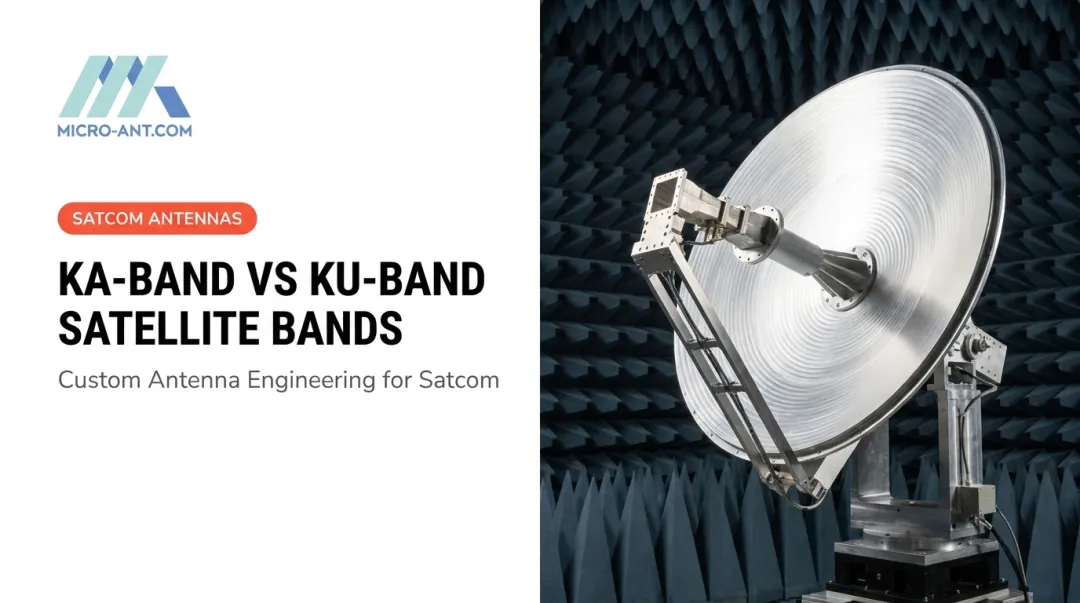
Ku-Band operates in the 12-18 GHz range. Its shorter wavelength means engineers can pack more gain into a smaller reflector, which is why Ku-Band antennas look nothing like the massive dishes associated with C-Band.
Why Operators Choose It
The advantages line up around mobility and speed:
- Smaller footprint: many professional Ku terminals run 0.83m to 1.8m, versus 2.4m+ for C-Band
- Higher power density, supporting HD video and data-heavy applications from a compact aperture
- Freedom from most terrestrial interference, since Ku spectrum isn't as heavily shared with ground-based microwave links
Faster installation and easier transport are the direct payoff. A terminal that fits in a case or mounts on a vehicle roof changes what's operationally possible in the field.
Two sub-variants matter here: FSS Ku-Band, used broadly for VSAT and enterprise data, and BSS/DBS Ku-Band, allocated for broadcast services. Together they've made Ku-Band the default for satellite news gathering, SATCOM-on-the-move, and disaster response terminals that need to go from packed case to live link in minutes.
Where Ku-Band Fits Operationally
Ku-Band dominates wherever speed and mobility outweigh maximum weather resilience:
- Satellite news gathering (SNG) vehicles and flyaway kits
- Maritime VSAT on vessels operating in moderate-rainfall regions
- Commercial aviation Wi-Fi and in-flight connectivity
- Rapidly deployable military and disaster-response terminals
Intelsat's FlexMove service, built on Ku-Band HTS capacity, is marketed as deployable in minutes for emergency response scenarios, a level of speed C-Band's larger hardware can't match.
On the aviation side, Japan Airlines committed to upgrading roughly 50 Boeing aircraft plus 14 Embraer E190s to Intelsat's 2Ku system, a sign of how deeply Ku-Band is embedded in commercial fleet connectivity at scale.
C-Band vs Ku-Band: Which Is Better?
There's no universal winner. The right call depends on four decision factors:
- Regional rainfall patterns: tropical or monsoon climates push the math toward C-Band
- Portability requirements: vehicle-mounted, flyaway, or SATCOM-on-the-move missions favor Ku-Band's smaller aperture
- Available bandwidth and budget: Ku-Band typically offers more throughput per dollar in low-rain regions
- Mission criticality: fixed, long-term infrastructure versus temporary or mobile deployment
Choose C-Band if: you're operating in a tropical or high-rainfall region, or the mission demands maximum link reliability for permanent infrastructure, such as offshore platforms, government fixed sites, or maritime routes through the ITCZ.
Choose Ku-Band if: mobility, rapid deployment, or a smaller footprint is the priority, and your operating region's rain fade risk is manageable with adequate power margin.
Why Many Operators Skip the Either/Or Decision
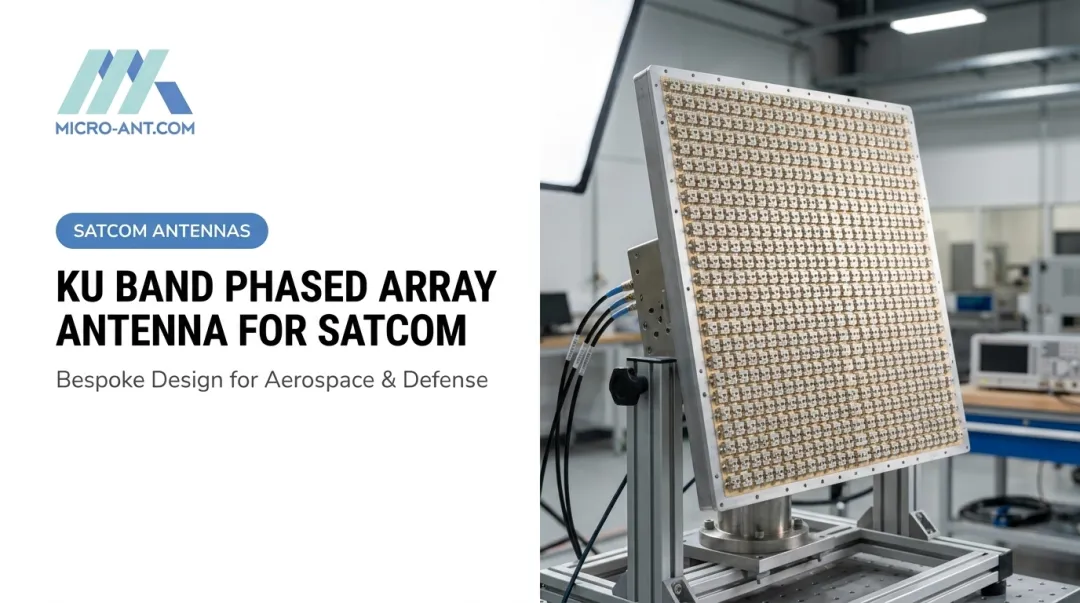
Increasingly, defense, maritime, and satcom operators sidestep this trade-off entirely by fielding dual-band or tri-band antennas that switch between C, Ku, and sometimes Ka feeds depending on region or mission.
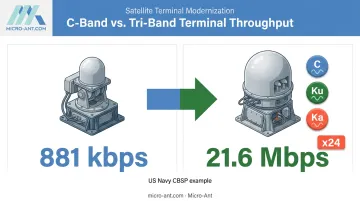
The US Navy's Commercial Broadband Satellite Program illustrates this shift well. Legacy C-Band-only terminals pushed throughput of roughly 881 kbps on small-ship variants; adding Ku-capable systems raised that to 21.6 Mbps on force-level terminals, a nearly tenfold jump tied directly to the added Ku capacity.
This is precisely the gap bespoke engineering fills. Micro-Ant's Kore Composites division builds Tri-Band Segmented Reflectors and Feeds under its Veritas line, designed for field-ready manpack and flyaway terminals that switch bands without swapping hardware.
The company's Ultra-Wide Band Ka system, which earned SatCom Technology of the Year honors, reflects the same design philosophy: give operators frequency flexibility instead of forcing a single-band compromise. For a defense or satcom client operating across both tropical fixed sites and mobile deployment zones, a custom multi-band reflector eliminates the need to choose at all.
Conclusion
The "better" band depends entirely on where and how you're operating. C-Band wins on weather resilience and long-term fixed infrastructure. Ku-Band wins on portability, deployment speed, and throughput in climates where rain fade is manageable.
What matters most are the practical outcomes: uptime, how fast you can get a terminal on air, and total cost of ownership over the system's life.
For missions spanning multiple climates or that can't tolerate an either/or trade-off, a custom-engineered multi-band antenna from an experienced manufacturer like Micro-Ant eliminates that compromise entirely.
Frequently Asked Questions
What is the difference between C-Band and Ku-Band antennas?
C-Band operates at 4-8 GHz and needs larger dishes but offers superior rain resistance. Ku-Band (12-18 GHz) allows smaller dishes and higher throughput but is more sensitive to rain fade.
Does C-Band satellite still work?
Yes. C-Band satellites remain fully operational, particularly for maritime, oil & gas, and government links in high-rainfall regions. US spectrum reallocation reduced bandwidth for terrestrial 5G, but it did not eliminate C-Band service.
Which is better for rain-heavy regions, C-Band or Ku-Band?
C-Band is generally preferred in tropical or high-rainfall climates. Its longer wavelength results in far lower signal attenuation during storms compared to Ku-Band.
Can one antenna support both C-Band and Ku-Band?
Yes. Dual-band and tri-band antennas with interchangeable or automatically switching feeds exist and are increasingly common among defense and satcom operators needing regional flexibility. Micro-Ant, for example, engineers tri-band segmented reflector systems built for this exact use case.
What's the typical antenna size difference between C-Band and Ku-Band systems?
C-Band antennas typically range from 2.4m to 4.8m, while Ku-Band antennas commonly run 0.75m to 1.8m, thanks to Ku's shorter wavelength.
Is Ku-Band being replaced by Ka-Band?
Ka-Band is gaining ground for high-throughput applications, but Ku-Band continues to serve broadcast and mobile SATCOM needs thanks to established infrastructure and equipment availability.