Industrial buyers don't get the luxury of consumer-grade shortcuts. Long distances, hazardous atmospheres, and corrosive environments demand engineering-grade decisions. NIST's own guidance on industrial wireless deployments sets loss-probability thresholds as tight as 10⁻⁷ for safety alarming applications, meaning the RF link has almost no margin for error (NIST, Guide to Industrial Wireless Systems Deployments).
This guide breaks down the core antenna types, the technical factors that actually determine performance, ruggedization requirements for harsh sites, real deployment examples across key industries, and what to look for in a manufacturing partner.
Key Takeaways
- Omnidirectional, directional, sector, and GNSS/specialty antennas cover most industrial use cases.
- Gain, frequency band, cable loss, and polarization determine real-world antenna performance.
- IP ratings, NEMA enclosures, and hazardous-area certifications are separate, non-interchangeable standards.
- Bespoke antenna engineering outperforms catalog products in defense, satcom, and extreme-environment applications.
Types of Industrial Wireless Antennas
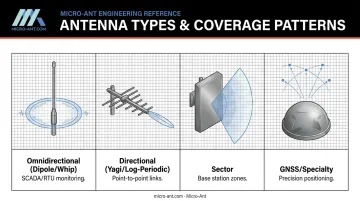
Most industrial RF engineers group antennas into four functional categories. Each one shapes the radio signal differently, and picking the wrong pattern for the application is one of the most common (and costly) mistakes in industrial deployments.
Omnidirectional Antennas (Dipole & Whip)
Dipole and quarter-wave whip antennas radiate in a 360-degree pattern around their axis, forming a doughnut-shaped coverage zone. That makes them the default choice for SCADA and RTU monitoring, where a central hub needs to reach multiple remote sensors scattered in different directions.
Size scales directly with frequency. A quarter-wave whip tuned for 896–970 MHz measures roughly 3 inches long, compact enough for tight equipment enclosures. Lower-frequency antennas, by contrast, require much longer elements to achieve the same electrical wavelength fraction.
Directional Antennas (Yagi & Log-Periodic)
Yagi and log-periodic dipole array (LPDA) antennas use director and reflector elements to concentrate RF energy in a single direction. Instead of spreading signal evenly, they redistribute it toward the target, boosting range at the cost of coverage angle.
That directionality makes them ideal for point-to-point industrial links: pipeline monitoring stations, remote water district telemetry, and oil field installations where the receiver sits miles away in a known direction rather than scattered across a wide area.
Sector Antennas
Sector antennas cover a defined angular slice, commonly 60 to 120 degrees, rather than a full circle. Industrial base stations use them to divide coverage into zones. That segmentation increases capacity per zone and reduces interference between overlapping cells, similar to how cellular towers split coverage into sectors instead of broadcasting everywhere at once.
For facilities managing multiple radios in close proximity, sectorization is often the difference between a clean network and constant interference troubleshooting.
GNSS and Specialty High-Precision Antennas
GNSS antennas have moved well beyond simple location tagging. Asset tracking fleets, autonomous vehicles, and precision agriculture equipment now depend on positioning accuracy measured in centimeters or better. GNSS signals are right-hand circularly polarized, so receiving antennas need matching polarization and a low axial ratio to maintain accuracy.
Micro-Ant's proprietary high-precision GNSS designs support millimeter-level positioning across multiple satellite constellations, meeting the accuracy demands of modern autonomous and precision-positioning equipment.
Key Factors for Selecting the Right Industrial Antenna
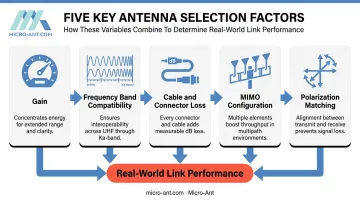
Picking an antenna type is step one. The technical specifications underneath that choice determine whether the link actually performs once it's installed. Custom-engineered antennas, like those Micro-Ant designs for defense, aviation, and industrial clients, are built against these exact variables rather than sold as one-size-fits-all products.
Gain determines how sensitive an antenna is to weak signals and directly shapes usable range. Higher-gain antennas suit long-distance or point-to-point links; lower-gain, wider-pattern antennas suit broad local coverage where distance matters less than flexibility.
Frequency Band Compatibility
Once gain is dialed in, matching the antenna to the exact operating band prevents expensive rework later. Industrial deployments span a wide range of standards:
- LTE bands are discrete allocations, not one continuous range (for example, Band 12 uses 699–746 MHz, while Band 46 operates at 5150–5925 MHz)
- 5G NR FR1 covers 410–7125 MHz
- Industrial WLAN (802.11be) operates in the 2.4, 5, and 6 GHz bands
- Satellite Ku-band typically spans 12–18 GHz, and Ka-band spans 26–40 GHz
An antenna built for one standard rarely performs well on another, even within the same general frequency neighborhood.
Cable and Connector Loss
Thinner, more flexible cables are easier to route through tight industrial installations, but they lose more signal per foot. At 900 MHz, LMR-400 loses about 3.9 dB per 100 feet, while the thicker LMR-600 loses only 2.5 dB per 100 feet (Times Microwave LMR-400 datasheet). Over a long antenna-to-radio run, that difference adds up fast.
| Frequency | LMR-400 Loss | LMR-600 Loss |
|---|---|---|
| 450 MHz | 2.7 dB/100 ft | 1.7 dB/100 ft |
| 900 MHz | 3.9 dB/100 ft | 2.5 dB/100 ft |
| 2500 MHz | 6.8 dB/100 ft | 4.4 dB/100 ft |
Balance flexibility needs against how much signal budget you can afford to lose.
MIMO and Multi-Element Configurations
Multi-antenna arrays improve reliability and throughput through three distinct mechanisms:
- Array/beamforming gain: coherent signal combining raises received SNR
- Diversity gain: independent fading paths reduce outage probability
- Spatial-multiplexing gain: independent data streams increase throughput, limited by channel rank
Industrial 4G/5G and Wi-Fi deployments increasingly rely on all three working together, not just raw antenna count.
Polarization Matching
Fixed infrastructure links should align polarization at both ends, whether vertical, horizontal, or slant ±45 degrees. Mobile or randomly oriented industrial equipment benefits more from dual-polarized designs, since orientation can't be guaranteed to stay consistent over time.
Built for the Field: Ruggedization and Environmental Requirements
Consumer antennas fail in industrial settings because they're never tested against the conditions industrial sites actually produce: dust, vibration, corrosion, temperature swings, and explosive atmospheres.
IP and NEMA Ratings
IP and NEMA ratings measure different things, and they're often confused:
| Standard | What It Covers |
|---|---|
| IP6X | Dust-tight construction |
| IPX5/IPX6 | Water jet and powerful water jet resistance |
| NEMA 4 | Windblown dust, splashing, hose-directed water |
| NEMA 4X | Adds corrosion resistance for outdoor/coastal sites |
For outdoor RTU and remote monitoring antennas, NEMA 4X enclosures are typically the minimum acceptable standard.
Hazardous-Area Certification
Antennas installed near flammable atmospheres—oil and gas facilities, chemical plants, or grain elevators—need explosion-proof certification. ATEX covers equipment in the EU, IECEx provides international certification, and UL/NEC Class I addresses North American installations. None of these substitute for an IP or NEMA rating; they're separate approvals addressing ignition risk specifically.
Lab Validation Before Field Deployment
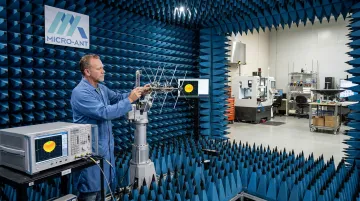
Reputable manufacturers test for ruggedness rather than simply claiming it. Micro-Ant validates antenna performance through in-house spherical and planar near-field test chambers spanning 750 MHz to 40 GHz at its Jacksonville, Florida facility. Testing domestically also means industrial buyers get faster turnaround and avoid the logistics headaches of shipping hardware overseas for certification.
Industrial Applications Across Key Sectors
Different industries lean on different antenna types, driven by their own combination of distance, environment, and network architecture.
Antenna priorities vary sharply across sectors:
- Defense, aviation, and maritime: Rely on multi-orbit roaming and extended Ka-band coverage for uninterrupted communications, with Micro-Ant supporting major satcom operators like Iridium, Inmarsat, and Intelsat.
- Oil and gas, mining, and agriculture: Depend on rugged, corrosion-resistant antennas for remote asset monitoring, autonomous vehicles, and precision positioning in extreme conditions.
- Construction, logistics, and telecom: Use directional and sector antennas to extend coverage across sprawling sites and complex facility layouts, where a single hub can't reach every corner.
Private cellular adoption is accelerating fastest in oil and gas, mining, and agriculture. By August 2025, GSA had cataloged 1,846 private-network customers across 80 countries, with manufacturing accounting for 359 deployments and mining for 134 (GSA private mobile networks report).
The Future of Industrial Connectivity and Choosing a Manufacturing Partner
6G is still years from finalized standards, but the direction is already visible. ITU's IMT-2030 framework, established in November 2023, points toward higher frequencies, massive MIMO, and AI-driven beamforming. 3GPP's Release 21, the first normative 6G release, won't be finalized until 2027–2028. Industrial players preparing infrastructure now are building alongside 5G rollout rather than waiting for 6G to fully materialize.
As networks push toward higher frequencies and denser deployments, generic catalog antennas increasingly fall short. Manufacturers build off-the-shelf products for average conditions, but industrial sites rarely operate that way.
What separates a reliable manufacturing partner from a risky one:
- Certifications like ISO 9001:2015 and AS9100:2016, signaling disciplined quality management for aerospace and defense-grade work
- Decades of engineering experience across defense, satcom, and extreme-environment deployments
- In-house testing capability rather than outsourced validation
- A track record with recognized operators and government programs
Micro-Ant has spent over 20 years designing and manufacturing bespoke antenna systems for defense, aviation, maritime, and land applications, trusted by satcom operators including Iridium, Inmarsat, and Intelsat. From custom Ultra-Wide Band Ka systems to high-precision GNSS designs, the team engineers, builds, and tests every product at the company's Jacksonville, Florida facility.
For buyers facing a mission-critical antenna decision, that combination of certification, in-house testing, and two decades of field experience is worth weighing carefully before defaulting to a catalog part.
Frequently Asked Questions
What are the four types of antennas?
Industrial antennas generally fall into four categories: omnidirectional (360-degree coverage), directional (focused, long-range), sector (angular zone coverage), and GNSS/specialty designs for precision positioning. Each suits different coverage and distance requirements.
How do sector antennas work?
Sector antennas focus RF energy within a defined angular range, commonly 60 to 120 degrees, instead of broadcasting in all directions. This increases network capacity per zone and reduces interference in base station deployments.
What is a 6G antenna?
6G antennas are next-generation designs expected to support higher operating frequencies, massive MIMO arrays, and AI-optimized beamforming. Standards are still in development, with 3GPP's first normative 6G release not expected before 2027.
What is the difference between omnidirectional and directional antennas?
Omnidirectional antennas broadcast in a 360-degree pattern, ideal for reaching multiple points from a central hub. Directional antennas concentrate signal in one direction, extending range for point-to-point links over long distances.
What certifications should I look for in an industrial antenna manufacturer?
Look for ISO 9001:2015 for general quality management and AS9100:2016 for aerospace and defense-grade manufacturing standards. Micro-Ant holds both certifications at its Jacksonville facility, reflecting the disciplined processes required for mission-critical production.
How do I choose the right antenna for a hazardous or extreme environment?
Prioritize antennas with appropriate IP or NEMA ratings for dust and water resistance, corrosion-resistant materials, and explosion-proof certification (ATEX, IECEx, or UL) where flammable atmospheres are present. Confirm the manufacturer validates these claims through actual lab and field testing.