Defense engineers and program managers face a real challenge here: radar and electronic warfare (EW) are usually explained in separate technical silos, when in practice they're deeply intertwined. A radar engineer who doesn't understand jamming, or an EW specialist who doesn't understand radar mechanics, is missing half the picture.
This guide breaks down EW fundamentals, radar mechanics, how the two systems depend on each other, and the antenna technology that makes both possible in the first place.
Key Takeaways
- EW divides into three disciplines: Electronic Attack, Electronic Protection, and Electronic Warfare Support.
- Radar is a target and enabler for EW, not a subcategory of it.
- Ukraine loses roughly 10,000 drones per month to navigational interference, according to RUSI.
- Antenna gain, bandwidth, and beam precision determine radar range and jamming performance.
- Certified, US-based antenna manufacturing reduces supply chain risk for defense programs.
What Is Electronic Warfare?
Electronic warfare is military action that uses the electromagnetic spectrum, or directed energy, to attack an adversary, protect friendly forces, or gain situational awareness. It's formally defined across joint military doctrine as action to control or exploit the EM spectrum for tactical advantage.
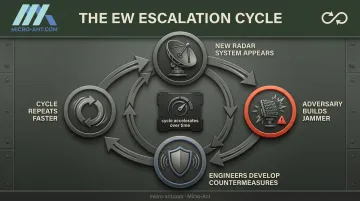
The dynamic driving EW forward is a cat-and-mouse cycle:
- A new radar system appears.
- Adversaries build a jammer to defeat it.
- Engineers develop protective countermeasures against that jammer.
- The cycle repeats, faster each time.
This cycle is no longer limited to major powers. GPS jamming technology, once the domain of large militaries, has become accessible to smaller states and even non-state actors. North Korea has repeatedly jammed GPS signals near its border, disrupting dozens of civilian aircraft and ships in South Korea in 2024, including flights operating near Incheon Airport.
EW matters strategically because it cuts both ways. It protects friendly use of the spectrum for communication, navigation, and targeting, while denying adversaries that same use. Lose spectrum superiority, and multiple systems fail at once:
- Radar-guided weapons lose targeting accuracy
- GPS-guided munitions drift off course
- Secure communications links drop or get intercepted
The war in Ukraine has made this painfully concrete. According to a RUSI report on Russian tactics, navigational interference contributes to roughly 10,000 drone losses per month on the battlefield. That's not a rounding error. That's a fundamental shift in how attrition happens in modern conflict, and it's driven almost entirely by electronic warfare, not conventional weapons.
The Three Pillars of Electronic Warfare
Joint military doctrine divides EW into three core disciplines. Each has a distinct job, and together they form a complete operational cycle.
Electronic Attack (EA)
EA is the offensive use of electromagnetic energy to degrade, disable, or destroy an enemy's ability to use the spectrum. This includes jamming, spoofing, and anti-radiation weapons designed to home in on enemy radar emissions.
A textbook example comes from Operation Allied Force, where EA-6B Prowlers and F-16CJs flew Suppression of Enemy Air Defenses (SEAD) missions. They jammed enemy radar systems and fired HARM anti-radiation missiles at emitters that stayed active too long.
Electronic Protection (EP)
Where EA pushes into the enemy's systems, EP works in the opposite direction: shielding friendly platforms from those same effects. Common techniques include:
- Chaff and flares to defeat radar and infrared tracking
- Spread spectrum and frequency-hopping communications
- Low observability and stealth shaping
EP also guards against "EW fratricide," where a friendly jammer accidentally disrupts a friendly radar or comms link operating on a nearby frequency.
Electronic Warfare Support (ES)
If EA and EP represent action and defense, ES supplies the intelligence that makes both possible. It focuses on detecting, intercepting, and locating enemy electromagnetic emissions to build situational awareness and prioritize threats. It overlaps heavily with signals intelligence (SIGINT), splitting into two subcategories: ELINT (electronic intelligence, focused on non-communication emissions like radar) and COMINT (communications intelligence).
The key distinction: ES supports immediate, time-sensitive targeting decisions, while broader SIGINT involves longer analytical cycles for intelligence purposes.
Radar Systems Fundamentals
Understanding radar isn't optional if you work in EW. Jamming, spoofing, and deception techniques all target radar's core operating principles directly, so you can't defend against or design around threats you don't understand mechanically.
Three Types of Radar Systems
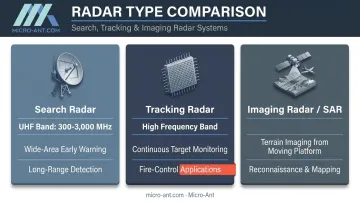
Radar systems generally fall into three functional categories:
- Search radar scans wide areas at long range for early warning. It typically operates at lower frequencies (like the UHF band, 300–3,000 MHz) since range matters more than fine resolution.
- Tracking radar uses higher frequencies for high-resolution, continuous monitoring of a specific target, often through phased array antennas that steer the beam electronically instead of mechanically. This electronic steering is the backbone of fire-control systems in air defense and missile guidance.
- Imaging radar, such as synthetic aperture radar (SAR), builds detailed images of terrain or objects by combining multiple radar returns as the platform moves.
How Radar Works
The basic cycle is straightforward: a radar transmits a pulse, the pulse reflects off a target, and the system receives the echo. Distance is calculated using the range equation, R = ct/2, where c is the speed of light and t is the round-trip time of the pulse's flight — giving you the exact distance to the target.
Doppler radar adds another layer. It measures the frequency shift in the returned signal to calculate target velocity, and it's what allows radar to filter out stationary ground clutter while still tracking moving targets.
Two performance metrics matter most: range and resolution. Engineers constantly trade off power, frequency, and pulse compression techniques to optimize both, since improving one often costs you the other.
How Radar and Electronic Warfare Work Together
Here's a question that trips people up constantly: is radar part of electronic warfare?
No. Radar is a target and an enabler that EW systems are built to detect, jam, deceive, or protect. It sits outside those categories entirely, as the target or enabler EW works against or on behalf of.
The practical relationship breaks down cleanly across the three EW pillars:
- ES locates enemy radar by intercepting its emissions and pinpointing location.
- EA jams or deceives that radar once it's been identified, denying its use.
- EP protects friendly radar from being jammed or deceived in turn.
The measurable impact of this relationship shows up constantly in Ukraine.
Russian jamming reportedly reduced the hit rate of US-supplied Excalibur GPS-guided artillery shells from 70% to just 6% by August 2023, according to a RUSI report on competitive electronic warfare.
That's a precision-guided weapon rendered nearly useless simply by disrupting the radar and GPS signals it depends on to function.
This is exactly why radar-dependent systems can't be designed in isolation from EW threats anymore. Every radar-dependent system, from fire-control radars to guided munitions and surveillance platforms, needs to assume it will be jammed, spoofed, or targeted the moment it starts transmitting.
The Critical Role of Antennas in Radar and EW Performance
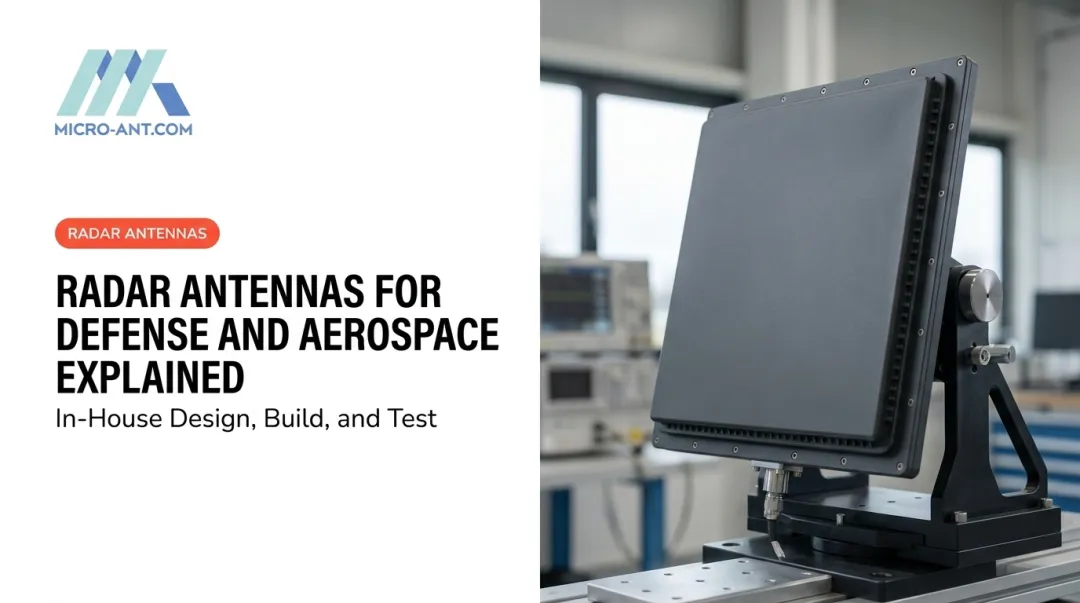
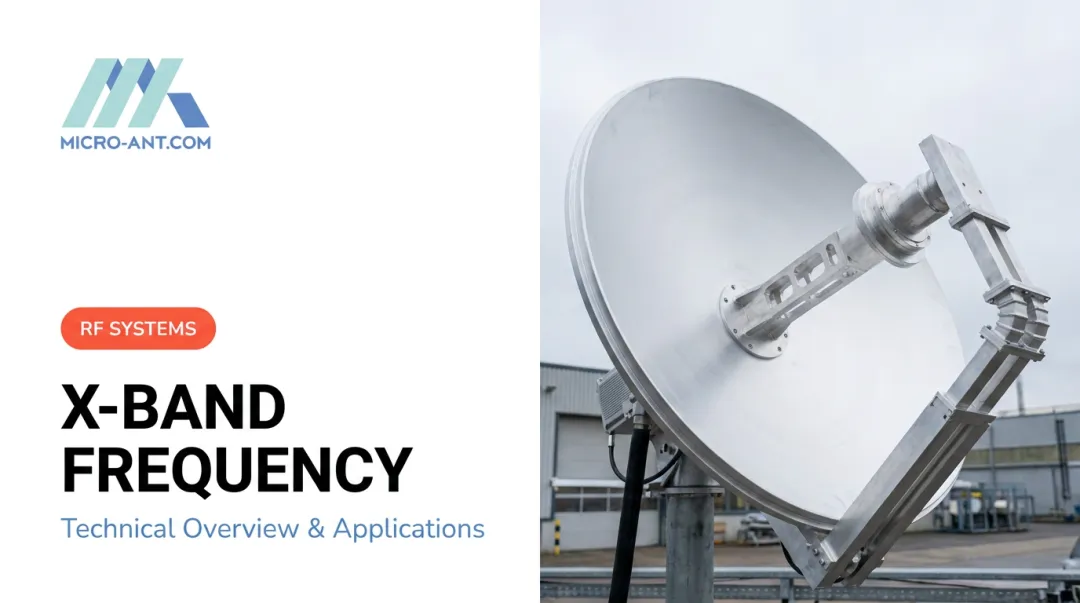
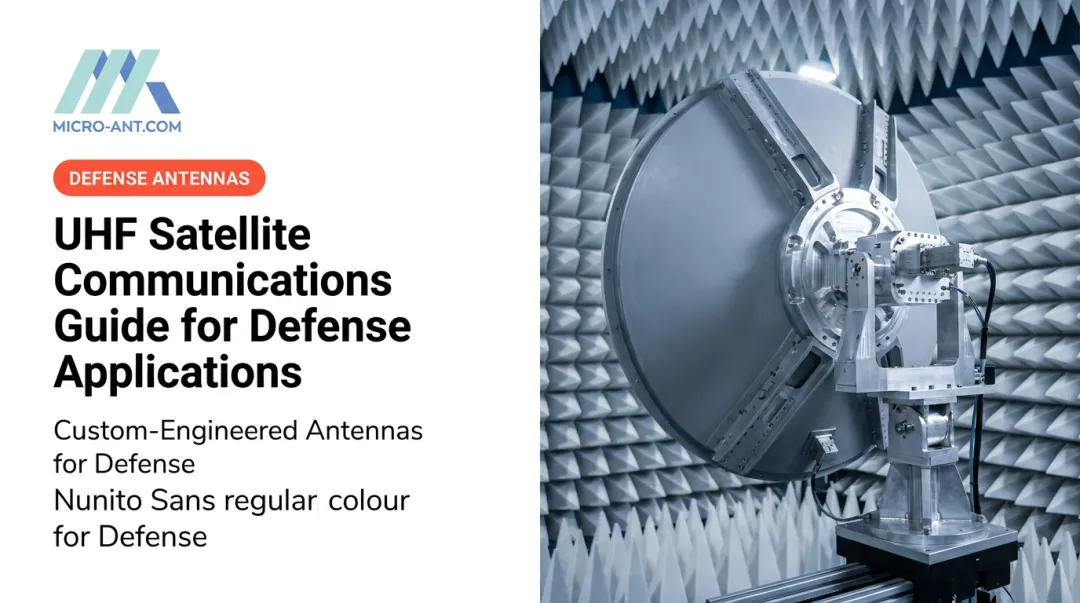
Every function in this guide, transmission, reception, jamming, sensing, depends entirely on antenna performance. A radar system with a brilliant signal processor and a mediocre antenna is still a mediocre radar. The antenna isn't a peripheral component. It determines whether the platform performs as a force multiplier or becomes a liability in the field.
Three antenna characteristics drive nearly everything else:
- Frequency range determines what part of the spectrum a system can operate in and defend.
- Gain directly affects detection range and signal strength.
- Beam precision controls resolution and how tightly an EW system can focus jamming energy or sensing capability.
Field conditions raise the stakes further. Defense programs increasingly demand ruggedized, wideband, and phased-array antennas that hold performance steady through vibration, temperature swings, and salt-air corrosion on maritime platforms.
Micro-Ant's Ultra-Wide Band Ka Antenna System demonstrates this principle in practice. It operates across a 3.5 GHz bandwidth, covering 17.7–21.2 GHz on receive and 27.5–31 GHz on transmit, wide enough to support roaming across multiple satellite operators without hardware swaps.
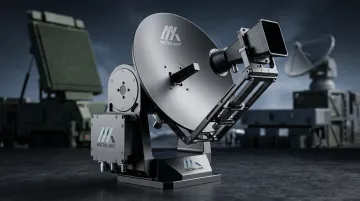
This purpose-built engineering, rather than a catalog adaptation, is what next-generation radar and EW platforms now require. The same design discipline carries through Micro-Ant's phased-array and beam-switching antennas, built specifically for electronic warfare and electronic attack missions.
Choosing an Antenna Partner for Defense Radar and EW Programs
Not every antenna vendor is equipped to support radar or EW programs. Program leads should evaluate a short list of hard criteria before committing:
- AS9100 and ISO 9001 certification, confirming quality management systems built for aerospace and defense standards.
- In-house testing capability, since third-party test cycles add weeks and unpredictable cost to a program timeline.
- Proven field ruggedness, not just lab performance under ideal conditions.
Beyond these three criteria, US-based design, build, and test operations matter more than they might seem to on paper. A CAGE-coded, Made in USA vendor removes a layer of supply chain risk that foreign-sourced components carry. It also cuts the travel and testing costs that come with shipping hardware overseas for verification.
Micro-Ant has spent over 20 years designing bespoke antennas at its AS9100 and ISO 9001-certified facility in Jacksonville, Florida (CAGE code 6XJFO). The company runs spherical and planar near-field testing chambers covering 750 MHz to 40 GHz.
That in-house testing infrastructure has supported satellite and defense customers including SES O3B mPower, Eutelsat, Intelsat, Inmarsat, Iridium, and ARSTRAT. For program leads evaluating antenna partners for radar or EW-adjacent work, that combination of domestic manufacturing and in-house testing is worth putting on the shortlist.
Frequently Asked Questions
Is radar part of electronic warfare?
No, radar itself is not a subdivision of EW. It's a primary target and enabler that EW systems detect, jam, deceive, or protect, depending on whose radar it is.
What are the three types of electronic warfare?
Electronic Attack (offensive jamming and disruption), Electronic Protection (defensive countermeasures), and Electronic Warfare Support (detection and situational awareness). Together they form the full EW operational cycle.
What are the 5 D's of electronic warfare?
Deceive, deny, disrupt, degrade, and destroy. These are the five core objectives EW seeks to achieve against an adversary's use of the electromagnetic spectrum.
What is the most powerful radar system?
It depends on the metric: long-range early warning systems like LRDR prioritize detection range, while AESA-based systems like the AN/SPY-6 emphasize power output and multi-target tracking.
What is the difference between electronic warfare and radar jamming?
Jamming is one specific Electronic Attack technique within the broader EW discipline. EW also includes Electronic Protection and Electronic Warfare Support, which jamming alone doesn't cover.
Why are antennas critical to radar and EW system performance?
Antenna gain, bandwidth, and beam control directly determine detection range, jamming effectiveness, and overall system reliability. A weak antenna undermines even the best radar or EW electronics behind it. That's why manufacturers like Micro-Ant custom-engineer antennas for each system's frequency band and mission profile.