
Introduction
Walk the deck of a naval destroyer or a commercial container ship and you'll spot a forest of antennas bristling from the masts. Most crews never think twice about them. Yet these devices are working around the clock, handling navigation, safety alerts, and fleet communication across frequencies spanning UHF through Ka-band.
Choosing and maintaining the right shipboard antennas isn't simple. Saltwater corrosion and constant vibration steadily erode performance, while a ship's own metal superstructure adds interference that drives up downtime.
This guide covers what shipboard antennas actually do, the main types used at sea, how to select the right ones, and the installation and maintenance habits that keep them working. We'll also look at why custom-engineered antennas matter for fleets that can't rely on generic, off-the-shelf hardware.
Key Takeaways
- Ships use multiple antenna types (VHF, HF, SATCOM, GPS/GNSS, radar, AIS) instead of one universal device
- Gain, mounting height, and frequency band drive real-world range and reliability at sea
- Marine environments demand ruggedized, corrosion-resistant materials and certified construction
- Custom antenna engineering is essential for defense, offshore, and commercial fleets needing wideband performance
- Routine grounding, inspection, and testing prevent corrosion-related signal loss and downtime
What Are Shipboard Antennas and Why Do They Matter?
Shipboard antennas are onboard devices engineered to transmit and receive RF signals for communication, navigation, and detection. Do ships have antennas? Absolutely — large vessels can carry dozens, each serving a distinct system without interfering with the others.
That's a very different challenge than mounting an antenna on a rooftop or cell tower. Marine installations face:
- Constant saltwater exposure, which accelerates corrosion on connectors, fasteners, and cable stand-offs
- Continuous vibration, pitch, and roll, which stresses mounts and connections that land-based antennas never experience
- Extreme temperature and humidity swings, from tropical humidity to arctic cold on the same voyage
- Signal interference from the ship's own structure, since a dense metal superstructure reflects and blocks RF energy in ways flat terrain doesn't
Navy engineering research has long documented how aggressively saltwater attacks topside electronics. Antenna fasteners, connection boxes, and cable stand-offs rank among the most corrosion-prone items on a vessel. Repairs that would take a couple of hours on dry land can balloon into a full day of rework once corrosion sets in.
The Roles Antennas Play Onboard
A single vessel's antenna suite typically covers:
- Distress and safety communication through the Global Maritime Distress and Safety System (GMDSS)
- Precision navigation via GPS/GNSS
- Fleet coordination through VHF and HF radio
- Situational awareness using radar and AIS
- Broadband connectivity via SATCOM
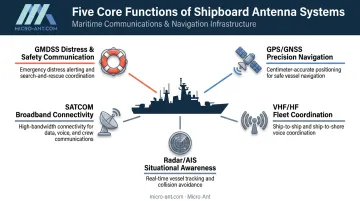
Losing even one of these systems can compromise safety, coordination, or connectivity, which is why each antenna type needs its own engineered mount rather than a one-size-fits-all bracket.
An Engineering Problem as Old as the Steel Hull
Antenna placement on metal ships isn't a new headache. Naval engineers have used scaled brass ship models on test ranges for decades to study how radiation patterns behave once an antenna is mounted against a real hull.
A 1949 Navy study used scale-model techniques to develop broadband communication antennas for destroyer classes. Later research applied a 1/48-scale brass model of USS Spruance to study low-frequency fan antennas, since at those frequencies the whole ship effectively becomes part of the antenna.
Types of Shipboard Antennas Used at Sea
No single antenna handles every job. Most vessels run a coordinated suite of specialized antennas, each tuned to a specific frequency band and mission.
VHF Antennas
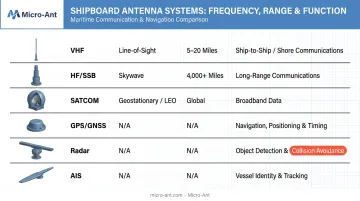
VHF is the workhorse for ship-to-ship and ship-to-shore communication, plus distress and weather channels. It's strictly line-of-sight, so range depends heavily on mounting height and gain rating.
The U.S. Coast Guard notes that marine VHF typically covers 5 to 10 miles between vessels, and at least 20 miles to a Coast Guard shore station. Higher-mounted antennas with more gain can push that range further, but gain comes with a trade-off (more on that below).
HF/SSB Antennas
When a vessel operates far offshore, beyond VHF and cellular range, HF/SSB takes over. It uses skywave propagation, bouncing signals off the ionosphere, to reach hundreds or even thousands of miles beyond the horizon. Properly installed marine SSB systems can exceed 4,000 miles, though performance depends heavily on grounding quality and antenna condition.
Satellite (SATCOM) Antennas
Fixed and stabilized SATCOM antennas deliver global voice, data, and broadband connectivity through geostationary or low-earth-orbit constellations. Demand is shifting fast: NSR forecasts maritime satellite throughput climbing from under 100 Gbps in 2021 to more than 1,500 Gbps by 2031.
That growth is fueling demand for wideband systems that roam across multiple satellite operators instead of locking a vessel into one network.
GPS/GNSS Antennas
These antennas handle precision navigation, dynamic positioning, and timing synchronization. As jamming and spoofing risks grow, fleets increasingly need multi-constellation, high-precision designs that hold accuracy through rough seas rather than relying on a single GNSS system.
Radar and AIS Antennas
Radar handles object detection and collision avoidance. AIS broadcasts vessel identity, position, course, and speed for tracking purposes. Both are mandated by maritime safety regulations for larger vessels under SOLAS, with carriage requirements scaling by gross tonnage and voyage type.
Specialized and Legacy Antennas
Older hardware (discone-cage, whip, and trussed whip antennas) remains in service alongside modern electronic warfare and IFF (Identification Friend or Foe) antennas on naval vessels. This blend of legacy and advanced hardware is exactly why defense fleets often need engineering partners comfortable working across both eras of design.
Key Factors When Selecting the Best Shipboard Antenna
What is the best marine antenna? There's no single answer. The right choice depends entirely on the vessel's mission, operating range, and environment.
Match Frequency Band to Application
- VHF for coastal, short-range communication
- SATCOM for blue-water, global connectivity
- GNSS for navigation and positioning
- HF/SSB for long-range comms beyond the horizon
Gain vs. Stability Trade-Off
Higher gain extends range, but it narrows the antenna's vertical beam. On a vessel with significant roll and pitch, that narrow beam can fade in and out as the ship moves.
Adding 3 dBd of gain doubles effective radiated power, but the trade-off matters at sea. The narrower pattern can cause a high-gain antenna to lose contact during heavy swells, where a lower-gain design holds steady.
Ruggedization Requirements
Marine antennas need to survive years of continuous saltwater exposure. Look for:
- Stainless steel or silver-plated brass/copper elements
- Sealed radomes rated against moisture ingress
- MIL-STD shock and vibration tolerance for defense and offshore platforms
- IP-rated enclosures (understanding that an IP rating alone doesn't guarantee corrosion resistance)
Mounting Height and Placement
Height above the waterline directly extends line-of-sight range for VHF and radar. Just as important: antennas need clear siting away from other electronics and metal structures to avoid EMI/RFI interference bleeding between systems.
The Move Toward Multi-Band, Wideband Systems
Fleets are consolidating. Instead of stacking a dozen single-purpose antennas on a mast, more vessels are adopting wideband systems that cover multiple frequencies in one unit. Extended Ka-band systems that roam across multiple satellite operators are a good example: one antenna, multiple networks, fewer physical units competing for deck space.
Validate Before You Install
A ship's structure dramatically alters how an antenna actually radiates once it's mounted. Near-field or anechoic chamber testing before installation catches these distortions early, rather than discovering a dead zone once the vessel is at sea. Micro-Ant's in-house spherical and planar near-field chambers, rated from 750 MHz to 40 GHz, let engineers validate shipboard designs before they reach open water.
Installation and Maintenance Best Practices for Shipboard Antennas
Multi-antenna integration is complicated enough that certified marine electronics technicians or engineering teams typically handle it, not general ship's crew. Grounding, counterpoise systems, and interference mitigation all require careful planning.
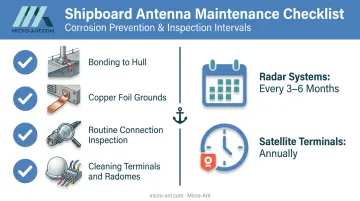
Grounding and corrosion prevention should include:
- Bonding antennas to the hull or keel to dissipate lightning strikes and static buildup safely
- Using copper foil rather than standard wire for RF grounds, since wire can introduce excessive impedance
- Inspecting connections routinely to catch saltwater intrusion before it degrades signal quality
- Cleaning terminals and radomes on a schedule suited to the vessel's operating environment
Testing matters just as much as installation. Periodic signal and radiation-pattern checks catch performance drift before it causes a communication failure at sea.
Radar OEM guidance, for instance, often calls for maintenance checks every 3-6 months to preserve sensor performance, while satellite terminal manufacturers commonly recommend annual inspections by certified technicians. Harsher saltwater exposure warrants more frequent checks than these baseline intervals.
Why Bespoke Shipboard Antenna Design Matters
Off-the-shelf marine antennas work fine for many recreational and light commercial applications. But defense and commercial fleets with unique frequency, space, or ruggedization requirements often hit a wall with generic products.
Consider the scale of the problem on complex naval vessels: Navy topside design research documents roughly 80 antennas on a destroyer and 150 on a carrier, all competing for space, avoiding mutual interference, and needing individual engineering attention. That's not a problem catalog antennas were built to solve.
This is where Micro-Ant fits in. Based in Jacksonville, Florida, Micro-Ant has spent over 20 years designing and manufacturing bespoke antenna systems for defense, aviation, maritime, and land applications.
The company operates AS9100:2016 and ISO 9001:2015 certified facilities, backed by in-house spherical and near-field testing chambers covering 750 MHz to 40 GHz. That infrastructure validates antenna performance before it ever reaches a hull.
Three capabilities stand out for shipboard applications:
- The Ultra-Wide Band Ka Antenna System, engineered for multi-operator satellite roaming rather than locking a vessel into one network
- Proprietary high-precision GNSS designs, built for the accuracy demands of dynamic positioning and navigation in rough seas
- Ruggedized construction, engineered to withstand shock, vibration, and saltwater exposure aboard ship
Micro-Ant has delivered more than 1,000 bespoke antenna products, with major satellite operators such as Intelsat, Inmarsat, and Iridium relying on its engineering. For fleets that need performance a catalog simply can't offer, that track record carries weight.
Frequently Asked Questions
Do ships have antennas?
Yes. Ships carry multiple antenna types simultaneously, each dedicated to a specific job like communication, navigation, or safety alerting. Large vessels can have dozens operating at once without interfering with each other.
What types of antennas are used on ships?
The primary categories are VHF, HF/SSB, SATCOM, GPS/GNSS, radar, and AIS. Each serves a distinct function, from short-range communication to global broadband connectivity and collision avoidance.
What is the best marine antenna?
There's no universal answer: the best antenna depends on the vessel's mission and operating environment. A coastal vessel's needs differ sharply from a blue-water cargo ship or naval platform, which is why manufacturers like Micro-Ant custom-engineer solutions to match each mission profile.
How high should a shipboard antenna be mounted for optimal range?
VHF and radar signals travel line-of-sight, so mounting height directly extends usable range. The higher the antenna sits above the waterline, the farther the radio horizon extends before the Earth's curvature blocks the signal.
How often should shipboard antennas be inspected or maintained?
Routine visual inspection, cleaning, and connection checks should happen regularly, with more frequent attention in harsh saltwater conditions. Many manufacturers recommend checks every few months, with annual technician-level inspections for satellite systems.
What's the difference between commercial marine antennas and military/naval shipboard antennas?
Military and naval antennas generally require stricter ruggedization standards, wideband capability, multi-frequency operation, and custom engineering to fit unique space and mission constraints. Commercial units more often use standardized, off-the-shelf designs suited to less demanding conditions.