
That demand has pushed antenna design past the simple passive radiating element. But the terminology hasn't kept up. "Integrated antenna," "active antenna," and "active integrated antenna series" get used almost interchangeably online, even though they mean different things.
This article clarifies exactly what an Active Integrated Antenna (AIA) Series is, how it works, where it delivers real value, and what to look for in a manufacturing partner if you're specifying one for a defense, aviation, maritime, or SATCOM program.
Key Takeaways
- AIAs pair a radiating element with an onboard LNA or PA, delivering amplification without beam steering
- A "series" means a manufacturer's family of designs across bands and missions, not one product
- Placing amplification at the antenna reduces cable and connector losses that hurt signal-to-noise ratio
- Cost and complexity place AIAs between passive antennas and full electronically steered arrays
- GNSS positioning and Ka-band SATCOM terminals are two of the most common AIA use cases
What Is an Active Integrated Antenna Series?
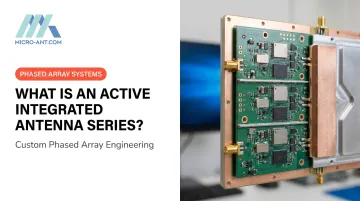
An Active Integrated Antenna (AIA) combines a radiating element (patch, dipole, horn, whatever the application calls for) with select active components mounted directly behind it. For receive applications, that's typically a Low-Noise Amplifier (LNA). For transmit, it's a Power Amplifier (PA).
The "series" part matters more than people assume. It doesn't refer to a single product. It refers to a manufacturer's product line: a family of AIA designs engineered across different frequency bands and mission profiles, from GNSS positioning to Ka-band SATCOM. A GNSS AIA and a Ka-band SATCOM AIA might share the same design logic (amplify close to the aperture) while differing completely in frequency, gain, and housing.
How AIAs Differ From Passive and Electronically Steered Antennas
People constantly conflate three architectures, so here's the quick version:
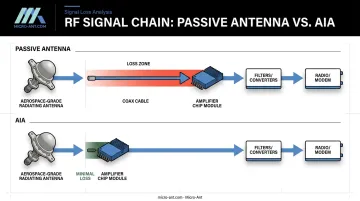
- Passive antennas carry zero onboard amplification. Every gain stage and every loss happens downstream, in cables, connectors, and the receiver front end.
- AIAs add one amplification stage right at the element. That's the whole point.
- Electronically steered antennas (ESAs), also called phased arrays, use many active elements with individually controlled phase and amplitude to steer a beam electronically, without moving parts.
AIAs don't do this. Their "active" designation is about amplification, not beam agility.
Where "Active" Enters the Signal Chain
The basic RF chain looks like this: antenna → amplification → filters/converters → radio or modem. In a passive setup, the amplification happens later in the chain, often after several feet of cable have already eaten into signal quality. In an AIA, the amplifier sits immediately behind the radiating element, before any of that cable loss occurs.
That single positioning change accounts for most of an AIA's performance advantage over passive designs.
Is Every "Integrated Antenna" Active?
Not necessarily. This trips up a lot of people searching for the term. Industry standards bodies draw a clean line: an integrated (or integral) antenna simply means the antenna is physically built into the equipment and can't be separated without factory rework. Think of a phone's PCB trace antenna or a laptop's internal Wi-Fi antenna. That's a packaging description, not an electronics one.
"Active" is a separate claim entirely. It means the unit contains integral active electronic components, such as transistors or amplifiers. So an integrated antenna can be purely passive, purely active, or something in between. The AIA label specifically means both things are true at once: physically integrated and electronically active.
How Active Integrated Antenna Series Work
The engineering rationale behind AIAs comes down to one idea: distance kills signal. Every meter of coaxial cable between a radiating element and its first amplification stage introduces attenuation, and that attenuation compounds with frequency.
Cutting the Cable Loss Problem
Placing the LNA or PA within millimeters of the radiating element minimizes the unamplified RF path length. Compare that to a traditional cabled setup, where the antenna connects through several feet of coax before hitting any active gain stage.
In GNSS applications, this matters because satellite signals arrive incredibly weak. According to u-blox's GNSS antenna application note, placing the LNA at the antenna changes how cable loss affects the system. Loss occurring after that first gain stage no longer degrades the receiver's overall noise figure the way it would in a passive setup.
The note identifies 15 dB of LNA gain as typically sufficient for cable runs up to 5 meters, a benchmark that shows just how much a well-placed amplifier can compensate for downstream loss.
Matching, Power, and Heat: The Supporting Cast
Amplification alone isn't the whole design problem. A few supporting elements make an AIA actually work in the field:
- Impedance matching between the amplifier and the radiator, typically factory-calibrated so performance stays consistent unit to unit
- Power distribution and regulation, since the active component needs a clean, stable supply, often fed up the same cable that carries the RF signal (a bias-tee arrangement)
- Thermal management, because even a small LNA or PA generates heat that has to dissipate without warping performance or reliability over time
A GNSS antenna with an integrated LNA card is the clearest everyday example. It's a compact, field-deployable unit that amplifies a whisper-quiet satellite signal right at the point of reception, before cable loss gets a chance to bury it in noise.
Key Benefits of Active Integrated Antenna Series
The case for AIAs rests on a handful of concrete advantages that show up directly in system performance.
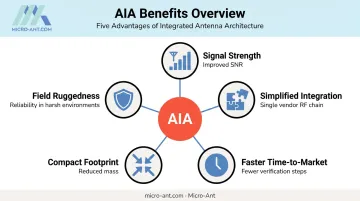
Improved signal strength and link budget. Eliminating loss before amplification directly boosts signal-to-noise ratio, which becomes critical at higher frequencies where cable attenuation climbs sharply.
HUBER+SUHNER, for example, specifies nominal attenuation of 3.36 dB/m at 33 GHz for one of its Ka-band coaxial cables. A single meter of unamplified run at that frequency can erase a meaningful chunk of your link budget before the signal reaches a receiver.
Beyond signal quality, AIAs solve real integration headaches:
- Simplified system integration: one qualified RF chain from a single vendor removes the need to separately source, test, and match an antenna and LNA or PA
- Faster time-to-market: fewer verification steps for OEMs and system integrators building defense, aviation, or SATCOM platforms
- Compact footprint and reduced mass: a real advantage on mobile military platforms, aircraft, vessels, and vehicles where every ounce and every cubic inch is contested
- Field ruggedness and reliability: consistent performance in extreme heat, vibration, salt spray, and temperature swings
That last point is where a manufacturer's field experience shows. Micro-Ant, for instance, builds its rugged connectivity products for defense and maritime platforms around this exact expectation: performance doesn't degrade just because the environment is hostile.
Active vs. Passive vs. Electronically Steered Antennas
Choosing between these three architectures comes down to how much complexity your mission actually needs.
| Factor | Passive Antenna | Active Integrated Antenna | Electronically Steered Antenna |
|---|---|---|---|
| Amplification | None on board | LNA or PA integrated at the element | Active devices at every element |
| Beam control | Fixed, externally pointed | Fixed, no beam steering | Real-time electronic beam steering |
| Complexity | Lowest | Moderate | Highest |
| Power/thermal load | Minimal | Modest, from one gain stage | Significant, scales with element count |
| Best fit | TT&C links, simple reliability-first missions | Link budget improvement without full array cost | High-value, multi-beam, mobile-platform missions |
Passive antennas remain the right call when RF losses are manageable and simplicity is the priority: telemetry, tracking, and command (TT&C) links are a classic example.
AIAs occupy the middle ground: amplification at the element without full beam agility, ideal when you need a link budget boost but cannot justify phased-array complexity, cost, or power draw.
ESAs, meanwhile, can contain hundreds or even thousands of active elements. Digital beamforming architectures add a mixer and analog-to-digital converter per element, which drives up cost and power demand fast. This is why ESAs stay reserved for high-budget, specialized missions (moving-vessel SATCOM, in-flight connectivity, radar) where beam agility justifies the expense.
Applications of Active Integrated Antenna Series
AIAs show up wherever engineers need better signal quality without the overhead of a full phased array.
- High-precision GNSS positioning: an integrated LNA boosts cold-start acquisition and signal-to-noise ratio, the same architecture Micro-Ant uses in GNSS antennas for agriculture, mining, and logistics OEMs like Trimble
- SATCOM terminals requiring extended frequency band connectivity, such as Ka-band, so terminals can roam across multiple satellite operators without swapping hardware
- Defense, aviation, maritime, and land-mobile platforms that need compact, rugged, high-performance antennas for mission-critical operations
Demand for this category isn't slowing down. Grand View Research pegged the global satellite antenna market at $5.97 billion in 2023, forecasting a 17.7% CAGR from 2024 to 2030.
That figure spans the whole satellite antenna market, not AIAs specifically. It reflects the same underlying pressure driving AIA adoption: more platforms need better link performance in smaller, lighter packages.
Choosing the Right Active Integrated Antenna Manufacturing Partner
Designing an AIA well requires balancing amplification gains against power draw, thermal load, and integration constraints: a genuinely difficult RF engineering problem, not a bolt-on afterthought.
When evaluating a manufacturing partner, look for:
- Deep RF engineering expertise: the team understands impedance matching, noise figure budgeting, and thermal design as a unified problem, not separate checkboxes
- In-house testing capabilities: near-field test chambers covering a wide frequency range let a manufacturer validate performance before a unit ever ships
- Recognized quality certifications: ISO 9001:2015 and AS9100:2016 signal a supplier can meet defense and aerospace procurement standards, which often require this documentation before a program will even open a purchase order
- U.S.-based manufacturing and testing: this shortens the feedback loop for defense and government programs that need domestic supply chain traceability
Micro-Ant fits this profile directly. The company has spent over 20 years designing bespoke antenna systems out of its Jacksonville, Florida facility, holding both ISO 9001:2015 and AS9100:2016 certification.
Its in-house spherical and planar near-field test chambers cover 750 MHz to 40 GHz, letting engineers validate a design before a unit ever ships instead of sending it out for third-party testing.

The company's proprietary Ultra-Wide Band Ka Antenna System earned the Satcoms Innovation Group's "Most Innovative" award. Its high-precision GNSS antenna designs reflect the same engineering discipline an AIA demands: getting amplification, matching, and thermal management right at the element, not after the fact.
Frequently Asked Questions
What is an integrated antenna?
An integrated antenna combines the radiating element with additional built-in components (amplifiers, matching circuits, even mounting hardware) into one compact unit. It can be passive or active depending on whether amplification is included.
Can active integrated antennas be customized for specific platforms or frequency bands?
Yes. Micro-Ant engineers bespoke AIAs tailored to frequency band, gain, and mounting requirements for defense, aerospace, and maritime platforms. Custom impedance matching lets each antenna meet mission-specific performance needs without adding external hardware.
What is the difference between an active and a passive antenna?
Passive antennas radiate or receive signal with no onboard amplification. Active antennas integrate an LNA or PA directly at the element, improving signal quality before cable loss can degrade it.
What are the main components of an active integrated antenna?
The core components are the radiating element, an integrated LNA or PA, an impedance matching network between the amplifier and radiator, and power distribution circuitry to feed the active component.
Where are active integrated antennas commonly used?
Common applications include GNSS positioning, SATCOM terminals needing extended frequency band coverage, and defense, aviation, or maritime platforms that need improved link budgets in compact, rugged form factors.
Are active integrated antennas more expensive than passive antennas?
Active integrated antennas (AIAs) typically cost more upfront because of the built-in electronics. However, they often lower total system cost by simplifying integration, cutting verification steps, and improving performance without extra hardware.