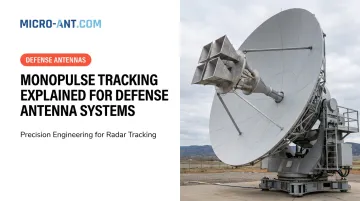
This explanation is written for defense and aerospace engineers, program managers, and procurement teams working with radar, missile guidance, or satellite tracking antenna systems. Precise angle tracking determines whether a fire-control system hits its target, whether a seeker resists jamming, and whether a tracking antenna can discriminate one object from clutter nearby.
Monopulse shows up constantly in radar literature, but it's frequently confused with older conical-scan methods at the operational level. This article covers how monopulse works, why it became the defense standard, where it's applied, and what actually affects real-world accuracy.
Key Takeaways
- Monopulse extracts angle error from a single pulse via sum (Σ) and difference (Δ) channels
- Amplitude- and phase-comparison are the two core implementations, with accuracy shaped mainly by aperture and calibration
- Real-world accuracy depends on comparator null depth, phase/amplitude balance, and calibration quality, not the principle alone
- Multiple closely spaced targets and multipath remain genuine limitations requiring supplementary processing
- Applications span fire-control radar, missile seekers, instrumentation radar, and satellite tracking antennas
What Is Monopulse Tracking?
Monopulse tracking uses a single antenna, or an array, split into quadrants or lobes that simultaneously generate a sum pattern and one or two difference patterns. From those patterns, a radar calculates angular error in real time, from a single received pulse rather than several.
The goal is straightforward: keep the antenna boresight pointed directly at a moving target with minimal lag or ambiguity. This capability proves critical in fire-control and missile-tracking radars, where even a brief loss of lock can mean losing the target entirely.
The two channel types serve distinct roles:
- Sum (Σ) channel — handles detection and range tracking, combining all quadrant signals additively for maximum gain
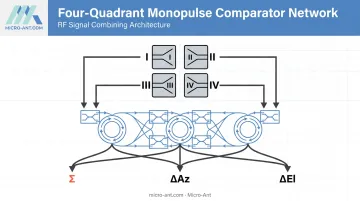
- Difference (Δ) channels: isolate azimuth and elevation error by subtracting quadrant signals across the four-quadrant convention (I, II, III, IV)
How This Differs from Conical Scanning
Conical scan rotates a single lobe over time and infers target direction from amplitude changes across multiple pulses. That sequential approach introduces lag between measurements and creates a vulnerability: if the target's own signal strength fluctuates between pulses (scintillation), the scan reads that fluctuation as motion. Monopulse sidesteps the problem entirely by comparing channels from the same instant.
The Comparator Network
A monopulse comparator network is a passive RF network, commonly built from rat-race or hybrid couplers, that mathematically adds and subtracts the quadrant signals. The output is three signals: Σ, ΔAz, and ΔEl. This network is where a design either delivers a clean, deep null at boresight or leaks error that no amount of downstream processing can fully correct.
Why Monopulse Tracking Is Used in Defense Antenna Systems
Fire-control radar, missile seekers, and precision tracking antennas typically need angular accuracy measured in hundredths of a degree. Monopulse delivers that because it doesn't depend on target signal fluctuation across multiple pulses — the comparison happens within a single return.
The U.S. Naval Research Laboratory developed the first monopulse radar in 1943 to overcome the angle-measurement limitations of earlier techniques. Its documented history credits the approach with a tenfold improvement in angular accuracy over prior systems, first fielded on the Nike-Ajax air defense missile (NRL, 1923–2023: NRL Contributions).
That order-of-magnitude jump is why the principle spread from air defense into instrumentation radar and space tracking within just a few years.
What conical scan gets wrong, and why it matters:
- Amplitude changes between sequential pulses can come from target scintillation, not actual motion, introducing tracking error
- Sequential-pulse amplitude comparisons are vulnerable to amplitude-modulated deception jamming, since spoofing the scan-rate signal is enough to fool the system
- Monopulse's simultaneous-channel comparison removes that specific attack surface
Monopulse has since become the accepted baseline for defense radar and tracking antenna design, used across most modern fire-control and tracking systems today. But the principle only holds if the manufactured hardware performs to spec.
This is where feed and comparator network design matter as much as the underlying math. Micro-Ant, based in Jacksonville, Florida, designs feed and comparator networks for defense and satellite tracking antennas.
The company validates sum/difference pattern performance and phase balance using in-house near-field test chambers spanning 750MHz to 40GHz before any unit ships. Manufacturing precision at that level is what actually determines whether a fielded system achieves its specified tracking accuracy, not just the monopulse architecture on a datasheet.
How Monopulse Tracking Works (Conceptual Flow)
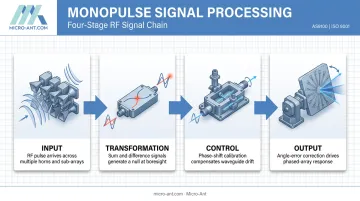
All quadrants or lobes receive the same reflected pulse at the same instant. The comparator network processes those signals into sum and difference outputs, and the radar computes a ratio, the monopulse ratio, Δ/Σ, to derive angular error. That error value then drives antenna positioning or missile guidance corrections.
The signal path, step by step:
- Input: RF energy from a single reflected pulse arrives across multiple feed horns or sub-arrays positioned symmetrically around boresight
- Transformation: hybrid couplers combine signals additively (sum) and subtractively (difference), producing a null at boresight; the difference signal grows as the target deviates from center
- Control: calibration signals and phase-shift compensation correct for waveguide length, temperature drift, and hardware phase mismatches that would otherwise degrade null depth
- Output: a signed angle-error value feeds a servo motor on mechanically steered antennas, or phase shifters on AESA/phased array systems, to re-center the target
Amplitude-Comparison Monopulse
Radar designers implement this angle-error extraction using one of two approaches: amplitude comparison or phase comparison. Amplitude comparison derives angular deviation by comparing signal amplitudes between two offset (squinted) beams in the same plane. When the amplitudes match, the target sits on boresight.
When they differ, the imbalance indicates both direction and magnitude of the error. Amplitude comparison is common in reflector and horn-based tracking antennas and is generally favored for its signal-to-noise performance.
Phase-Comparison Monopulse
Phase comparison uses parallel, non-squinted beams from two or more spatially separated antennas or array segments, deriving angular offset from the phase delay between them rather than amplitude difference. It's often assumed to be inherently more precise, but that's not quite right.
Sandia's analysis of amplitude versus phase comparison monopulse found only a 1.4% precision advantage (roughly 0.06 dB in effective SNR) for phase comparison under equivalent aperture conditions. Researchers called the difference insignificant (Doerry & Bickel, Sandia National Laboratories).
The real tradeoff isn't accuracy. Phase comparison typically requires multiple independent antennas or an AESA, which raises system complexity and cost. That's the design decision program planners actually need to weigh.
Where Monopulse Tracking Is Applied in Defense Antenna Systems
Monopulse tracking operates in the track phase, after initial target acquisition or search, once a radar has locked on and needs continuous fine-angle correction. It's not typically the technique used for wide-area search.
Common system types:
- Fire-control radar for air and missile defense
- Missile seeker and guidance antennas
- Precision instrumentation radar used for range and missile testing
- Shipboard tracking radar, including systems aboard Aegis-class cruisers and destroyers
- Satellite and space-object tracking antennas
Satellite tracking is a particularly well-documented case. The European Space Agency's VIL-2 S-band antenna uses a two-channel monopulse system for satellite autotracking.
80 milli-degrees of angular-data accuracy, including autotrack and pointing error (ESA, ESAC Radio Antenna documentation).
That figure gives program planners a real benchmark for what a well-engineered monopulse satellite antenna can deliver.
Micro-Ant's bespoke antenna work spans DoD, aerospace, and satellite communications customers requiring this class of high-precision tracking and pointing antenna — from GNSS-grade designs through Ka-band systems supporting government and defense missions.
Key Factors, Common Misconceptions, and Limitations of Monopulse Tracking
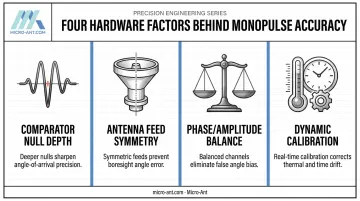
Real-world monopulse accuracy depends on several hardware factors, not the monopulse principle by itself:
- Comparator network design and null depth: deeper nulls generally mean lower angle-tracking error, though small phase or amplitude errors before the comparator can limit achievable null depth
- Antenna feed symmetry: asymmetric feeds shift the difference-pattern null away from the sum peak
- Phase/amplitude balance between channels: imbalances scale or rotate the monopulse ratio, distorting the reported angle
- Dynamic calibration: long waveguide runs, temperature drift, and A/D timing offsets all require active compensation
There's no single universal "monopulse accuracy" number. It depends on antenna aperture, achievable null depth, and calibration quality. Anyone evaluating a specific program should request the published angular accuracy figures for that exact system rather than relying on generalized claims.
A common misconception worth clearing up: monopulse and conical scan are often used interchangeably in casual conversation, but they're fundamentally different. Monopulse derives angle from one pulse across simultaneous channels, while conical scan infers angle from signal strength changes across multiple pulses over time.
That distinction is why monopulse resists the jamming and scintillation errors that conical scan doesn't.
Known limitations system designers need to plan around:
- Accuracy degrades when multiple targets occupy the same resolution cell
- Multipath-heavy environments, such as low-altitude or maritime clutter, can produce large angle errors
These limitations are why Doppler processing is frequently layered on top of monopulse in modern systems.
Monopulse also isn't always the right tool. Wide-area search and surveillance are usually better served by scanning arrays, and resource-constrained platforms may not justify the added comparator and receiver channel complexity. Dense multi-target environments often need supplementary discrimination techniques altogether.
Monopulse tracking remains the defense industry's benchmark for single-target angular precision. But that precision is only realized when comparator design, calibration, and antenna manufacturing quality are engineered to match the mission's actual accuracy requirements.
Frequently Asked Questions
What is monopulse tracking?
Monopulse tracking is a single-pulse angle-measurement technique that uses sum and difference channels to locate a target's azimuth and elevation error relative to boresight. It computes the error from one received pulse rather than comparing signals across multiple scans.
What is the difference between monopulse tracking and conical scan tracking?
Conical scan infers direction from amplitude changes across multiple rotating-lobe pulses over time. Monopulse derives angle instantaneously from one pulse across simultaneous channels, making it faster and more resistant to jamming and target scintillation.
How accurate is a monopulse tracking system?
Accuracy depends on comparator null depth, calibration quality, and antenna design. Well-engineered defense and instrumentation radars can reach hundredths of a degree, though specific figures vary by system, so consult published specifications for exact numbers.
What is a monopulse comparator network?
It is a passive RF network, typically built from hybrid or rat-race couplers, that adds and subtracts quadrant signals to generate the sum and difference outputs used for angle-error calculation.
Can monopulse tracking track multiple targets simultaneously?
Monopulse works best for single-target tracking, and accuracy degrades noticeably when multiple targets share the same resolution cell. Multi-target scenarios typically require separate track-while-scan or Doppler discrimination techniques.
Is monopulse tracking used in satellite tracking antennas?
Yes. Monopulse principles apply directly to satellite and space-object tracking antennas requiring precise pointing. Micro-Ant designs these systems for government and satcom customers needing GNSS-grade through Ka-band precision.