Introduction
Ka-band and Ku-band power most of the satellite links running today, from broadcast trucks to drone datalinks to ships crossing open ocean. Program managers rarely get to pick their frequency band twice.
Get it wrong, and you're stuck with an antenna too heavy for the airframe or a link that drops out in every rainstorm. Maybe it's a terminal locked to one operator when the mission needs three.
These trade-offs hit budget, weight, and reliability all at once.
This guide breaks down the real frequency ranges, where each band actually earns its keep, and a practical framework for choosing between them.
TL;DR
- Ku-band (12-18 GHz): lower cost and stronger rain resilience across whole continents
- Ka-band (17.7-31 GHz): more spectrum and smaller terminals, but tougher rain-fade engineering
- Pick Ku for broadcast and legacy VSAT; pick Ka for high-throughput, multi-operator broadband
- Both bands power GEO, MEO, and LEO fleets at Intelsat, Inmarsat, SES, and Amazon Leo
Ka-Band vs Ku-Band: Quick Comparison
Before choosing a band, engineers need to see the numbers side by side. Here's how the two stack up across the factors that actually drive system design.
| Factor | Ku-Band | Ka-Band |
|---|---|---|
| Frequency | 12-18 GHz (IEEE) | 27-40 GHz (IEEE); 17.7-31 GHz typical for satellite uplink/downlink (ITU) |
| Wavelength | 16.7-25.0 mm | 7.5-11.1 mm |
| Bandwidth | Moderate, broadcast-grade | Roughly double the allocated spectrum of Ku |
| Rain fade | Moderate sensitivity | Higher sensitivity, needs active mitigation |
| Terminal size | Moderate aperture required | Smaller, lighter apertures possible |
| Coverage pattern | Single wide beam can cover a continent | Multiple narrow spot beams with frequency reuse |
A quick note on that frequency range: different standards define Ka differently.
- IEEE Standard 521-2019 sets Ka at 27-40 GHz
- ITU allocations for satellite use span 17.7-31 GHz
- Typical downlink operations run 17.7-21.2 GHz
- Typical uplink operations run 27.5-31 GHz
Different sources, different conventions, same underlying hardware.
On bandwidth, Avanti's 2021 operator white paper found that Ka-band carries at least twice the allocated spectrum of Ku-band. That's a spectrum allocation figure, not a guaranteed doubling of your actual data rate. Delivered throughput still depends on beam reuse, gateway design, and link margin.
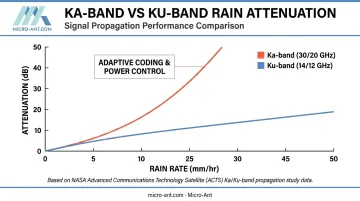
Rain fade is where the gap gets real. NASA's own propagation studies found that 30/20 GHz Ka-band links suffer more severe rain attenuation than 14/12 GHz Ku-band links. That's why Ka terminals typically carry adaptive coding and power control that Ku systems often skip.
What is Ku-Band?
Ku-band sits at 12-18 GHz under the IEEE designation, and it's been the commercial workhorse of satellite communications since the 1980s. The frequencies are low enough to punch through moderate rain and high enough to dodge the terrestrial interference that plagues C-band. Ground equipment is also mature enough to be cheap and plentiful.
That maturity is the real selling point. A Ku terminal doesn't require exotic components, and installation crews have decades of experience with the hardware. Intelsat has explicitly cited backward compatibility with existing Ku networks as a way operators cut capital expense when migrating to newer platforms.
Ku's single wide beam can also cover an entire continent from one satellite. For operators serving customers scattered across a landmass, that means:
- Fewer satellites needed to reach the same footprint
- Simpler network architecture with less beam-handoff complexity
- Lower infrastructure overhead for dispersed customer bases
Use Cases of Ku-Band
Ku-band still dominates several high-volume applications:
- Direct-to-home (DTH) television — Intelsat alone delivers content to nearly 2.3 billion viewers across roughly 10,900 channels
- In-flight connectivity on commercial aircraft
- Maritime broadband for vessels needing reliable, moderate-throughput links
- Commercial VSAT networks run by operators like Eutelsat across broadcast and enterprise data services
Legacy VSAT deployments keep choosing Ku largely for cost-per-terminal reasons. The ground segment ecosystem, from antennas to modems to installation know-how, is already built out. Ripping that out for a new band means paying for infrastructure that already exists elsewhere.
What is Ka-Band?
Ka-band's IEEE range runs 27-40 GHz, though satellite operators typically work within the ITU's narrower 17.7-31 GHz allocation split between uplink and downlink. This is the band behind the current wave of High-Throughput Satellite (HTS) systems promising broadband speeds that used to require fiber.
The shorter wavelength (7.5-11.1 mm versus Ku's 16.7-25.0 mm) is what makes Ka attractive for anything that needs to move or fit in a backpack. Smaller wavelengths support smaller apertures for a given gain requirement, which translates directly into lighter, more portable terminals.
That size advantage matters for:
- Cloud access and 5G backhaul where throughput demands keep climbing
- ISR and defense data links moving high-resolution imagery and sensor feeds
- Man-portable and UAV terminals where every ounce counts
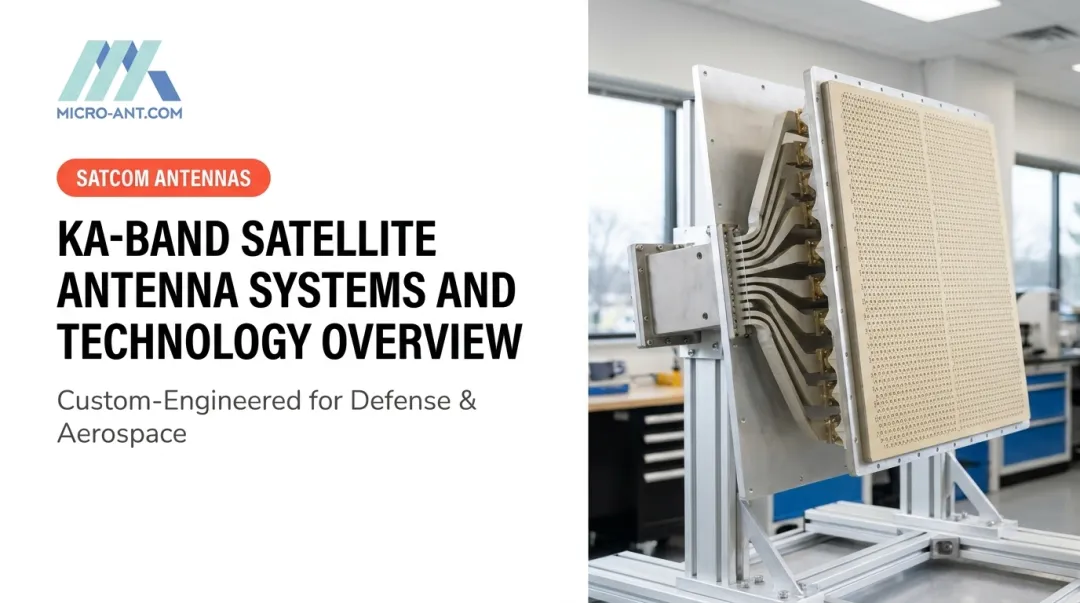
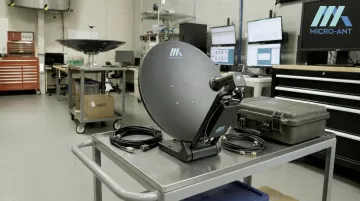
Micro-Ant's Ultra-Wide Band (3.5 GHz) Ka Antenna System was built to solve one of Ka's persistent headaches: narrow per-beam coverage that can lock a terminal to a single operator's frequency plan.
The system spans the full Ka SatCom range: 17.7-21.2 GHz on receive and 27.5-31 GHz on transmit. That range lets a single antenna roam across multiple satellite operators and orbital classes, instead of requiring separate hardware for each.
Use Cases of Ka-Band
Ka-band applications lean toward high-capacity, mobility-driven missions:
- HTS internet services delivering broadband-class speeds to fixed and mobile users
- Military SATCOM requiring secure, high-bandwidth links in the field
- Manpack and on-the-move terminals for forces that can't stop to set up a dish
- MEO/LEO broadband constellations including SES O3b mPower, Inmarsat Global Xpress, and Amazon Leo
Amazon Leo has already put more than 375 satellites in orbit as of its latest deployment updates, operating within FCC-authorized Ka allocations.
That growth mirrors the broader HTS capacity market: Euroconsult forecast global HTS capacity supply to grow at a 45% CAGR and exceed 60,000 Gbps by 2026. Ka-band spot-beam architectures are largely built to serve that trend.
Ka-Band vs Ku-Band: Which Is Better for Your Mission?
Neither band wins on paper. The right answer depends on five factors program managers need to weigh together, not in isolation:
- Budget per terminal: Ku's mature ecosystem generally costs less to deploy and maintain
- Required throughput: Ka's spectrum advantage suits bandwidth-hungry applications
- Operating environment: rain-prone regions push toward Ku or require serious Ka fade mitigation
- Platform size constraints: man-portable and UAV platforms often need Ka's smaller aperture
- Multi-operator roaming needs: some missions can't afford to be locked to one satellite fleet
Choose Ku-band when wide continental coverage and lower-cost ground segments matter most, with rain resilience as an added bonus. Broadcast operators and legacy VSAT networks fit this profile well.
Choose Ka-band when high throughput and compact terminals matter most, especially if the mission needs connectivity across multiple satellite operators. Defense on-the-move units, HTS broadband providers, and MEO/LEO constellation operators land here.
A Real-World Ka-Band Deployment
Defense and SATCOM customers working toward MEO constellation compatibility face a specific problem: terminals built for one operator's frequency plan often can't roam onto another network without a hardware swap. Micro-Ant's engineering team built its Ultra-Wide Band Ka Antenna System specifically to meet the requirements of SES O3b mPower, an MEO network known for demanding link performance.
Hitting an axial ratio spec under 1dB across both receive and transmit, over the full Ka SatCom range, required proprietary work on the feed and reflector design. The result is a single antenna platform now supplied to multiple terminal manufacturers without redesigning hardware for each network, supporting:
- O3b mPower MEO deployments
- Eutelsat man-pack terminals
- WGS military systems
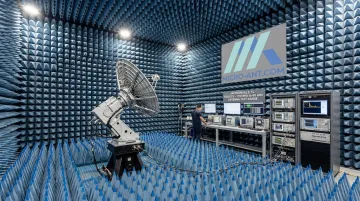
Delivering that cross-network flexibility also demanded rigorous in-house validation. Micro-Ant's US-based testing facility, covering 750 MHz to 40 GHz in spherical and planar near-field chambers, keeps that qualification work in Jacksonville instead of shipping units overseas for certification. For program managers on a deployment clock, that shortens the path from prototype to fielded terminal.
Not sure which band fits your platform? Micro-Ant's engineering team can evaluate your mission profile, terminal constraints, and operator requirements to recommend the right band-and-antenna combination. Reach out to discuss your project.
Conclusion
Ku-band and Ka-band solve different problems. Ku still makes sense for broad, cost-sensitive coverage where rain resilience matters more than raw throughput. Ka takes over when missions need compact terminals, high capacity, or the flexibility to roam across operators.
The decision comes down to matching frequency characteristics to your specific constraints: terminal size, budget, weather exposure, and coverage footprint. Working with an antenna manufacturer that's actually fielded both bands, like Micro-Ant, helps ensure whichever one you pick performs the way the spec sheet promises once it's in the field.
Frequently Asked Questions
What frequency does Ka-band use?
IEEE 521-2019 defines Ka-band as 27-40 GHz. Satellite operators, however, typically work within the ITU's narrower allocation of roughly 17.7-31 GHz split between downlink and uplink. Sources vary depending on which convention they're citing.
What is the wavelength of Ka-band?
Based on IEEE's frequency endpoints, Ka-band wavelengths run from approximately 11.1 mm down to 7.5 mm. This short wavelength is what allows Ka antennas to use smaller physical apertures than Ku for comparable gain.
What frequency range does Ku-band use?
Ku-band runs 12-18 GHz under the IEEE designation. Satellite links typically split this into separate uplink and downlink segments within that range, depending on the operator's specific filing.
Is Ka-band or Ku-band more affected by rain fade?
Ka-band is more susceptible to rain attenuation than Ku-band because its shorter wavelength interacts more strongly with raindrops. As a result, Ka systems commonly use adaptive coding and uplink power control to maintain link availability.
Can a single antenna support both Ka-band and Ku-band?
Yes. Multi-band and convertible designs, including segmented reflector systems like Micro-Ant's Tri-Band Segmented Reflectors, let a single antenna switch between or combine Ka and Ku operation. These designs trade some complexity for operational flexibility across networks.
Which band is better for maritime or aviation connectivity?
Operators have traditionally favored Ku-band for broad maritime and aviation coverage thanks to its mature, cost-effective ecosystem. Ka-band adoption is growing faster in both sectors where operators need higher throughput from a smaller terminal footprint.