That connection is easy to overlook because it's rarely the part engineers obsess over. Yet poor antenna selection is exactly what causes signal loss, GPS spoofing vulnerability, shortened range, and outright mission failure, even when every other subsystem performs exactly as designed.
This guide breaks down what UAV antennas actually are, the major types in use today, the design trade-offs separating reliable systems from fragile ones, and how to evaluate a manufacturing partner capable of delivering mission-ready RF performance.
Key Takeaways
- UAV antennas manage four link types: command and control, GNSS/navigation, telemetry/video, and payload/ISR data.
- Antennas are classified by function (GNSS, C2, video, SATCOM) and form factor (blade, patch, dipole, omni).
- Weight, aerodynamics, frequency band, and polarization all compete against airframe constraints like carbon fiber interference.
- Military ISR platforms and precision-agriculture drones need fundamentally different antenna solutions.
- A bespoke antenna manufacturer with in-house testing lowers the risk of mission-critical field failure.
What Is a UAV Antenna?
UAV vs. UAS: Where the Antenna Fits
A UAV (unmanned aerial vehicle) is the aircraft itself: the airframe, motors, and flight electronics that get airborne without a pilot on board. A UAS (unmanned aircraft system) is the bigger picture, including the ground control station, the data links, and every piece of equipment needed to fly it safely.
The antenna is what turns a UAV into a functioning UAS. Without it, the aircraft is just hardware sitting on a bench. With it, the aircraft becomes part of a communication loop spanning the operator, the airframe, and often a satellite constellation thousands of miles away.
Four Links Every UAV Depends On
Most UAV antenna systems support four distinct link types, and each one fails differently if the antenna is wrong for the job:
- Command & control (C2): the uplink that lets the operator steer, arm, or abort the aircraft
- GNSS/navigation: the receive-only link providing position, timing, and precision guidance
- Telemetry/video downlink: the channel carrying flight status data and live imagery back to the ground
- Payload/ISR data: mission-specific data, such as sensor feeds or surveillance imagery, transmitted separately from flight-safety traffic
Why Off-the-Shelf Antennas Struggle
Consumer-grade antennas are built for stationary routers and cars, not airframes shedding grams to stay aloft. UAV platforms impose constraints catalog antennas were never designed to survive:
- Strict weight budgets where every gram cuts into flight time
- Aerodynamic drag from any protruding hardware
- Continuous vibration from motors and propellers
- Electromagnetic interference generated on the airframe itself
That last point isn't theoretical. NASA's small-UAS interference testing found the aircraft itself was often the dominant EMI source affecting onboard RF payloads. Against a receiver sensitivity near -119 dBm, interference became measurable once received signal power dropped below roughly -100 dBm. That's a razor-thin margin, one a poorly placed or poorly shielded antenna can erase instantly.
Types of UAV Antennas
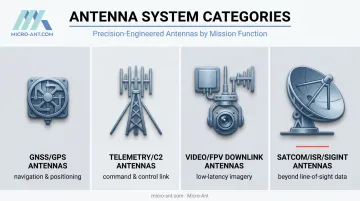
Classified by Communication Function
Every UAV antenna serves one of the four link types described above, and the hardware differs sharply depending on which one it's built for.
- GNSS/GPS antennas receive multi-constellation satellite signals for navigation, with Micro-Ant's proprietary designs delivering millimeter-level accuracy for mapping, autonomous navigation, and precision agriculture.
- Telemetry and C2 antennas maintain the bidirectional link that keeps the aircraft under control and reports status to the operator, running on spectrum regulators keep separate from mission-payload traffic.
- Video/FPV downlink antennas stream live imagery for piloting and situational awareness, prioritizing throughput and low latency over long range.
- SATCOM, ISR, and SIGINT antennas extend operations beyond line of sight, relaying secure data over vast distances for defense and intelligence missions where terrestrial links can't reach.
Classified by Physical Form Factor
The same link type can be delivered through very different hardware, and form factor decisions often come down to where on the airframe the antenna has to live.
- Blade antennas: low-profile, aerodynamic housings common on fixed-wing and larger UAV platforms where drag matters as much as gain
- Patch/microstrip antennas: flat, lightweight designs that embed into the airframe skin without adding protrusions
- Dipole/monopole whip antennas: simple, cost-effective options frequently used for telemetry and video links on smaller UAVs
- Omnidirectional antennas: broad coverage that tolerates a moving, rotating aircraft but sacrifices concentrated gain
- Directional antennas: concentrated gain and extended range, at the cost of needing accurate pointing or beam steering
The omni-versus-directional trade-off comes up constantly. An omnidirectional antenna keeps the link alive no matter how the aircraft banks or turns. A directional antenna pushes range and signal quality further, but only if it stays pointed correctly. That's exactly why many SATCOM and long-range ISR platforms pair directional apertures with active tracking or beam-switching electronics.
Key Design Considerations & Challenges
Weight, Aerodynamics, and Frequency
Every gram an antenna adds comes directly out of flight time or payload capacity, and every millimeter of protrusion adds drag. That's why UAV antenna construction leans toward ultra-lightweight, low-profile builds rather than the heavier housings used on manned aircraft.
Frequency choice compounds the challenge. A single UAV platform might need:
- L-band for GNSS reception
- UHF/VHF for telemetry
- S/C-band for video downlink
- Ka/Ku-band for SATCOM
Wideband designs solve a real operational problem here. An antenna capable of roaming across multiple satellite operators without a hardware swap solves this directly. Micro-Ant's Ultra-Wide Band Ka Antenna System offers exactly that flexibility, so an operator isn't grounded every time a mission shifts between satellite networks.
Polarization and Environmental Ruggedization
Polarization mismatch is one of the most common, and most avoidable, causes of link degradation. When a transmitting antenna is vertically polarized and the receiving antenna is horizontal, the signal loss can be severe.
According to McMaster University's antenna engineering course materials, the polarization loss factor can reach a full 3 dB for linear-to-circular mismatches, dropping to zero received power for perfectly orthogonal linear polarizations. On a platform constantly changing attitude in flight, that mismatch has to be engineered around, not assumed away.
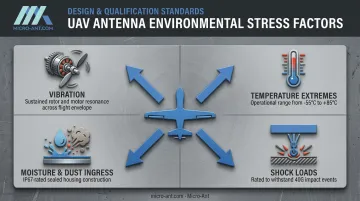
Ruggedization adds another layer. UAV antennas need to survive:
- Continuous vibration from motors and propellers
- Temperature extremes across altitude changes
- Moisture and dust ingress in field conditions
- Shock loads from hard landings or turbulence
MIL-STD-810H environmental test methods and IP ingress ratings each cover part of this picture, but neither one certifies RF performance on its own. A properly qualified antenna needs testing as installed hardware, not just as a datasheet part.
Interference From the Airframe Itself
Carbon fiber is conductive, and conductive airframe material sitting near an antenna will distort its radiation pattern if placement isn't engineered carefully. Motors and ESCs add their own noise floor on top of that.
Addressing this takes antenna placement, isolation, and pattern testing done on the actual airframe configuration, not in isolation on a bench.
Applications of UAV Antennas Across Industries
Different missions put entirely different demands on the antenna stack. A defense ISR platform and a crop-mapping drone might both carry a GNSS antenna, but almost nothing else about their RF requirements overlaps.
- Defense and ISR: Reconnaissance and combat-support platforms need hardened, long-range antenna systems capable of secure SATCOM links and resistance to jamming or spoofing in contested environments.
- Precision agriculture and surveying: Crop mapping, spraying, and infrastructure inspection all depend on GNSS antennas accurate enough to guide autonomous passes across a field or structure without drift.
- Public safety, logistics, and delivery: Search and rescue, disaster response, and cargo drones need resilient telemetry and video links that hold up during beyond-visual-line-of-sight operations, often over difficult terrain.
That last category isn't theoretical. A 2024 FAA-supported trial using path diversity across C-band, cellular, and Starlink connectivity flew BVLOS missions covering 21.6 to 42.8 miles, with C-band latency averaging around 25 milliseconds. Results like that depend on antenna architecture matched to the mission, not a one-size-fits-all approach. Micro-Ant designs airborne and UAV antenna systems, from SATCOM-ready to GNSS and defense-grade tactical antennas, calibrated to these same mission-specific RF demands.
Choosing the Right UAV Antenna Partner
Standardized, off-the-shelf antennas rarely meet the frequency, form factor, and environmental demands of a specialized UAV mission. Weight, gain, band, and ruggedization all have to align at once, and that's usually only achievable through bespoke design.
Experience and In-House Testing to Expect
Micro-Ant has spent over 20 years designing and manufacturing bespoke antennas for defense, aviation, maritime, and land applications, building more than a thousand custom antenna products along the way. That kind of track record matters when a mission has zero tolerance for a dropped link mid-flight.
A design that looks good on paper still has to survive real-world conditions. Look for a partner with:
- In-house testing and certification: Micro-Ant holds AS9100:2016 and ISO 9001:2015 certifications, the standard aerospace and defense buyers expect
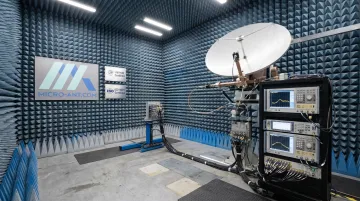
- Broad frequency validation: near-field test chambers spanning 750 MHz to 40 GHz cover GNSS through Ka-band SATCOM in a single facility
- Installed-configuration testing: validating the antenna on the actual airframe, not just as an isolated part
A Quick Evaluation Checklist
Before committing to a manufacturer, confirm these four points cover your program's full lifecycle, from initial design through fielded hardware:
- Frequency coverage: does their testing span your full operating band, from GNSS through SATCOM?
- Ruggedization capability: can they document vibration, temperature, and ingress testing relevant to your platform?
- Customization flexibility: will they engineer form factor and gain around your airframe, or ask you to adapt to theirs?
- Turnaround time: how fast can they move from prototype to tested, deployable hardware?
A manufacturer that can't answer these questions clearly isn't ready to support a mission-critical UAV program, and finding that out after contract signing costs far more than vetting it upfront.
Frequently Asked Questions
What antennas do drones use?
Most drones use a combination of GNSS/GPS antennas for navigation, telemetry antennas for control, video/FPV antennas for imagery, and SATCOM antennas for long-range missions beyond line of sight.
What are the 4 types of antennas?
In the UAV context, four core link types drive the aircraft's communications: command & control, GNSS/navigation, telemetry/video downlink, and payload/ISR data. Each one handles a distinct job within the overall system.
What does UAV mean for drones?
UAV stands for unmanned aerial vehicle, referring specifically to the aircraft itself. It's distinct from UAS (unmanned aircraft system), which includes the ground control station and data links as well.
How do I choose the right antenna for my UAV mission?
Start with your required frequency bands, range needs, weight and aerodynamic limits, and the environmental conditions the aircraft will actually operate in. Those four factors narrow the field quickly.
Can UAV antennas be customized for specific missions?
Yes. Micro-Ant's bespoke design process tailors frequency, gain, form factor, and ruggedization to match a specific mission's requirements, rather than forcing a platform to adapt to catalog hardware.
How far can UAV antennas transmit signals?
Range depends on antenna type, frequency, gain, and environmental factors. SATCOM antennas enable beyond-line-of-sight communication over far greater distances than standard terrestrial telemetry links.