Introduction
Your 5G phone, a Navy destroyer's radar, and a satellite terminal tracking a LEO constellation all share the same underlying trick: antenna arrays. Instead of relying on one antenna, they combine dozens or thousands of small radiating elements to electronically steer a signal with no moving parts.
Many engineers and program managers hit the same wall, though. Which array topology fits a mobile platform? Should you specify AESA or PESA? What ruggedization does a maritime or airborne deployment actually need?
This guide breaks down how antenna arrays work and the main types in use today. It also covers their real advantages over dish and reflector systems, plus what to look for when sourcing a custom-built array for demanding field conditions.
Key Takeaways
- Antenna arrays combine multiple elements to electronically steer and shape beams with zero moving parts.
- Configurations range from simple linear designs to AESA and digital beamforming systems for defense and 5G.
- Benefits include faster scanning, smaller footprint, graceful degradation, and multi-beam capability.
- Micro-Ant's AS9100 and ISO 9001 certifications back reliable antenna array performance for defense, aviation, and maritime deployments.
What Is an Antenna Array and How Does It Work?
An antenna array is a group of individual radiating elements, arranged and electronically controlled to behave as one larger, more directional antenna.
IEEE credits Karl Ferdinand Braun as the inventor of the phased-array antenna concept. The design matured significantly during World War II, when Germany's MAMMUT radar system used a fixed array with electrical beam steering across roughly ±50 degrees.
An array's behavior comes down to five controllable variables:
- Geometry/configuration – how elements are physically arranged
- Element spacing – the distance between individual radiators
- Excitation amplitude – the power fed to each element
- Excitation phase – the timing offset applied to each element
- Element radiation pattern – how a single element radiates on its own
Core Components of an Array
Most arrays use patch, dipole, monopole, or waveguide elements. The choice depends on the target frequency band and desired radiation pattern — a compact patch element suits a flat-panel Ku-band terminal, while a dipole might fit a lower-frequency tactical system.
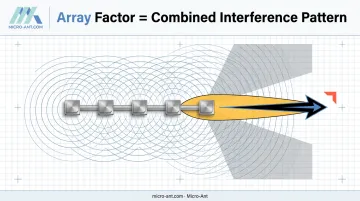
Here's the part that trips people up: the overall beam shape isn't determined by any single element. It's the array factor: the combined interference pattern created when every element's signal overlaps in space. Get the spacing and weighting right, and those overlapping waves reinforce each other in the direction you want and cancel out elsewhere.
Beamforming and Phase Control
Phase shifters and amplitude weighting applied to each element let the beam point in any direction electronically. No motors or gimbals are required.
There's a catch. Space elements too far apart and you create grating lobes — unwanted duplicate beams that waste transmit power and can create interference. Analog Devices notes that 0.5-wavelength spacing is required if you want to scan fully to the horizon without grating lobes appearing in the visible region. Wider spacing can still work, but only if the scan range is restricted.
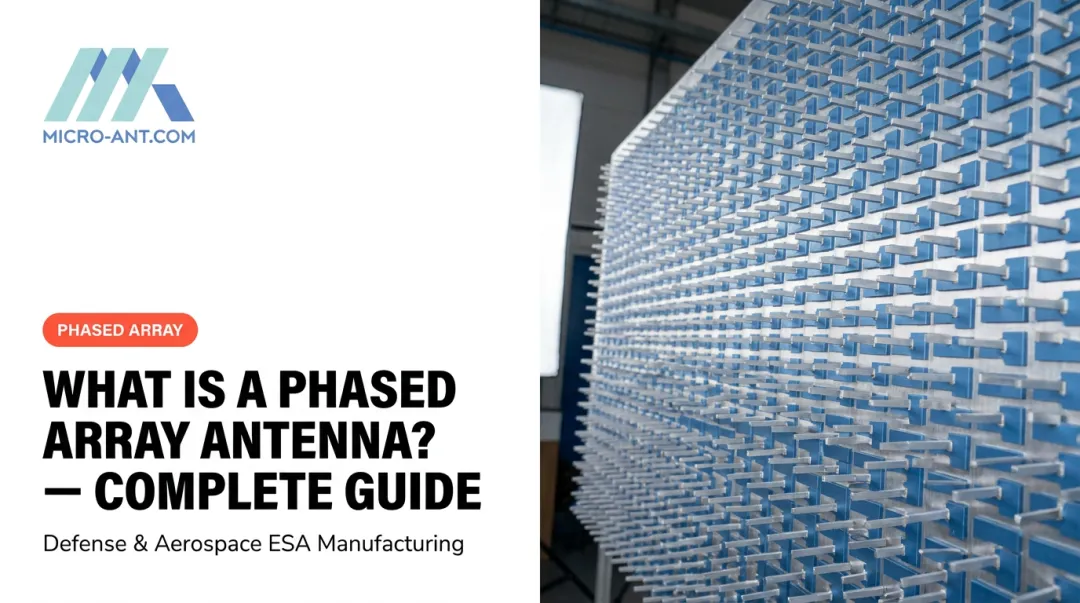
Sidelobes are the smaller, unavoidable side beams that leak energy away from the main beam. Minimizing sidelobe level matters most in radar and defense systems, where a stray sidelobe can mean detecting, or being detected by, the wrong target. Micro-Ant's phased array and beam-switching antenna designs are engineered around these same variables, balancing sidelobe suppression with mission-specific beam agility.
Types of Antenna Arrays
Not every array looks or behaves the same. Two questions define most design decisions: what shape does the array need, and how is the beamforming hardware distributed?
Array Topologies
- Linear (1D) arrays control a single axis, either azimuth or elevation. They're common in simpler tracking or directional systems where full 2D coverage isn't required.
- Planar (2D) arrays are the industry standard. They offer symmetrical beam control across both azimuth and elevation, making them the preferred configuration for radar and satcom systems.
- Conformal (3D) arrays mount onto curved surfaces, such as an aircraft fuselage or vehicle body, enabling full-volume beam steering. NASA's 64-element CPAAD demonstrator, built on an aerogel backbone, shows where airborne integration is headed.
Beamforming Architectures
| Architecture | How it works | Best fit |
|---|---|---|
| PESA | Single shared transceiver drives the whole array | Cost-sensitive, simpler installations |
| AESA | Each element has its own transceiver module | Military and aerospace radar needing high reliability |
| Digital/Hybrid | FPGA-controlled digital transceivers enable multiple simultaneous beams | 5G/6G base stations, multi-beam satellite systems |
PESA keeps hardware simple but depends on that one shared module. AESA distributes the transceivers, which improves reliability and performance but increases module count and thermal load.
Digital and hybrid beamforming go a step further, applying weighting after signals are digitized. This enables adaptive interference nulling and multiple simultaneous beams from the same physical aperture. Micro-Ant designs phased array and beam-switching ESA antennas built on these same principles, engineered in-house for defense and satcom customers that need adaptive, multi-beam performance.
Key Advantages of Antenna Arrays
Why go through the added design complexity of an array instead of a mechanically steered dish? The performance gap is significant.
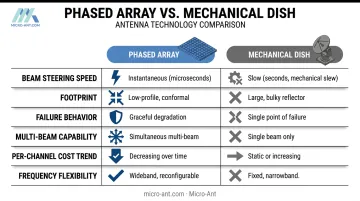
- Faster beam steering. NOAA reports that a conventional rotating NEXRAD radar takes 4-6 minutes for a full-volume scan, while phased-array radar completes the same scan in under a minute, a major advantage for weather tracking, missile defense, and target acquisition.
- Smaller footprint. Arrays can be built flush or low-profile onto a vehicle, vessel, or aircraft skin, a major win over bulky mechanical dishes for mobile defense and maritime platforms.
- Graceful degradation. Losing one element in an array of hundreds barely affects performance, but losing the single moving part in a mechanical antenna shuts the whole system down.
- Multi-beam, multi-user capability. Modern arrays track or communicate with multiple satellites, targets, or users at once, supporting scenarios like roaming across multiple satellite operators in extended Ka-band systems.
- Falling per-channel costs. As beamforming components migrate to integrated circuits, large arrays are becoming more economical relative to comparable mechanically steered systems.
- Wideband flexibility. Ultra-wideband array designs, including Micro-Ant's Ultra-Wide Band Ka Antenna System, maintain connectivity across broad frequency ranges, cutting down the need for multiple separate antennas in the field.
Real-World Applications of Antenna Arrays
Arrays aren't confined to any one industry anymore. They've spread from defense labs into everyday commercial infrastructure.
Defense and radar remain the largest use case: missile defense, target tracking, and early-warning systems all depend on array agility. Mordor Intelligence values the electronically scanned array radar market at $11.02 billion in 2026, growing to $15.48 billion by 2031 — a 7.05% CAGR, with AESA already accounting for the majority of revenue.
Satellite communications benefit just as directly. Arrays let a terminal track LEO, MEO, and GEO satellites without repositioning a mechanical dish, supporting always-on connectivity for maritime vessels, aircraft, and government users who can't afford a dropped link mid-mission.
Micro-Ant designs phased array and beam-switching antennas for exactly this kind of mission-critical SATCOM and defense work.
Commercial uses are catching up fast, too:
- 5G/6G base stations using Massive MIMO beamforming
- Enterprise WiFi access points using directional beam selection
- Automotive radar for autonomous vehicle sensing
Design Challenges and Sourcing a Reliable Antenna Array Manufacturer
Designing an array on paper is one thing. Fielding one that survives a helicopter deck, a desert deployment, or a decade at sea is another.
Common challenges include:
- Managing sidelobes and grating lobes without sacrificing gain
- Managing mutual coupling between closely spaced elements, which can alter active impedance and embedded radiation patterns
- Managing thermal loads — the F/A-18E/F's AESA upgrade, for instance, required adding aft heat exchangers just to handle the added liquid-cooling load
- Ruggedizing against temperature swings, vibration, and moisture, typically validated against MIL-STD-810 tailoring requirements
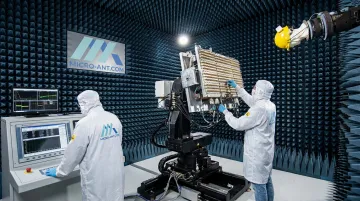
Simulation alone won't catch every issue. Rigorous near-field and far-field testing across the full operating frequency range is what separates a design that works in software from one that survives the field.
This is where sourcing matters. Micro-Ant, based in Jacksonville, Florida, has spent more than 20 years designing bespoke antennas for defense, aviation, maritime, and land applications.
The company's AS9100:2016 and ISO 9001:2015 certified facilities back that track record with hard capability:
- An in-house spherical/planar near-field test chamber spanning 750 MHz to 40 GHz
- Proprietary Ultra-Wide Band Ka Antenna System technology
- High-precision GNSS antenna designs built for rugged operating conditions
If you're designing a custom or ruggedized array, loop in an experienced antenna engineering partner early. Catching a coupling or thermal issue in the design phase costs far less than a redesign after certification testing fails.
Frequently Asked Questions
What are the advantages of array antennas?
Array antennas steer beams electronically, offer a smaller and lower-profile footprint, and degrade gracefully if a single element fails. They also support multiple simultaneous beams, unlike traditional mechanically steered antennas.
What is the difference between a phased array and a traditional antenna?
A traditional antenna radiates in a fixed pattern. A phased array uses multiple elements with controlled phase and amplitude to steer that pattern electronically, without moving any hardware.
How many elements are typically in an antenna array?
Element counts vary widely by application — a smartphone might use a handful, while large radar or satcom systems can use hundreds or even thousands of elements.
What industries use phased array antennas?
Defense, satellite communications, aviation, maritime, telecom (5G/6G), and automotive radar are the primary industries relying on phased array technology today.
Can antenna arrays be customized for specific applications?
Yes. Arrays can be tailored in frequency, size, ruggedization, and beamforming architecture. Micro-Ant designs each array around mission-specific requirements rather than relying on off-the-shelf specs.
What is beamforming in antenna arrays?
Beamforming is the process of adjusting phase and amplitude across an array's elements to focus and direct the combined radiation pattern toward a specific target or direction.