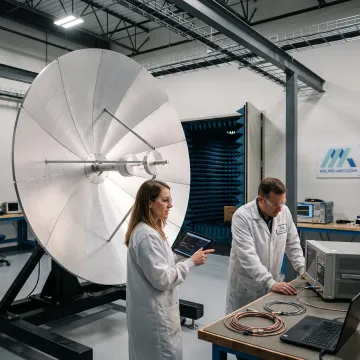
What is a reflector antenna used for?
A reflector antenna directs RF energy using a shaped reflecting surface and a feed assembly, helping achieve high gain, focused beams, and reliable long-distance communications. These antennas are commonly used for satellite communications, aerospace, maritime connectivity, fixed ground stations, defense systems, and specialized wireless applications. The required reflector geometry, feed design, frequency band, polarization, and environmental protection depend on the specific mission.
What types of reflector antennas can Micro-Ant manufacture?
Micro-Ant supports parabolic, segmented, Gregorian, and offset reflector antenna configurations, along with associated feeds and RF components. The team can also address reflectors, radomes, orthomode transducers, polarizers, and other integrated antenna hardware. Each program is evaluated around its operating band, gain and beam requirements, mechanical envelope, mounting approach, environmental conditions, and applicable customer or certification requirements.
Which frequency bands can reflector antennas support?
Micro-Ant designs custom antennas across microwave spectrum bands including UHF, L, S, C, X, Ku, and Ka. Its testing chambers support measurements from 750 MHz to 40 GHz, covering many satellite, aviation, maritime, and defense use cases. Band selection affects reflector size, feed architecture, materials, tolerances, polarization, and testing requirements, so it should be defined early in the engineering process.
Can Micro-Ant develop a custom reflector antenna from concept?
Yes. Micro-Ant provides bespoke antenna design and manufacturing, supporting programs from early concepts through prototype development, production transition, and final characterization. Engineering work can address reflector geometry, feeds, RF integration, mechanical interfaces, packaging, and intended operating environments. The company also contract-manufactures qualified third-party designs when they meet the required quality gating and production requirements.
How is reflector antenna performance tested?
Reflector antenna performance can be characterized in Micro-Ant’s spherical and planar near-field chambers. Testing evaluates relevant electrical behavior, such as radiation pattern, gain, beam characteristics, polarization, and other customer-defined parameters. The facility tests passive antennas, radomes, reflectors, feeds, OMTs, and polarizers. Programs receive documented reports, with custom reporting formats available when a specific certification or system integration workflow requires them.
What production volumes can Micro-Ant support?
Micro-Ant supports custom product runs ranging from five units to more than 200,000 units per year. The appropriate manufacturing approach depends on design maturity, component availability, test requirements, and forecasted demand. Its vertically integrated production capabilities include precision machining, assembly, RF integration, environmental screening, and final characterization, helping customers move qualified designs from prototype quantities into larger-scale production without unnecessary handoffs.
Are Micro-Ant manufacturing processes certified?
Yes. Micro-Ant operates under AS9100:2016 aerospace quality management and ISO 9001:2015 quality systems. These frameworks support controlled processes, traceability, documentation, inspection, and continuous quality management across antenna production. In addition, every product is 100% tested in production to verify electrical and mechanical performance against applicable requirements before final delivery.
How long should I plan for antenna testing or production?
Timing depends on antenna complexity, design readiness, fixture requirements, test scope, materials, certification needs, and production quantity. For testing, Micro-Ant recommends planning approximately four weeks, particularly when specialized setup or detailed reporting is needed. A well-defined requirements package, including frequency band, performance targets, interfaces, environmental conditions, and documentation needs, helps establish an accurate schedule for engineering, testing, or manufacturing.