Introduction
Picture a satellite terminal that needs to hop between Intelsat, Eutelsat, and SES without swapping a single component. Or a SIGINT platform scanning an unknown, rapidly shifting slice of spectrum where the threat frequency isn't known until the moment it appears.
Neither scenario tolerates a single-frequency antenna. Both need something that performs consistently across a huge swath of spectrum.
That's a wideband antenna: one that maintains stable impedance, gain, and radiation pattern across a frequency range far wider than a standard, single-band design.
The catch? Marketing teams throw "wideband" around loosely, often interchanging it with "broadband" or "ultra-wideband" in ways that confuse engineers trying to spec real hardware.
This article breaks down the technical definition, how these antennas actually achieve their range, how they differ from narrowband and UWB designs, and where they show up in real deployments.
Key Takeaways
- Wideband antennas maintain steady gain, impedance, and pattern across ranges exceeding one octave
- Achieved via impedance-matching networks or frequency-independent geometries like spirals and log-periodic arrays
- Classification matters: wideband, ultra-wideband (UWB), and broadband are distinct, not interchangeable marketing terms
- Common applications include SIGINT/EW, SATCOM roaming, public safety, and multi-constellation GNSS
What Is a Wideband Antenna? Definition and Technical Basics
The IEEE defines antenna bandwidth as the frequency range over which performance "conforms to a specified standard" — measured against gain, impedance, polarization, or pattern criteria. Notably, IEEE's standard antenna terminology doesn't set a numeric ratio for what qualifies as "wideband." That's a rule of thumb the industry adopted, not a codified spec.
The common convention: bandwidths exceeding one octave (a 2:1 ratio between high and low frequency, roughly 66.7% fractional bandwidth) get labeled wideband. Narrowband antennas typically stay under that threshold.
Real designs stretch far beyond a single octave:
| Antenna | Frequency Range | Ratio |
|---|---|---|
| Conical log spiral (ETS-Lindgren 3102) | 1–10 GHz | 10:1 |
| Multi-octave spiral (Q-par) | 1–18 GHz | 18:1 |
| Double-ridged horn (R&S HF907) | 0.8–18 GHz | 22.5:1 |
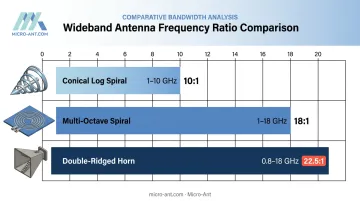
From communications theory, there's a related but separate concept: coherence bandwidth. That's the frequency range over which a propagation channel behaves as approximately flat. Wideband signals often span more than the channel's coherence bandwidth, which introduces frequency-selective fading. That fading originates in the channel itself, separate from antenna performance.
Here's where the confusion creeps in. "Wideband," "broadband," and "ultra-wideband" get used interchangeably in spec sheets and sales decks. Technically, the distinction hinges on whether both the passband and the radiation pattern/gain stay stable across the range, not just the impedance match.
Why "Wideband" Depends on Context
A simple dipole hitting 50% fractional bandwidth might earn the "wideband" label within its category. Meanwhile, a frequency-independent spiral achieving 1000%+ bandwidth carries the same term.
Classification depends on:
- The baseline antenna type (dipole vs. frequency-independent geometry)
- The application domain's expectations
- Whether the comparison is to a narrowband version of the same design
How Wideband Antennas Achieve Their Wide Frequency Range
Two fundamentally different approaches get an antenna to "wideband" status.
Impedance matching networks. Engineers extend a simple radiator's natural bandwidth using RLC matching circuits, thicker conductors, or resonant transmission-line sections. This works, but it runs into a hard physical limit: the Bode-Fano bound.
You cannot achieve arbitrarily broad, lossless matching to a reactive load — wider match typically means added loss or reduced efficiency.
Frequency-independent geometries. Spiral, log-periodic, and sinuous designs sidestep the matching problem entirely.
Their conductor geometry is defined by angles rather than fixed lengths, so the "active" radiating region shifts with wavelength as frequency changes. This is Rumsey's principle in action, and it's why a well-designed spiral can span a 10:1 or greater ratio without a tuning network.
Every wideband approach carries tradeoffs:
- Larger physical size: low-frequency cutoff is set by the largest dimension
- Reduced peak gain at certain points in the band compared to a narrowband equivalent
- More complex feed and matching networks, especially near the high-frequency cutoff where fabrication tolerances matter most
Because performance claims mean nothing without measurement, full-band validation is non-negotiable. That means VSWR, return loss, and pattern consistency checked across the entire operating range, not just at a center frequency.
Micro-Ant runs this validation in-house using spherical and planar near-field test chambers spanning 750 MHz to 40 GHz. This lets engineers confirm gain flatness and pattern integrity before a design ships.
One more wrinkle: wideband antennas expose receivers to a broader slice of the noise floor. More instantaneous bandwidth means more integrated noise and more potential interferers reaching the front end. That's why wideband systems typically need more sophisticated filtering to protect signal-to-interference-plus-noise ratio (SINR).
Wideband vs. Narrowband vs. Ultra-Wideband: Key Differences
These three terms get lumped together constantly, but they answer different engineering questions.
Spectrum usage differs sharply. Narrowband antennas operate within tightly channelized spectrum (think a single cellular band). Wideband antennas cover a much larger continuous chunk, often spanning multiple traditional band designations.
Data capacity follows a similar logic. Wideband systems generally support higher throughput because they can occupy more instantaneous bandwidth, while narrowband links are engineered for reliability over raw capacity.
Interference exposure flips the advantage. Narrowband systems benefit from tighter channel-to-channel isolation and lower interference probability. Wideband systems need more advanced filtering since they're exposed to noise and blockers across a wider slice of spectrum.
Power requirements trend higher for wideband channels, since signal strength often needs a boost to overcome weakening across the widened frequency range.
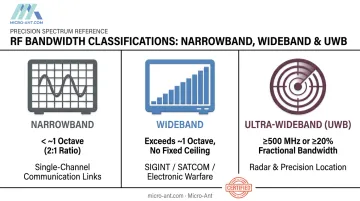
Then there's Ultra-Wideband (UWB) — a formally regulated subclass, not a synonym for "very wideband." The FCC defines UWB by a specific threshold: fractional bandwidth of at least 20%, or absolute bandwidth of at least 500 MHz, measured at the 10 dB-below-peak emission points.
| Classification | Bandwidth Threshold | Typical Use Case |
|---|---|---|
| Narrowband | Under ~1 octave (2:1) | Single-channel voice/data links |
| Wideband | Exceeds ~1 octave; no fixed ceiling | SIGINT, SATCOM roaming, EW |
| Ultra-Wideband (UWB) | ≥500 MHz or ≥20% fractional bandwidth | Radar, precision location, short-range sensing |
Common Types of Wideband Antenna Designs
Three geometries dominate wideband engineering, each solving the bandwidth problem differently.
Log-Periodic Dipole Arrays (LPDAs)
These antennas use a series of scaled dipole elements. As frequency shifts, the "active" element pair moves along the array, keeping performance consistent across a multi-octave sweep. LPDAs are directional and typically linearly polarized—a good fit for spectrum monitoring and EMC testing.
Spiral Antennas
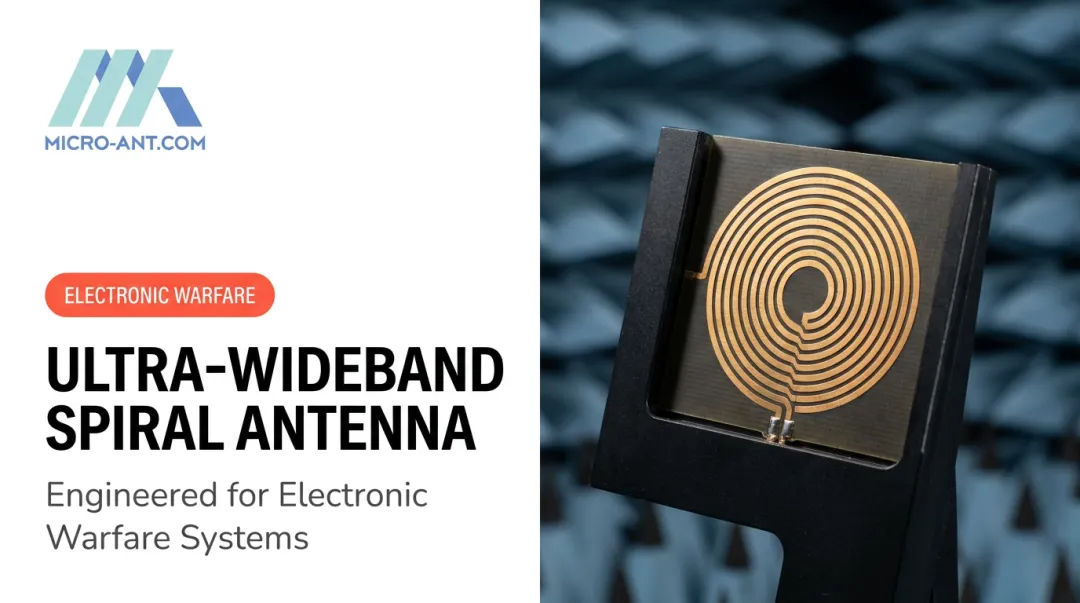
Spiral designs (such as Archimedean, log-spiral, and sinuous) rely on continuously expanding conductor geometry rather than discrete elements. This allows the active region to scale with wavelength, helping these designs achieve impressive 10:1 bandwidth ratios or better.
Spiral versions tend toward circular polarization, while sinuous variants can offer dual polarization, which is critical for direction-finding and ELINT work.
Vivaldi, Notch, and Horn Antennas
These antennas, including ridged horns, use tapered-slot or ridge-loaded geometry to launch a traveling wave across a broad aperture. Vivaldi designs are planar and array-friendly, making them common in radar and through-wall sensing.
Ridged horns trade some size and weight for high directive gain. A well-known commercial example, the R&S HF907, spans a bandwidth ratio of nearly 23:1.
Real-World Applications of Wideband Antennas
SIGINT, ISR, and electronic warfare missions can't predict which frequency a threat signal will appear on. A wideband front end lets a receiver scan and characterize unknown or rapidly changing emissions without physically swapping hardware — critical when revisit time and missed short-duration signals directly affect mission outcomes.
SATCOM roaming presents a similar challenge in a commercial context. A terminal built for one operator's Ka-band allocation can't simply switch to another network's frequency plan. NASA proved out this exact concept, demonstrating a wideband terminal capable of roaming between government and commercial Ka-band relay networks.
Micro-Ant's Ultra-Wide Band (3.5 GHz) Ka Antenna System applies the same principle, engineered to maintain connectivity across extended Ka-band frequencies as terminals move between networks like Intelsat, Eutelsat, and SES.
Public safety, multi-band cellular/Wi-Fi, and multi-constellation GNSS benefit in a more practical way: a single wideband antenna replaces a stack of narrowband units. Fewer antennas means less weight, less mounting complexity, and fewer points of failure, a meaningful advantage on vehicles, aircraft, and vessels where space is already tight.
Choosing the Right Wideband Antenna for Your Application
Picking a wideband antenna isn't just about matching a frequency range on a spec sheet. Consider:
- Required bandwidth ratio: Does your mission need 3:1, 10:1, or beyond?
- Gain flatness: Watch for performance dips at the band edges that could hurt your link budget.
- Size and weight constraints: Lower frequency cutoffs demand larger apertures.
- Environmental ruggedness: Shock, vibration, temperature extremes, and salt fog all take a toll in maritime deployments.
Off-the-shelf wideband antennas work for lab testing and general-purpose monitoring. Defense, aviation, and maritime environments rarely fit that mold, though. Mission-specific constraints (mounting geometry, radome integration, EMI coexistence with adjacent systems) usually push the requirement toward a bespoke design.
Micro-Ant has spent over 20 years building custom wideband antennas for exactly these demanding environments, backed by AS9100:2016 and ISO 9001:2015 certified manufacturing and in-house testing facilities. If your application needs performance validated across the full band rather than a single center frequency, Micro-Ant's engineering team can help scope a solution.

Frequently Asked Questions
What is the difference between wideband and broadband antennas?
Broadband generally describes a wide passband without requiring stable gain or pattern across it. Wideband implies the antenna's operating characteristics , including impedance, gain, and pattern, stay consistent throughout that range.
What is considered a wideband frequency range?
Bandwidths exceeding roughly one octave (a 2:1 ratio) are typically classified as wideband. The exact threshold varies depending on antenna type and application.
What are examples of wideband antennas?
Spiral, log-periodic, Vivaldi/notch, and impedance-matched dipole antennas are all common wideband designs, each achieving their range through different geometries or matching techniques.
Is Wi-Fi considered wideband or narrowband?
Wi-Fi antennas are generally considered wideband, since they need consistent performance across 2.4 GHz, 5 GHz, and 6 GHz bands rather than a single narrow channel.
What is the difference between wideband and ultra-wideband (UWB)?
UWB has a formal regulatory threshold, typically over 500 MHz of bandwidth or more than 20% fractional bandwidth. It's a specific technical subclass within the broader wideband category.
Why use a wideband antenna instead of multiple narrowband antennas?
A single wideband antenna reduces size, weight, and complexity while still covering multiple bands or operators. That's especially valuable in defense and SATCOM roaming applications where space and reliability both matter.