Introduction
Inside tactical radios, airborne SATCOM terminals, cellular base stations, and rugged maritime communication systems, a diversity antenna handles one job: keeping a signal alive when the environment works against it.
Multipath fading (the reflections, bounces, and phase cancellations that happen indoors, in cities, or on a moving vehicle) causes dropouts that a single antenna can't recover from.
As spectrum gets more congested and platforms get more mobile, engineers are leaning harder on multi-antenna designs. The phased array antenna market alone was valued at $3.83 billion in 2025 and is projected to reach $5.88 billion by 2030, a sign of how central diversity and multi-antenna architectures have become to reliable signal performance.
Yet many buyers still treat diversity antennas as a black box. This guide breaks down exactly how they work, not just the textbook definition.
Key Takeaways
- Diversity antennas use multiple antennas to defeat multipath fading and stabilize the link.
- The system continuously compares, switches, or combines signals based on real-time quality.
- Main types: spatial, pattern, polarization, and transmit/receive diversity.
- Used everywhere from wireless mics to ruggedized defense and satcom terminals.
- Antenna spacing and diversity type directly determine dropout rates.
What Is a Diversity Antenna?
A diversity antenna system uses two or more antennas, paired with receiver logic, to improve the reliability of a wireless link. Multiple antennas offer multiple "observations" of the same signal, so the receiver always has a good copy to work with.
Why it exists: single-antenna systems suffer deep fades. When a reflected signal path arrives out of phase with the direct path, the two can destructively cancel each other, sharply reducing received power. This happens constantly in urban, indoor, or obstructed environments where signals bounce off walls, structures, and terrain.
What Diversity Antennas Are Not
A diversity antenna differs from a higher-gain antenna, MIMO, and phased arrays, even though all three use multiple antennas:
- Diversity uses multiple copies of the same signal to improve reliability.
- MIMO/spatial multiplexing uses multiple independent data streams to increase throughput.
- Phased arrays/beamforming steer a single beam electronically rather than selecting between redundant signal paths.
Despite the rise of AESA and beamforming, diversity remains a cost-effective, widely deployed solution because it solves a narrower, well-defined problem: keeping one link stable, without the cost or complexity of full array processing.
The Four Main Types
- Spatial diversity: physically separated antennas create independently fading paths.
- Pattern (angle) diversity uses directional antennas to capture signals arriving from different angles.
- Polarization diversity: vertical and horizontal elements reduce correlation without needing physical separation.
- Transmit/receive diversity combines multiple antennas on either end of the link to improve signal-to-noise ratio.
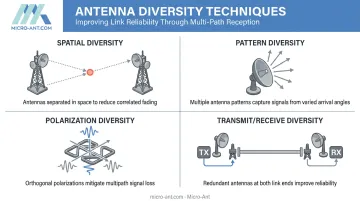
Each type feeds into one of three processing approaches: switching, selecting, or combining. That's where the real engineering happens.
How Does a Diversity Antenna Work?
A diversity antenna runs a continuous loop: reception, evaluation, control, and output. None of it is manual. It happens automatically, dozens or hundreds of times per second, as the environment changes.
Signal Reception (Initiation)
Multiple antennas, separated physically or by characteristic (polarization, pattern), pick up the same incoming signal simultaneously. This isn't triggered by an operator. It runs constantly as movement, obstacles, and weather shift the propagation environment.
The most common design bottleneck happens right here: antenna spacing. If the antennas sit too close together, both can fade at the same time, defeating the whole purpose of having two in the first place.
Signal Evaluation & Switching (Core Operation)
Once both antennas have a signal, the receiver has to decide what to do with it. There are three approaches:
- Switching: stay on one antenna until quality drops below a threshold, then jump to the other
- Selecting: compare both branches first, then route the stronger one to the receiver
- Combining: blend both signals together, either with equal weighting (Equal-Gain Combining) or weighted by signal quality (Maximal-Ratio Combining)
Receiver circuitry compares signal strength or signal-to-noise ratio across antennas in real time to make this call. Performance here comes down to switching speed and power consumption: a system that reacts slowly to a fading signal will still drop the link, even with two antennas.
Control & Monitoring (Regulation)
Underneath switching or combining sits a comparator or threshold-based control mechanism. It continuously monitors signal level on each branch and decides when a switch or combining adjustment is needed.
This stage matters because it's what prevents a complete signal loss during a deep fade. On moving platforms such as aircraft, vehicles, and ships, this constant monitoring is the difference between a stable connection and a dropped call.
Output & Result
The end result is a single, clean, continuous signal handed off to the demodulator, decoder, or downstream data processing unit. The receiver never sees the fading happening on the individual branches. It only sees the recovered output.
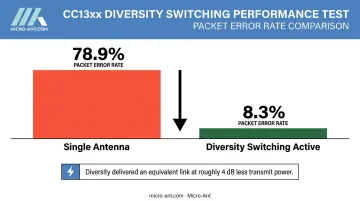
Published field data backs up why this matters. In Texas Instruments' CC13xx radiated diversity test, a single antenna alone produced a 78.9% packet error rate after the test board was rotated 90 degrees. With diversity switching active, that dropped to 8.3%.
A separate moving-transmitter scenario told the same story. Diversity cut the packet error rate roughly in half compared to either fixed antenna alone, and the same test found diversity delivered an equivalent link at roughly 4 dB less transmit power.
Where Are Diversity Antennas Used?
Diversity antennas show up anywhere a signal has to survive reflections, movement, or interference:
- Wireless microphones and pro audio — predictive diversity receivers monitor RF-level trends and switch before an anticipated dropout
- Wi-Fi networking — routers favor an antenna in a defined strong-signal region and reconsider the branch if packet loss appears
- Cellular base stations — polarization diversity lets two orthogonal branches share one antenna housing instead of two separate ones
- Defense, aviation, and maritime satcom — ruggedized terminals often need to roam across multiple frequency bands and satellite operators while resisting shock, vibration, and weather
These use cases share three traits:
- Heavy multipath — urban, indoor, or obstructed environments
- Platform mobility — ships, aircraft, or vehicles in motion
- Congested spectrum — overlapping frequency use nearby
Consumer Wi-Fi usually gets by with simple two-antenna switching. Defense and satcom platforms demand more: multi-band roaming, wide operating temperature ranges, and validated performance under vibration and shock that a catalog antenna was never designed to survive. Micro-Ant builds antennas validated against shock, vibration, and multi-band roaming before they ship.
Choosing the Right Diversity Antenna Solution
Off-the-shelf diversity antennas were built for a general use case. Defense, satcom, and maritime platforms rarely fit one. Frequency range, ruggedization, and multi-band roaming requirements on these platforms often exceed what a standard catalog product can deliver.
That's where custom antenna engineering earns its place. Bespoke design lets spacing, polarization, and switching or combining logic get optimized around a specific mission profile, rather than forcing the mission to adapt to a generic antenna.
Micro-Ant has spent over 20 years building custom antenna systems for defense, satellite communications, aviation, and maritime platforms out of its Jacksonville, Florida facility. A few relevant capabilities:
- Ultra-Wide Band Ka Antenna System, operating at 3.5 GHz, earned a "Most Innovative" award from the Satcoms Innovation Group for enabling multi-operator roaming on modern satcom terminals
- Engineering spans the full microwave spectrum, from UHF through Ka-band, giving flexibility across spatial, polarization, and pattern diversity configurations
- In-house near-field testing chambers covering 750 MHz to 40 GHz validate antenna performance before a system leaves the facility
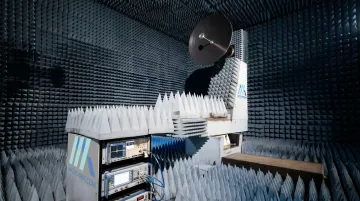
On these platforms, a dropped link can mean mission failure. That's why validated, purpose-built engineering matters more than a spec sheet.
Conclusion
A diversity antenna's job comes down to one continuous loop: monitor multipath conditions, then switch or combine signals fast enough to keep the link stable. Understanding that loop, not just the marketing term, is what separates a good antenna spacing decision from a costly mismatch.
Whether you're speccing a Wi-Fi deployment or a satcom terminal built for rough seas, that understanding shapes which diversity type and spacing—and which manufacturing partner, like Micro-Ant, gets the job done.
Frequently Asked Questions
What is antenna diversity?
Antenna diversity is the use of two or more antennas to reduce multipath fading and improve the reliability of a wireless link. It works by giving the receiver multiple independent chances to capture a usable signal.
What is a diversity antenna connection?
A diversity antenna connects to a receiver through dual antenna ports, with internal circuitry that switches between or combines the two signal paths. The receiver processes both inputs and outputs a single, stable signal.
How far apart should diversity antennas be?
For spatial diversity, Sennheiser recommends at least a quarter wavelength, with a half to full wavelength considered ideal. Higher frequencies allow closer spacing since wavelength shrinks.
What are the different types of antenna diversity?
The four main types are spatial (physical separation), pattern (different arrival angles), polarization (vertical vs. horizontal), and transmit/receive diversity (multiple antennas on either end of the link).
Is antenna diversity the same as MIMO?
No. Diversity focuses on link reliability by using redundant copies of the same signal. MIMO can also use multiple antennas, but often for spatial multiplexing, sending separate data streams to increase throughput rather than reliability.
Do I need a diversity antenna for my application?
If your application faces multipath interference, mobility, or strict reliability requirements, such as satcom, defense, or maritime communications, diversity is worth serious consideration. It's a proven, cost-effective way to reduce dropouts.