Introduction
Ultra-wideband technology lives a double life. It's the quiet feature letting your iPhone find an AirTag buried in couch cushions or unlock your car without a key fob.
That same signal also powers radar imaging, buried-object detection, and satellite roaming systems trusted by defense and aerospace programs.
This range causes confusion. Engineers and procurement teams often lump UWB in with generic broadband radio, missing what makes it different, how it's regulated, and why antenna selection matters.
This article breaks down what a UWB antenna actually is, the technical characteristics that define it, the design types available, and how to choose or engineer one for demanding applications.
Key Takeaways
- UWB is defined by 500 MHz or 20% fractional bandwidth at -10 dB, not by center frequency.
- Positioning accuracy reaches 0.03 to 0.30 meters, outperforming Wi-Fi and Bluetooth in consistency.
- Antenna type (directional vs. omnidirectional) must match the mission before frequency band matters.
- Mission-critical UWB and Ka-band systems demand custom engineering, not off-the-shelf parts.
What Is an Ultra-Wideband Antenna?
The FCC defines ultra-wideband precisely: a fractional bandwidth of 0.20 or greater, or an absolute bandwidth of 500 MHz or more, measured at the -10 dB points of the complete radiating system, antenna included. This is stated explicitly in 47 CFR Part 15 Subpart F. A standard narrowband antenna, by contrast, might occupy just a few megahertz around its center frequency.
That distinction matters more than most engineers assume. Bandwidth, not carrier frequency, is what separates UWB from every other radio category.
A Longer History Than You'd Expect
UWB antenna design isn't new. Historical research traces wide-aperture radiating structures back to Oliver Lodge's 1898 patent, which described spherical, bow-tie, and biconical dipole shapes. Those geometries still echo in today's printed monopole designs used in smartphones and IoT tags.
Pulses, Not Waves
Conventional radio varies the amplitude, frequency, or phase of a continuous sine wave. UWB does something different: it transmits information as short-duration pulses spread across a wide slice of spectrum.
- Enables pulse-position modulation for data encoding
- Allows very low transmit power per pulse
- Spreads energy so thinly that UWB can coexist with other allocated services
One practical result: a single UWB antenna can often cover functions that once required multiple narrowband antennas, cutting device footprint. Published antenna engineering research confirms the form-factor benefit, though a precise interference-reduction percentage isn't well established in the literature, so treat any specific number you see with some skepticism.
Two Radiation Pattern Families
Every UWB antenna falls into one of two camps:
- Directional: concentrates energy toward a target, ideal for radar and point-to-point links
- Omnidirectional: radiates roughly evenly in all directions, suited to mobile and portable devices
This split determines almost everything downstream in antenna selection, a topic covered in more depth further down.
Micro-Ant's award-winning Ultra-Wide Band (3.5 GHz) Ka Antenna System illustrates a related but distinct application of wideband engineering: extending usable frequency coverage within the Ka-band so satellite terminals can roam across multiple operator networks without swapping hardware.
This satcom use of "ultra-wideband" refers to broad frequency coverage engineering, not the short-pulse, low-power radio defined under FCC Part 15. That's a useful distinction for anyone comparing consumer UWB chips to satcom antenna systems.
 for satellite communications](https://file-host.link/website/micro-ant-uwpncc/assets/blog-images/a7b08296-5247-46af-a692-6b5b340363bb/1785161315053003_8d7ec8c4c9964216b637aaa936afb94d/360.webp)
How UWB Antennas Work: Range, Frequency & Key Characteristics
Spectrum Allocation Varies by Region
The FCC allocates 3.1–10.6 GHz for hand-held UWB devices in the US. Europe's ECC takes a segmented approach instead, dividing operation across 3.1–4.8 GHz, 6–8.5 GHz, and 8.5–9 GHz, each with different power and mitigation requirements. Anyone designing for global markets needs to treat these as separate regulatory conditions, not one unified band.
Range Is a Trade-Off, Not a Fixed Number
There's no single UWB range figure. Published ITU examples illustrate just how much it varies by application:
- 4–10 meters for very high-throughput links (around 500 Mbit/s)
- About 10 meters at 100 Mbit/s
- Under 100 meters at lower data rates (roughly 40 Mbit/s)
- Around 20 meters for vehicular radar and select ground-penetrating radar devices
The pattern here is consistent according to the ITU-R SM.1755-0 report: higher precision and lower power come at the cost of distance. UWB trades distance for precision, built to deliver exact short-range measurements rather than compete with long-range radio systems.
Accuracy: Where UWB Actually Wins
This is UWB's real differentiator. A 2023 peer-reviewed indoor localization review found UWB positioning errors of 0.03 to 0.30 meters, according to research published on PMC.
Wi-Fi posted 0.09 to 7.60 meters and Bluetooth Low Energy landed at 0.10 to 4.92 meters in the same review. Wi-Fi and BLE can occasionally match UWB under ideal conditions, but UWB's results stay consistently tighter across methods and environments.
Positioning Techniques Enabled by the Antenna
UWB antennas support several ranging methods, each suited to different use cases:
- Time of Flight (ToF): Distance calculated from signal travel time
- Two-Way Ranging (TWR): Bidirectional packet exchange derives round-trip distance
- Time Difference of Arrival (TDoA): Position calculated from arrival-time differences across synchronized receivers
- Phase/Angle of Arrival (PDoA/AoA): Direction derived from phase differences across an antenna array
Built to Resist Interference
Because UWB pulses are so short, they carry high temporal resolution. Reflected signal paths in cluttered environments (think ship interiors, aircraft cabins, or dense urban terrain) arrive distinctly enough that the receiver can separate them instead of merging into one blurred, unusable signal. This doesn't eliminate multipath error entirely, but it reduces it dramatically compared to narrowband systems.
The FCC's power spectral density limit of -41.3 dBm/MHz caps average emissions and directly shapes antenna design. Engineers have to hit performance targets within that ceiling, which is part of why UWB antenna design is rarely a plug-and-play exercise.
Types of UWB Antenna Designs
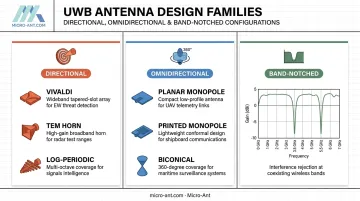
Directional UWB Antennas
Directional designs concentrate energy toward a target rather than spreading it broadly. This matters for radar, imaging, and point-to-point links where signal confinement improves resolution and reduces wasted power. A tighter beamwidth also extends usable range for a given transmit power, which is why these designs dominate ground-penetrating radar and through-wall imaging systems.
- Vivaldi antennas — tapered slot geometry supports through-wall imaging and high-gain radar applications
- TEM horn antennas — used in hand-held and vehicle-mounted ground-penetrating radar for buried-object detection
- Log-periodic antennas — broadband directional patterns with stable gain, common in EMC/EMI testing and surveillance systems
Omnidirectional UWB Antennas
Mobile devices and indoor systems need coverage in every direction since users and devices move constantly. This omnidirectional pattern matters most in crowded environments, such as offices and warehouses, where devices connect from any angle without manual alignment.
- Planar monopole antennas — compact designs (some as small as 20 x 28 mm) covering broad frequency ranges with roughly omnidirectional H-plane patterns
- Printed monopole antennas — the go-to choice for smartphones, tags, and IoT sensors where board space is limited
- Biconical antennas — provide flat, omnidirectional response across the UWB range, widely used in EMC/EMI and electronic warfare test setups
Band-Notched UWB Antennas
UWB spectrum overlaps existing WLAN and WiMAX allocations. Band-notched designs solve this by engineering rejection notches, typically near 3.5 GHz and 5.5 GHz, directly into the antenna using resonant stubs or partial ground planes. The result: the antenna still spans its full UWB range but suppresses the specific frequencies where interference would otherwise occur.
Real-World Applications of UWB Antennas
Consumer and mobile devices started the UWB conversation for most people. Apple's AirTag and Samsung's Galaxy SmartTag use UWB chips for precision finding, while digital car key systems rely on UWB's secure ranging to unlock vehicles without traditional key fobs.
Autonomous vehicles and robotics push UWB further. Field trials measuring vehicle-to-infrastructure and vehicle-to-vehicle positioning have demonstrated decimeter-level accuracy under favorable conditions, according to research published in MDPI's Remote Sensing journal. This precision supports collision avoidance and cooperative localization between vehicles and infrastructure.
That same need for precision carries into higher-stakes settings. Defense and intelligence applications lean on directional UWB designs:
- Through-wall radar imaging for tactical situational awareness
- Buried-object and IED detection using MIMO antenna arrangements
- Secure, difficult-to-intercept tactical communications research
Satellite communications and aerospace represent a different flavor of "ultra-wideband" engineering. Micro-Ant's Ultra-Wide Band Ka Antenna System extends usable frequency coverage so terminals can roam across multiple satellite operators without hardware swaps. That flexibility matters for programs juggling operators like Intelsat, Inmarsat, and Iridium.
Not every application looks skyward, though. Maritime and rugged land environments demand interference resistance, where metal structures and cluttered RF conditions create constant multipath challenges.
Industrial IoT and logistics operations round out the picture. Warehouses and factories use UWB real-time location systems (RTLS) to track assets with sub-meter accuracy across crowded floor plans.
Key Benefits of UWB Technology
UWB's advantages come directly from its pulse-based architecture:
- Efficient short-range data: Standards-compliant implementations achieve data rates from roughly 850 kbps to 6.8 Mbps, with lower rates extending ranging coverage
- Low power draw: Some compliant sensing implementations operate in the single-digit milliwatt range, though actual battery impact depends heavily on device duty cycle
- Space savings: Consolidating multiple narrowband antennas into one UWB solution reduces device footprint and simplifies RF design
- Relay-attack resistance: Precise time-of-flight measurement prevents attackers from faking distance without adding detectable delay, the basis for the Car Connectivity Consortium's Digital Key standard
Caveat: UWB improves ranging integrity, but secure authentication and proper protocol implementation still matter. It reduces relay risk without eliminating every attack vector on its own.
Turning these advantages into a working antenna means balancing frequency, form factor, and power constraints—the custom engineering Micro-Ant applies when building UWB systems for defense, aviation, and maritime platforms.
Choosing the Right UWB Antenna for Your Application
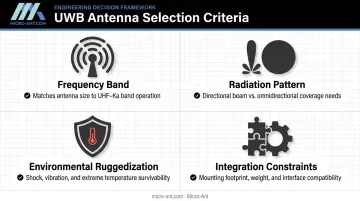
Selecting a UWB antenna isn't just about picking a bandwidth. The right choice depends on:
- Frequency band: US, European, or application-specific allocations each carry different power and mitigation rules
- Radiation pattern: directional for radar and imaging, omnidirectional for mobile and portable use
- Environmental ruggedization: shock, vibration, and temperature tolerance for maritime, airborne, or field deployments
- Integration constraints: available space, mounting geometry, and coexistence with nearby antennas
For mission-critical programs in defense, aerospace, or satcom, off-the-shelf parts rarely meet spec. This is where custom engineering and rigorous testing earn their keep. Micro-Ant's Jacksonville, Florida facility operates under ISO 9001:2015 and AS9100:2016 certification, with spherical and planar near-field testing chambers supporting measurement across a broad frequency range.
Working with a US-based bespoke antenna manufacturer that designs, builds, and tests in-house shortens testing turnaround. It also reduces the coordination overhead of juggling multiple vendors, a real advantage for programs where schedule slippage carries operational consequences.
Frequently Asked Questions
What is an ultra wide band antenna?
A UWB antenna radiates signals meeting the FCC/ITU bandwidth threshold: 500 MHz or greater, or 20% fractional bandwidth. It's built for short-range, high-precision, low-power communication rather than long-distance broadcast.
What is the range of an ultra wide band antenna?
Range varies by application, from a few centimeters for secure unlocking to roughly 10-100 meters for tracking, radar, and vehicular use cases. UWB trades distance for precision and low power rather than maximizing range.
What certifications should I look for in a UWB antenna manufacturer for defense or aerospace programs?
Look for manufacturers holding AS9100 and ISO 9001 certifications, which validate quality control and traceability for mission-critical systems. In-house environmental and RF testing capabilities provide added assurance for demanding aerospace and defense programs.
How does UWB differ from Bluetooth and Wi-Fi?
UWB uses short pulses across wide bandwidth to measure precise time-of-flight, achieving centimeter-level accuracy. Bluetooth and Wi-Fi typically rely on signal strength, which is less consistent for fine-grained positioning.
What industries rely on UWB antenna technology?
Defense, aerospace, satellite communications, maritime, automotive, and industrial IoT all depend on UWB for precision positioning and secure ranging. This same technology also delivers interference-resistant communication in demanding environments.
Can UWB antennas be customized for specific frequency bands or environments?
Yes. Bespoke UWB antenna design is common for specialized frequency requirements and ruggedization needs, especially under tight integration constraints. Micro-Ant engineers custom UWB and Ka-band systems for exactly these scenarios.