Yet many engineers and procurement teams still mix up S-band with its neighbors, L-band and C-band. That confusion isn't harmless. Picking the wrong frequency band during antenna selection can mean redesigns, missed launch windows, or a system that simply doesn't perform in the field.
This guide breaks down what S-band actually means, how S-band antennas work, where they show up in real-world systems, and what to look for when you're specifying one for a mission-critical application.
Key Takeaways
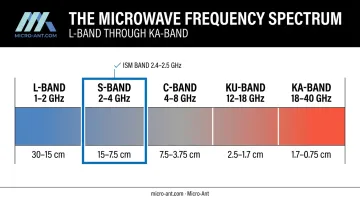
- S-band spans 2-4 GHz, sitting between L-band and C-band on the IEEE spectrum chart.
- S-band offers a practical middle ground: better rain penetration than Ku/Ka, more bandwidth than L-band.
- NASA relies on S-band for Space Shuttle, ISS, and TDRSS links.
- Weather radar (NEXRAD), airport surveillance radar, and defense telemetry all depend on S-band.
- Choosing the right antenna type and design partner matters as much as choosing the right band.
What Is an S-Band Antenna?
An S-band antenna is engineered to transmit and receive signals efficiently within the 2 to 4 GHz range, as defined by IEEE Standard 521-2019. NASA's electromagnetic spectrum reference pairs this range with wavelengths of roughly 15 to 7.5 cm, giving engineers a practical starting point for antenna sizing and design.
Within that band, specific slices are reserved for satellite use. The U.S. frequency table allocates 2200-2290 MHz for space-operation and Earth-exploration downlinks, with 2290-2300 MHz carved out for deep-space missions. These aren't interchangeable blocks of spectrum. Each has its own licensing basis and service designation, so specifying the wrong sub-band can create regulatory headaches down the line.
Where S-Band Sits in the Spectrum
S-band sits directly above L-band (1-2 GHz, home to GPS) and below C-band (4-8 GHz). It also crosses the traditional UHF/SHF boundary at 3.0 GHz, which is part of why engineers sometimes debate exactly where S-band "belongs" in older classification systems.
Why S-Band Handles Weather Better
That spectral position isn't just a classification detail; it directly affects performance when weather turns severe. Higher-frequency bands like Ku and Ka suffer more from rain fade, atmospheric moisture, and fog attenuation. S-band's longer wavelength pushes through these conditions with far less signal loss, making it a dependable choice for links that simply cannot afford downtime during a storm.
NASA's own history illustrates this reliability. The Space Shuttle used S-band for direct-Earth and TDRSS communications throughout launch and entry. Today's TDRSS satellites still provide S-band multiple-access services supporting the International Space Station.
At Micro-Ant, engineering teams have spent over two decades solving frequency-specific design puzzles like these, building bespoke S-band and multi-band antennas that balance gain, bandwidth, and physical footprint for each customer's mission.
How S-Band Antennas Work
Every antenna performs one fundamental job: convert electromagnetic waves into electrical signals on receive, and electrical signals into radiated waves on transmit. An S-band antenna is simply tuned to do this efficiently across the 2-4 GHz window, no more, no less.
Engineers reach for several physical form factors depending on the mission:
- Parabolic reflectors for high-gain, long-range links
- Helical antennas for circular polarization in a compact package
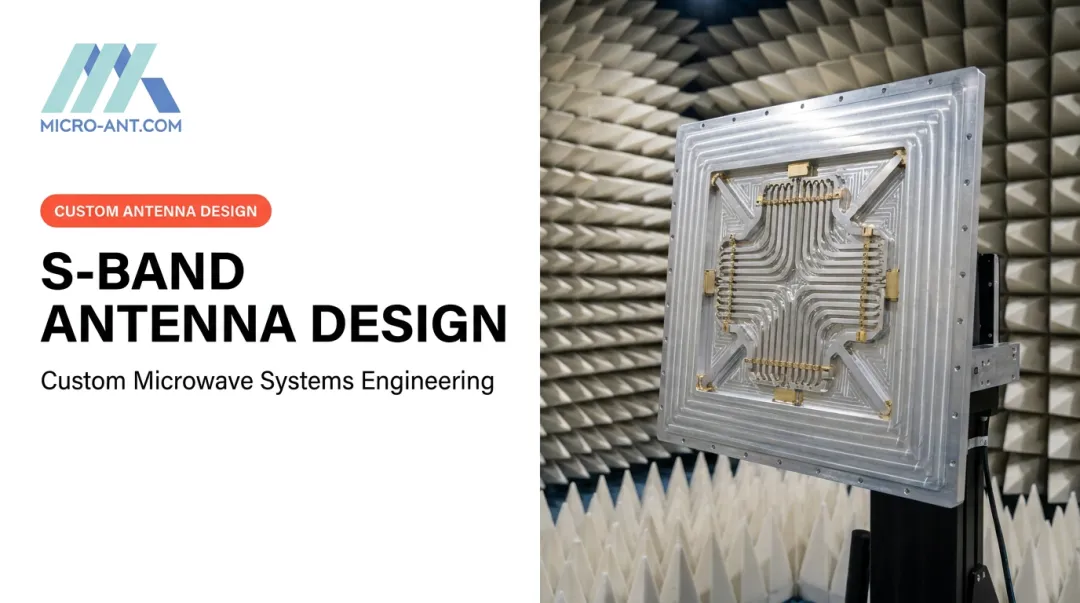
- Patch (microstrip) arrays for low-profile, vehicle-mounted installs
- Phased arrays for electronically steerable, multi-target tracking
Balancing Gain, Beamwidth, and Polarization
S-band's mid-range position reflects a deliberate engineering trade-off rather than a random spot on the spectrum chart. Compared to Ku or Ka, S-band gives up some bandwidth but gains dramatically better weather penetration. L-band offers longer range, but S-band trades some of that reach for meaningfully more usable bandwidth.
That trade-off shapes every design decision. Engineers have to balance:
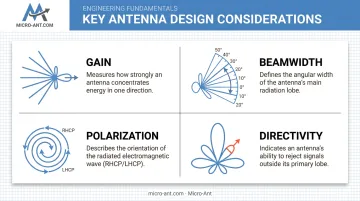
- Gain: how tightly the antenna focuses energy toward a target
- Beamwidth: the angular coverage needed for the mission profile
- Polarization: right-hand or left-hand circular polarization (RHCP/LHCP) for satellite links
- Directivity: how well the antenna rejects unwanted signals from other directions
Managing the 2.4 GHz Interference Zone
One recurring headache: the 2400-2500 MHz ISM band overlaps directly with Wi-Fi, Bluetooth, and portions of cellular spectrum, including 3GPP band n53. This isn't a minor coexistence issue. Without careful filtering and shielding, an S-band antenna operating near this range can pick up noise from every consumer device within range.
Solving this requires precise band-pass filtering, tight shielding, and, in many cases, custom radome design rather than an off-the-shelf fix.
Key Applications of S-Band Antennas
S-band's blend of range, bandwidth, and weather resilience makes it the default choice across several demanding industries.
Here's how these strengths translate into real-world use:
- Defense and military systems: S-band handles telemetry, tracking, and command links for missiles, UAVs, and ground vehicles, delivering the mission-critical connectivity DoD and defense customers demand.
- Space and deep-space communication: NASA's Deep Space Network uses S-band alongside its 34-meter and 70-meter antennas, and the James Webb Space Telescope sends commands over S-band while reserving Ka-band for high-volume science data. Engineers size each link to its purpose rather than defaulting to one band for everything.
- Weather and surveillance radar: The U.S. NEXRAD network operates at 2700-3000 MHz, and the FAA's ASR-11 airport surveillance radar runs at 2700-2900 MHz with a primary detection range of 60 nautical miles. Both systems have decades of field-proven performance in the weather conditions S-band handles best.
- Satellite communications and mobile satellite services: Operators such as Inmarsat, Intelsat, and SES rely on S-band for broadcasting and mobile satellite links, including Inmarsat's S-band satellite supporting the European Aviation Network, which now covers over 300 aircraft.
- Maritime and mobile tracking: Surface ship radar and rugged, weather-resistant antennas keep vessels connected regardless of sea state.
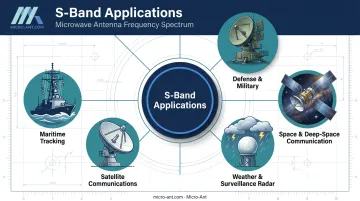
Micro-Ant designs custom S-band antennas across many of these same verticals, including defense, SATCOM, and maritime shipboard systems, each engineered to a program's specific frequency, environmental, and mounting requirements.
Types of S-Band Antennas
Not every S-band application calls for the same hardware. The right form factor depends on gain requirements, mounting constraints, and mission environment.
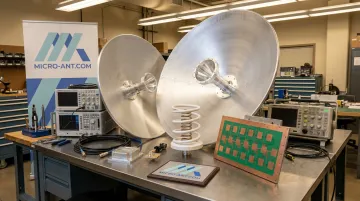
Parabolic and dish antennas deliver the high gain needed for satellite ground stations and deep-space tracking. NASA's commercial-grade S/X ground antennas range from 2.4 to 7.3 meters, while dedicated deep-space assets reach 34 and 70 meters. Bigger apertures mean more gain, but also more mass, cost, and installation complexity.
Helical and patch (microstrip) antennas solve a different problem entirely. These compact, low-profile designs handle circular polarization reception efficiently and integrate cleanly onto:
- Vehicles and mobile platforms
- Aircraft fuselages
- Handheld or portable terminals
Phased array antennas represent the most electronically sophisticated option. TDRSS itself uses a 30-element phased array supporting 20 simultaneous users, a strong proof point for multi-satellite tracking capability.
Micro-Ant engineers custom phased array and beam-switching antennas spanning UHF through Ka-band, including S-band configurations for defense and satellite communications customers. The company's 2022 SatCom Technology of the Year award recognized this phased array engineering expertise.
S-Band vs. Other Frequency Bands
Choosing between frequency bands comes down to a straightforward trade-off: range and weather resilience versus available bandwidth and antenna size.
S-band vs. L-band: L-band (1-2 GHz) offers longer range and better obstacle penetration, which is exactly why GPS uses it. But S-band provides considerably more usable bandwidth for the same power budget.
S-band vs. C, X, Ku, and Ka bands: These higher bands pack more bandwidth into smaller antennas, which is attractive for high-throughput satellite links. The trade-off is rain fade. The European Space Agency notes that higher-frequency bands are consistently more susceptible to rain fade than their lower-frequency counterparts, and they typically require larger dish apertures to match S-band's gain performance.
| Band | Frequency Range | Typical Wavelength | Primary Use Case |
|---|---|---|---|
| L | 1-2 GHz | 30-15 cm | GPS, mobile satellite links |
| S | 2-4 GHz | 15-7.5 cm | Weather/airport radar, TT&C, satcom |
| C | 4-8 GHz | 7.5-3.75 cm | Satellite links, radar |
| Ku/Ka | 12-40 GHz | 2.5-0.75 cm | High-rate satellite, direct broadcast |
Band selection ultimately depends on your mission profile: link budget, environmental exposure, and available bandwidth all factor into the right fit.
Choosing the Right S-Band Antenna
Selecting an S-band antenna starts with a clear-eyed look at your mission profile, not a spec sheet.
Key factors to weigh:
- Application type — fixed ground station versus mobile, maritime, or airborne deployment
- Required gain and bandwidth for your specific link budget
- Environmental ruggedization needs, especially for defense or maritime use where MIL-STD and shock/vibration requirements come into play
- Interference management around the 2.4 GHz ISM zone
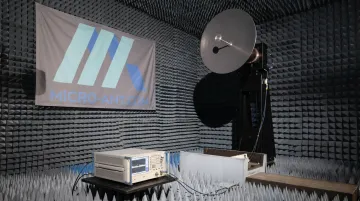
Off-the-shelf antennas rarely hit every mark on that list simultaneously. Bespoke engineering lets a design team tune gain, beamwidth, and polarization specifically for your mission rather than a generic use case. Micro-Ant's in-house near-field testing chambers, spanning 750 MHz to 40 GHz, validate antenna performance before it ever ships, covering the full S-band range and beyond.
For defense, aerospace, or government procurement, credentials matter too. Look for manufacturers holding AS9100:2016 and ISO 9001:2015 certification, along with Made-in-USA manufacturing. These credentials signal a controlled, auditable quality process, though they confirm process rigor rather than RF performance on their own.
Frequently Asked Questions
What does the S-band stand for?
"S-band" isn't an acronym. It's an IEEE (Institute of Electrical and Electronics Engineers) designation for the microwave frequency range of 2-4 GHz, positioned between L-band and C-band on the spectrum chart.
What is the S-band frequency used for?
Major uses include weather radar, air traffic control surveillance, satellite communications, deep-space telemetry, and Wi-Fi/Bluetooth within the 2.4-2.5 GHz ISM sub-band.
What are L and S bands?
L-band (1-2 GHz) handles GPS and mobile satellite services with strong range and penetration. S-band (2-4 GHz) trades a bit of range for more bandwidth, serving radar and broader satcom needs.
Is S-band better than Ku or Ka band for satellite communication?
Not universally. S-band resists rain fade far better than Ku or Ka, but those higher bands offer significantly more bandwidth. The right choice depends on your link priorities.
Can S-band antennas perform reliably in bad weather?
Yes. S-band shows strong resistance to signal degradation from rain, fog, and atmospheric moisture, which makes it a preferred choice in tropical or high-precipitation regions.
What industries rely most on S-band antennas?
Defense, aerospace, satellite communications, meteorology, and maritime industries are the primary users, each leaning on S-band's reliability for mission-critical links.