What is the near-field of an antenna?
The near-field is the region close to an antenna where electromagnetic fields have not yet formed the stable radiation pattern seen at long distances. Field strength, phase, and polarization can vary significantly across this region. Near-field measurement captures those detailed conditions on a defined scan surface, then uses processing to calculate the antenna’s far-field performance, including gain, pattern, and sidelobes.
What is near-field and far-field in an antenna?
Near-field describes the area close to an antenna, where reactive and radiating field behavior is strongly affected by the antenna’s physical structure. Far-field is the more distant region where the radiated wave pattern is stable and measurements represent the antenna’s directional behavior. Near-field testing measures the close-range field efficiently, while mathematical transformation produces the equivalent far-field results used for performance evaluation.
What antennas can be tested with near-field measurement?
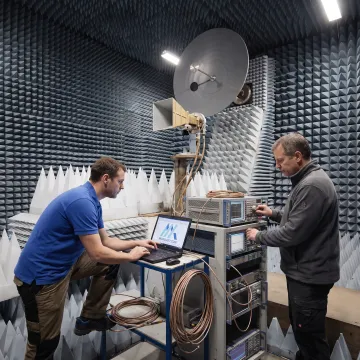
Near-field testing can support passive antennas and radomes, including flat panels, parabolic antennas, phased arrays, patches, horns, lenses, helicals, bi/quadrifilars, shaped arrays, Gregorian and offset antennas. Micro-Ant also measures RF components such as feeds, orthomode transducers, polarizers, and reflectors. The appropriate spherical or planar method depends on antenna size, geometry, frequency, and the measurements required.
What frequency range does Micro-Ant test?
Micro-Ant’s spherical and planar near-field chambers are optimized for measurements from 750 MHz to 40 GHz. This range supports L-, S-, C-, X-, Ku-, and Ka-Band antenna programs, along with many associated RF components and radomes. During project planning, the team reviews the intended band, antenna configuration, required parameters, and fixture needs to confirm the appropriate measurement setup.
When should spherical measurement be used?
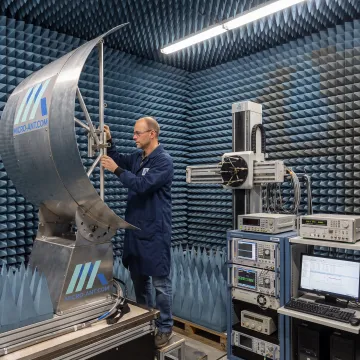
Spherical near-field measurement is often selected when a complete three-dimensional characterization is required. It is well suited to antennas with complex radiation patterns, multiple beams, broad angular coverage, or performance requirements involving sidelobes and polarization over a full sphere. The method collects amplitude and phase data around the antenna, enabling detailed far-field pattern calculation and comprehensive evaluation.
When should planar measurement be used?
Planar near-field measurement is particularly effective for directional antennas with a defined aperture, including flat-panel, patch, array, and beamforming designs. A probe scans a plane in front of the antenna to measure amplitude and phase distribution across its aperture. The data can verify beam pointing, gain, polarization, aperture performance, and array consistency while supporting efficient characterization of suitable antenna geometries.
How long does near-field antenna testing take?
Testing duration depends on antenna size, frequency range, scan density, fixture preparation, required measurements, and reporting scope. Micro-Ant recommends planning approximately four weeks for a typical program so requirements, logistics, measurements, processing, and documentation can be properly coordinated. Well-prepared units and clear test requirements help streamline execution. A 30-minute consultation with the test program manager establishes the project plan.
Can Micro-Ant provide reports for certification programs?
Yes. Micro-Ant produces formatted reports for FCC-regulated submissions and satellite-operator certification programs, with custom reports available for specific characterization requirements. The team has experience supporting programs associated with Eutelsat, Intelsat, Inmarsat, SES O3B, Iridium Certus, ARSTRAT, Thuraya, Hughes, and others. Documentation is managed under AS9100 quality standards and matched to the agreed test scope.