Introduction
A ship rolling through swells. A tactical vehicle convoy moving through contested terrain. A 5G base station juggling hundreds of users at once. Each needs directional RF gain that can keep pace with motion, but neither a mechanically steered dish nor a full phased array always fits the budget, weight, or power envelope.
Mechanically steered systems add moving parts that fail in the field. Phased arrays deliver precision but demand dedicated RF chains and processing behind every element, driving up cost and power draw.
Switched beam smart antennas fill the gap. They use multiple fixed directional elements and electronic switching to point a beam in microseconds—no motors, no continuous phase calculation. This guide breaks down how switched beam antennas work, how they stack up against phased arrays and omnidirectional designs, and where they're already deployed across defense, satcom, and telecom networks.
Key Takeaways
- Switched beam antennas switch between pre-formed beams instead of continuously steering phase.
- They deliver 360-degree coverage with directional gain in a smaller, lower-power package.
- Defense, maritime satcom, 5G base stations, and GNSS/IoT systems all rely on switched beam architectures.
- Your choice depends on the tracking precision your mission needs versus budget and SWaP constraints.
What Is a Switched Beam Smart Antenna?
A switched beam smart antenna contains an array of fixed directional elements, often 20 or more, arranged to cover the full azimuth. Instead of physically rotating or calculating a continuous steering angle, the system electronically selects which element (or combination of elements) is active at any given moment.
An internal microcontroller handles this selection. Send a serial or Ethernet command, and the active beam changes almost instantly. Cyntony reports switching speeds measured in microseconds, fast enough to track a moving transmitter without any mechanical lag.
Key Components of a Switched Beam System
Three building blocks make this possible:
- Directional radiating elements – Each covers a fixed azimuthal sector. Stack enough of them and you get complete 360-degree coverage without gaps.
- RF switch matrix – The hardware layer that physically routes signal to and from the active element based on incoming commands.
- Controller logic – The decision-making layer, whether firing elements on command or, in advanced designs, switching automatically.
Some implementations add logic that automatically selects whichever beam produces the strongest signal, or steers a low-gain region toward a known interference source.
Types of Beam Patterns
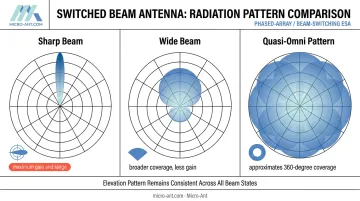
Not every switched beam antenna produces just one type of beam. A well-designed system can generate:
- Sharp beams – Narrow width for maximum gain and range.
- Wide beams – Broader coverage sacrificing some gain for area.
- Quasi-omni patterns – Multiple wide beams active simultaneously, approximating omnidirectional coverage when needed.
The elevation pattern stays consistent across all these modes since each pattern is built from the same physical elements. That consistency gives system designers flexibility to trade range for coverage width depending on mission phase, without redesigning hardware.
Switched Beam vs. Phased Array vs. Omnidirectional Antennas
Three architectures, three different tradeoffs. Here's how the mechanisms actually differ:
- Switched beam – Activates one of several pre-formed fixed beams via a switch matrix.
- Phased array – Continuously steers a beam by adjusting signal phase (and often gain) across every element.
- Omnidirectional – Radiates equally in all directions with no beam concentration at all.
Cost, Complexity, and SWaP
Phased arrays need far more hardware to work. Analog arrays place phase and gain control behind each element; fully digital arrays require a dedicated receiver and analog-to-digital converter for every single element in the aperture. That repeated electronics stack drives up size, power draw, and bill of materials fast.
Switched beam architectures skip most of that. A single switch matrix plus controller handles beam selection, which is why SBAs consistently land in a smaller, lighter, lower-power footprint.
Precision and Tracking Granularity
Here's the honest tradeoff: phased arrays win on precision. Beamforming ICs like the ADAR1000 offer phase steps below 2.8 degrees, enabling near-continuous tracking. Switched beam systems, by comparison, jump between discrete sectors. One production example uses beams roughly 25 degrees wide with 18-degree spacing between them.
This is a deliberate engineering tradeoff. If your application needs to track a target to a fraction of a degree, continuously, a phased array is worth the added cost and complexity. If it needs reliable link coverage across a full circle with fast reacquisition, switched beam gets you there for less.
Coverage and Gain vs. Omnidirectional
This is where switched beam antennas clearly outperform omni designs. One manufacturer benchmark reports 15 dBi of gain from its switched beam antenna versus 6 dBi from a comparable omnidirectional unit, a difference the vendor says can potentially triple usable link distance.
| Attribute | Switched Beam | Phased Array | Omnidirectional |
|---|---|---|---|
| Mechanism | Preset beam selection | Continuous phase steering | No directional gain |
| Precision | Sector-level (~18-25°) | Sub-degree | None |
| Relative SWaP | Low | Higher | Lowest |
| Coverage | Full 360°, segmented | Full 360°, continuous | Full 360°, uniform |
A Simple Decision Framework
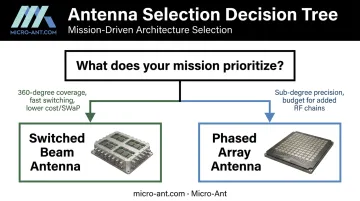
Pick switched beam when full 360-degree coverage, fast switching, and lower cost/SWaP top your priority list. Pick a phased array when sub-degree beam steering is mission-critical and budget allows for the added RF chains and DSP. Micro-Ant engineers both switched beam and phased array antennas in-house, so the architecture gets matched to your mission profile instead of a stock catalog part.
Key Applications of Switched Beam Smart Antennas
Defense and Tactical Communications
Tactical networks live and die on link reliability in contested spectrum. Switched beam antennas support direction-finding, jamming resistance, and MANET-style radio networks by rapidly selecting the beam with the strongest signal or by steering low-gain regions toward known interference sources.
Field-deployed units in this category measure a compact 270 x 390 mm and 4 kg, small enough for vehicle mounting without adding meaningful payload weight. Micro-Ant builds tactical antennas to this footprint under AS9100-certified processes, meeting the rugged specifications defense integrators require for vehicle-mounted systems.
Satellite Communications and Maritime Connectivity
Ships and offshore platforms move constantly between satellite coverage areas. Automatic beam switching (ABS) systems apply similar switching logic at the network level, shifting between beams, satellites, or hubs as conditions change.
Modern ABS platforms build in additional intelligence layers, including:
- Real-time network availability checks
- Capacity-aware switching decisions
- Band selection (C-, Ku-, or Ka-band) based on conditions
This differs from antenna-level switched beam hardware, but it borrows the same core principle: react fast, minimize downtime.
5G and Telecom Base Stations
Sub-6 GHz base station antennas use switched-beam logic to divide a 120- or 90-degree macro-sector into multiple narrower subsectors, sometimes triple, quad, or penta beams, according to a Microwave Journal design overview. Each subsector gets independently adjustable electrical tilt.
This boosts gain and manages capacity per user without the cost of a fully active beamforming network across every antenna port.
GNSS, Autonomous Vehicles, and IoT
Compact switched beam designs are showing up in autonomous robotics and IoT sensor networks. One published design measures just 45 x 45 x 45 mm, operates at 5.8 GHz, and delivers 8.4 dBic of directional gain by activating one face of a four-sector cube at a time.
Use cases here lean toward interference avoidance, improved signal-to-noise ratio, and device isolation, rather than direct positioning accuracy gains.
Benefits and Limitations of Switched Beam Antennas
Benefits
- Lower SWaP – Fewer RF chains than a phased array means less size, weight, power draw, and cost.
- No moving parts – Microsecond-level switching with zero mechanical wear, a real advantage in vibration-heavy vehicle, vessel, or aircraft environments.
- Full coverage – True 360-degree azimuth coverage without gaps.
Limitations
- Fixed beam count – The number and spacing of beams are set at design time. You can't add finer granularity after manufacture the way you can adjust a phased array's steering angle.
- Lower tracking precision – Sector-level switching can't match sub-degree phased array tracking, though for most line-of-sight communication links, that precision simply isn't necessary.
- Some insertion loss – Beam-forming networks add minor switching loss, a small tradeoff for the reduced RF chain count.
For platforms prioritizing reliable coverage over pinpoint tracking, that tradeoff is usually an easy call.
Choosing the Right Antenna Manufacturing Partner
Switched beam antennas aren't off-the-shelf products. Frequency band, polarization, power handling, and mechanical footprint all need to match the platform, whether that's a tactical vehicle, a maritime terminal, or a base station enclosure. That calls for a manufacturing partner comfortable building bespoke RF hardware from scratch.
Micro-Ant has spent over 20 years engineering custom antennas, including phased array and beam-switching ESA systems, across the UHF through Ka-band spectrum for defense, satcom, aviation, and maritime customers.
The company's Jacksonville, Florida facility operates under AS9100:2016 and ISO 9001:2015 certification, with in-house spherical and planar near-field test chambers covering 750 MHz to 40 GHz.
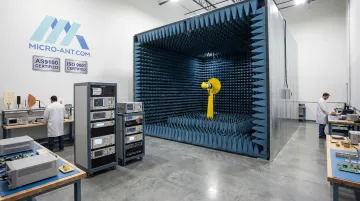
That in-house testing matters more than it might seem:
- Eliminates the need to ship antennas to third-party labs
- Cuts travel costs for customers who'd otherwise need to attend off-site test campaigns
- Shortens design iteration cycles when adjustments are needed after a test run
If you're evaluating whether a switched beam architecture, a phased array, or something in between fits your platform, Micro-Ant's engineering team can walk through the tradeoffs for your specific frequency band and coverage requirements. Reach out to start a consultation.
Frequently Asked Questions
What is a switched beam antenna?
A switched beam antenna is a smart antenna system with multiple fixed directional elements that a microcontroller switches between in microseconds. This points the active beam at a target without any mechanical movement.
How does a switched beam antenna differ from a phased array antenna?
Switched beam antennas activate pre-formed fixed beams through electronic switching. Phased arrays continuously steer a beam by adjusting signal phase across elements, offering finer precision at higher cost and complexity.
What are the main benefits of switched beam smart antennas?
Switched beam smart antennas reduce size, weight, and power draw compared to phased arrays while typically costing less. Microsecond switching speed and full 360-degree coverage without moving parts round out the advantages.
Where are switched beam antennas commonly used?
Defense and tactical communications, maritime satellite beam switching, 5G base stations, and GNSS/IoT applications all use this technology today. Each application values fast, reliable directional coverage over ultra-fine tracking.
Can switched beam antennas track moving satellites or vehicles?
Yes, though not through continuous steering like a phased array. They switch between fixed beams fast enough to maintain a link with a moving platform, especially when paired with intelligent, signal-strength-aware switching software.
Are switched beam antennas more affordable than phased array systems?
Yes, in most cases. Their simpler RF architecture and fewer active components mean lower cost, making them attractive for budget-conscious deployments that still need wide, reliable coverage.