What is an X-band antenna?
An X-band antenna is designed to transmit, receive, or both transmit and receive radio-frequency signals in the X-band portion of the microwave spectrum, generally 8 to 12 GHz. X-band systems are used where compact form factors, focused beams, and high-frequency performance are valuable, including radar, satellite communications, aerospace, defense, maritime, and specialized wireless applications.
What types of X-band antennas can Micro-Ant develop?
Micro-Ant can develop bespoke X-band antenna solutions based on the application’s electrical, mechanical, and environmental requirements. Its broader engineering capabilities include phased arrays, patches, parabolic and flat-panel antennas, low-profile beam-switching antennas, electronically steered antennas, reflectors, feeds, and related RF components. The appropriate configuration depends on bandwidth, gain, polarization, coverage, platform space, and integration constraints.
Can you manufacture an existing X-band antenna design?
Yes. Micro-Ant can contract-manufacture qualified third-party antenna designs that meet its quality-gating requirements. The team can support the transition from prototype to production and provides in-house precision machining, assembly, RF integration, environmental screening, final characterization, and production testing. Manufacturing capacity supports custom-product runs from five units to more than 200,000 units per year.
How is X-band antenna performance tested?
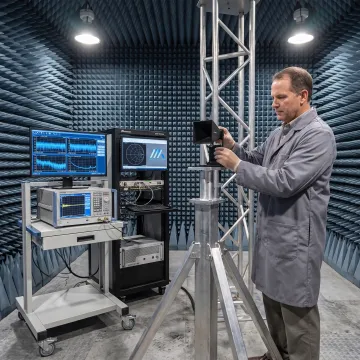
X-band antenna performance is characterized by measuring parameters such as radiation pattern, gain, polarization, sidelobes, beamwidth, and impedance-related performance as required by the program. Micro-Ant uses spherical and planar near-field chambers optimized for 750 MHz to 40 GHz testing. Near-field measurements can be processed to evaluate far-field behavior and support detailed engineering reports.
Can you support X-band certification testing?
Micro-Ant provides antenna characterization, compliance reporting, and certification support for relevant programs. Its testing experience includes standard FCC-regulated submissions and satellite-operator certification workflows. The team can produce formatted reports or custom reports based on the required characterization. Certification requirements vary by equipment, operator, application, and intended deployment, so requirements should be defined early in the test plan.
What information is needed to start an X-band antenna project?
A productive starting package identifies the operating frequencies, bandwidth, gain, polarization, radiation-pattern goals, power handling, platform dimensions, mounting approach, environmental conditions, interfaces, and target quantity. It is also helpful to provide applicable standards, certification goals, available drawings, and integration constraints. Micro-Ant can review these inputs to clarify technical scope, test needs, and manufacturing considerations.
How long does X-band antenna testing take?
Testing time depends on antenna complexity, fixture readiness, measurement requirements, and whether certification documentation is needed. For planned test programs, Micro-Ant recommends allowing approximately four weeks for coordination and execution. A testing requirements intake form, followed by a detailed specification review and consultation with the test program manager, helps establish an appropriate schedule and deliverables.
What quality standards apply to Micro-Ant manufacturing?
Micro-Ant operates under AS9100:2016 aerospace quality management and ISO 9001:2015 quality systems. Every product is 100% tested in production for electrical and mechanical performance compliance. The company also uses ERP-supported planning, supply-chain management, manufacturing tracking, and quality management processes to maintain traceability and support repeatable production across program volumes.