Many buyers assume a single antenna design can handle any job. That assumption causes real problems. A radome built for a desert convoy won't survive an Arctic patrol route. A gain pattern tuned for GEO satellite tracking won't work for a fast-moving LEO constellation. Defense, aviation, maritime, and land operators working in extreme conditions need antennas engineered for their exact frequency, environment, and mission.
This guide breaks down what communication antennas actually are, the main design types, the performance specs that matter, and how to choose (or custom-build) the right one.
Key Takeaways
- Communication antennas both transmit and receive, converting electrical signals to radio waves and back
- Radiation pattern (omnidirectional vs. directional) decides whether you get broad coverage or long-range precision
- Gain (dBi), frequency band, and polarization must match your network or satellite operator exactly
- Harsh field environments demand tested, ruggedized designs, not catalog hardware
- Bespoke design becomes necessary once mission requirements outgrow off-the-shelf options
What Is a Communication Antenna?
A communication antenna is a passive device. It converts an electrical signal into an electromagnetic wave for transmission, and it converts an incoming electromagnetic wave back into an electrical signal for reception. It's a transducer: no power amplification happens inside the antenna itself, only a conversion between electrical and electromagnetic energy.
Most antennas work both ways using the same physical structure. This is the principle of reciprocity — an antenna's radiation pattern, gain, and impedance behave identically whether it's transmitting or receiving. Engineers rely on this constantly, measuring an antenna's transmit performance and applying those same figures to its receive behavior.
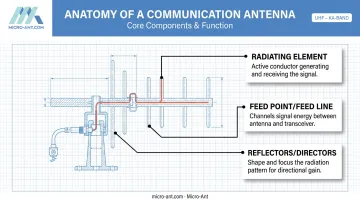
Every antenna shares a few basic building blocks:
- Radiating element - the conductor that actually launches or captures the electromagnetic wave
- Feed point or feed line - the connection carrying the signal between the radio and the radiating element
- Reflectors and directors - optional elements that shape, focus, or redirect the radiation pattern
Beyond these building blocks, an antenna's overall size comes down to physics: frequency dictates wavelength, and wavelength in turn dictates antenna size. That's why antennas range from chip-sized GNSS patches embedded in a tracker to multi-meter parabolic dishes tracking satellites in geostationary orbit. Higher frequency (shorter wavelength) allows a smaller antenna; lower frequencies need more physical real estate.
How Do Communication Antennas Work?
On transmit, an electrical signal drives the radiating element, creating oscillating electric and magnetic fields that propagate outward as radio waves. On receive, those same incoming waves induce a tiny electrical current in the element, which then passes to a receiver for amplification and processing.
That exchange, happening billions of times a second, is what makes satellite phones, ship-to-shore radios, and tactical data links possible.
Types of Communication Antennas
By Radiation Pattern
Antennas fall into two broad categories based on how they distribute energy:
- Omnidirectional (low-gain) antennas radiate energy roughly equally across the horizontal plane, making them the standard choice for GPS receivers, Wi-Fi access points, and cellular base stations.
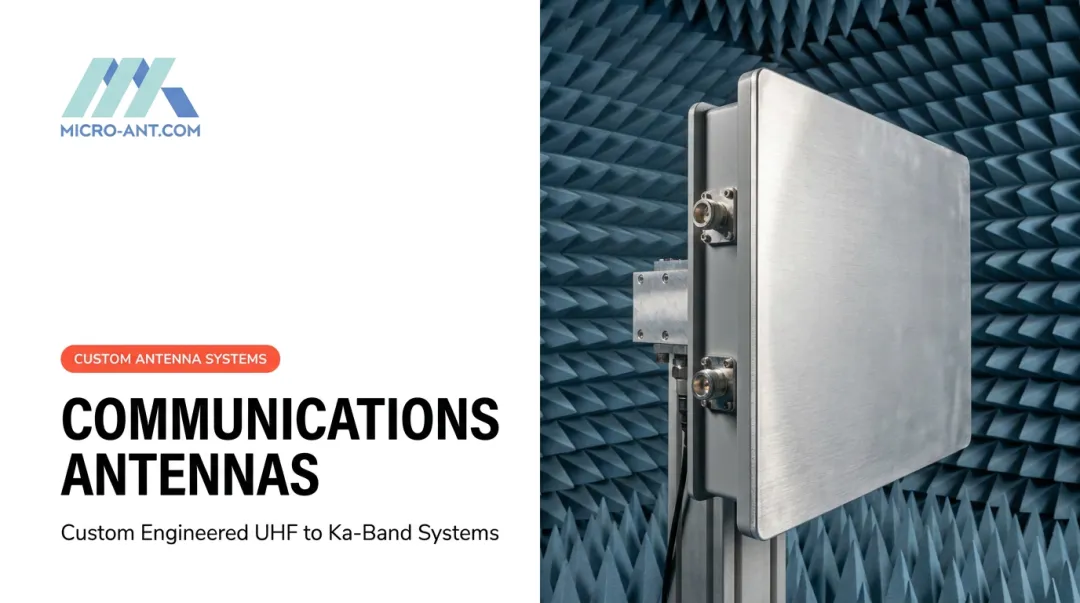
- Directional (high-gain) antennas concentrate energy into a narrow beam, trading coverage for range and precision. Radar, weather satellites, and satcom terminals rely on this focused approach, a specialty of Micro-Ant's engineering team.
Two directional antennas can have very different gain, beamwidth, and sidelobe performance depending on construction. The general category only tells part of the story; the specific design determines the rest.
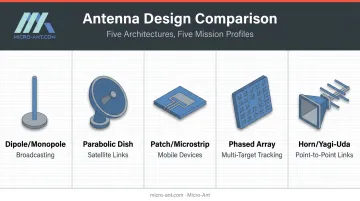
Common Antenna Designs Used in Communication Systems
- Dipole and monopole antennas - simple, low-cost designs widely used in radio and TV broadcasting, plus short-range tactical devices
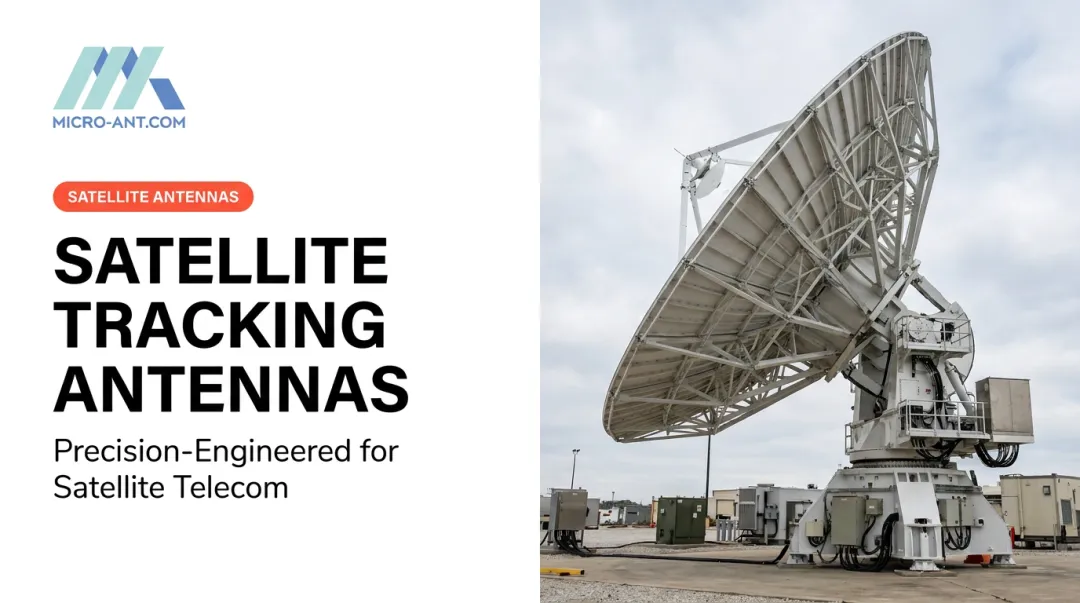
- Parabolic dish/reflector antennas - highly directional designs that concentrate a signal at a focal point, standard for long-distance satellite links and radar. Actual gain depends on aperture size and surface efficiency, not a generic spec sheet.
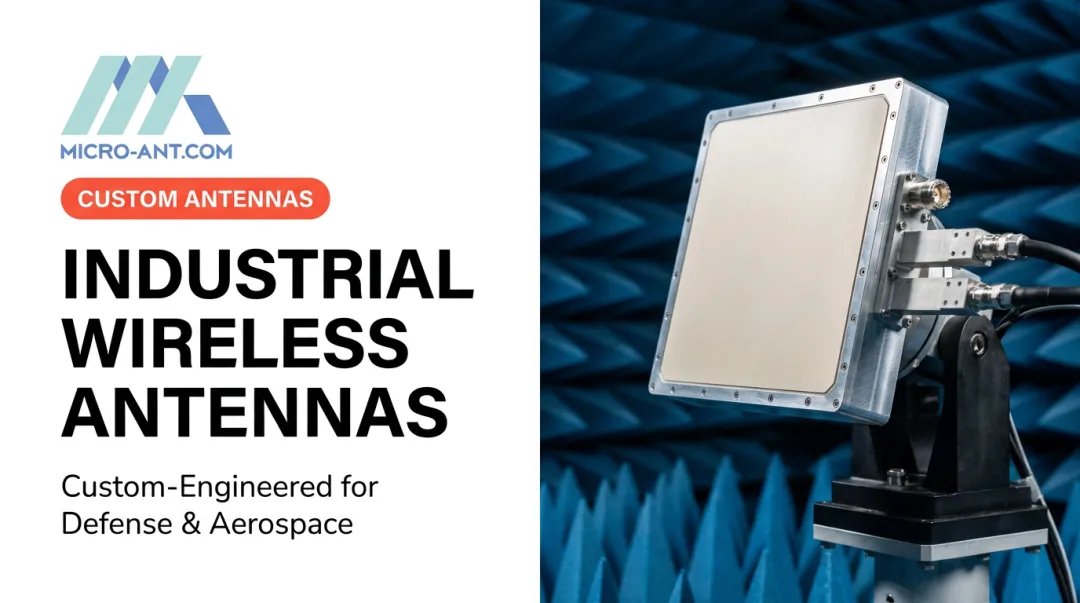
- Patch/microstrip antennas - low-profile designs printed onto a flat substrate, common in mobile devices, GNSS receivers, and conformal aircraft installations
- Phased array antennas - multiple elements steer the beam electronically through phase shifts, with no moving parts. Defense and aerospace favor this design for multi-target tracking, including Micro-Ant's Ultra-Wide Band Ka Antenna System.
- Horn and Yagi-Uda antennas - directional designs used for microwave point-to-point links, reflector feeds, and fixed UHF connections
Key Performance Characteristics to Understand
Choosing the right antenna comes down to matching three technical dimensions to the mission.
Gain and directivity determine how far and how tightly focused a signal travels. Gain is measured in dBi — decibels relative to a theoretical isotropic radiator that spreads energy equally in every direction. A higher dBi figure means a more concentrated beam and greater range, at the cost of a narrower footprint.
That range-versus-footprint tradeoff only matters if the antenna is tuned to the right signal in the first place. Frequency band and bandwidth must match the network or operator you're connecting to, and band names aren't always exact allocations. The ITU has noted that Ka-band isn't formally defined in the Radio Regulations; one of its own satellite-network documents uses 17.3-31 GHz as a working range for analysis. The exact uplink and downlink allocation always comes from the specific operator.
| Band | Typical Use | Note |
|---|---|---|
| L-band | Maritime and mobile satcom (FleetBroadband, Iridium) | Lower frequency, larger antenna, strong penetration |
| Ku-band | VSAT, broadcast, fixed satcom | Mid-range frequency, moderate dish size |
| Ka-band | High-throughput, multi-orbit satcom | Higher frequency, smaller dish, more rain-fade sensitivity |
Getting the gain and frequency band right still won't help if the physical signal path is mismatched. Polarization and ruggedness affect that real-world reliability. Linear and circular polarization must match between the antenna and the signal source, or you lose signal to polarization mismatch. For antennas deployed at sea, in the air, or in the field, resistance to temperature swings, vibration, and moisture ingress often matters as much as raw RF performance.
Applications of Communication Antennas Across Industries
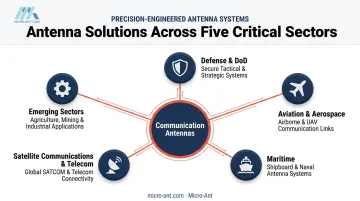
Communication antennas power mission-critical connectivity across sectors where failure isn't an option:
- Defense & DoD: Ruggedized, secure antennas support command, control, and battlefield communications in conditions that would disable consumer-grade hardware, from desert heat to Arctic cold.
- Aviation & Aerospace: Avionics communication and satellite-tracking antennas must perform reliably at altitude, at speed, and under constant vibration, often in a low-profile form that doesn't compromise aerodynamics.
- Maritime: Shipboard satcom terminals keep vessels connected at sea through providers like Inmarsat and Iridium. Inmarsat's Fleet Xpress service, for example, combines Ka-band and L-band coverage backed by a 99.9% uptime service-level agreement, leaving almost no margin for antenna failure mid-crossing.
- Satellite Communications & Telecom: Multi-band antennas need to work across MEO and GEO constellations, including SES O3b mPOWER, Eutelsat, and Intelsat networks. Each operator sets its own frequency, polarization, and approval requirements, so roaming compatibility has to be engineered in, not assumed.
- Emerging Sectors: Autonomous vehicles, agriculture, mining, and oil & gas depend on always-on, field-rugged connectivity. GSMA Intelligence estimates that roughly 2.5 to 3.0 billion IoT devices are addressable by satellite across these industries. That figure reflects addressable market size rather than current installed base, but it points to a clear direction for future demand.
How to Choose the Right Communication Antenna
Start with the technical match, then work outward to durability and support.
- Match frequency band, polarization, and gain to the specific network or satellite operator the antenna will connect to. A dish built for one operator's Ka-band allocation won't necessarily work on another's, even within the same nominal band.
- Prioritize environmental durability. Look for antennas tested against temperature extremes, vibration, humidity, and salt fog, not just rated for them on paper. MIL-STD-810 is the reference standard, but ask for the specific test methods and results behind that label, not just the certification claim.
- Recognize when off-the-shelf won't cut it. Catalog antennas are built for average conditions and average performance. When a mission calls for a specific gain figure, a non-standard mounting footprint, or qualification for an environment no catalog part was designed for, a bespoke design partner becomes necessary.
That third point is where in-house testing capability matters. Micro-Ant validates designs using spherical and planar near-field test chambers covering 750 MHz to 40 GHz, giving engineers measured performance data rather than modeled estimates before a product ships.
Why Organizations Choose Micro-Ant for Bespoke Antenna Design
Micro-Ant has spent over 20 years designing and manufacturing bespoke antennas at its AS9100:2016 and ISO 9001:2015 certified facility in Jacksonville, Florida. That combination of decades of RF engineering experience and certified quality systems matters when a single antenna failure can take down a ship's connectivity or a squad's data link.
The company's proprietary Ultra-Wide Band (3.5 GHz) Ka Antenna System and high-precision GNSS antenna designs were built for demanding, multi-constellation environments, where one terminal needs to roam across operators without losing lock.
Micro-Ant's product range includes:
- Parabolic and flat panel antennas
- Phased array systems
- Airborne and maritime shipboard antennas
Every product is designed, built, and tested in-house rather than assembled from third-party parts.
That in-house control extends to who trusts the results. Major satcom and defense operators, including Intelsat, Eutelsat, Iridium, and Thuraya, work with Micro-Ant across defense, aviation, maritime, and land applications. For organizations that have outgrown catalog antennas, that track record, paired with U.S.-based design, manufacturing, and testing under one roof, is often the deciding factor.
Frequently Asked Questions
What is a communication antenna?
A communication antenna is a passive device that transmits and receives electromagnetic signals, converting electrical energy into radio waves and back into electrical current. It's the physical interface between a radio system and the airwaves.
What are the antennas used in communication?
Common types include dipole, monopole, patch, parabolic dish, phased array, and Yagi-Uda antennas. Each is optimized for a specific frequency range, gain requirement, and application, from broadcast radio to satellite links.
What type of antenna is most commonly used for cellular communication?
Cell towers typically use panel or sector antennas to cover defined zones, while mobile devices rely on small omnidirectional antennas built into the handset. The two work together to maintain a consistent link as users move.
What is the difference between directional and omnidirectional antennas?
Directional antennas focus energy into a narrow beam, maximizing range and precision for point-to-point or satellite links. Omnidirectional antennas spread coverage broadly but sacrifice range and gain in the process.
How do I know which antenna frequency band I need?
Your required frequency band depends on the network or satellite operator you're connecting to, not a generic industry standard. Using the wrong band, or even the wrong slice of the right band, causes signal loss or a failed link.
Can communication antennas be customized for extreme environments?
Yes. Bespoke antennas can be engineered for temperature extremes, constant vibration, and corrosion resistance — the environmental qualification that defense, maritime, and aviation clients require as standard practice.