Introduction
A warfighter in the field needs one terminal that talks to Ka-band satellites in the morning and Ku-band assets by afternoon. A cargo ship needs one dome that keeps a connection whether it's parked off Rotterdam or crossing the Pacific. Single-band antennas can't do either job alone.
Many defense, aerospace, and maritime teams still bolt on separate antennas for each frequency band. That approach adds weight, cabling, installation hours, and long-term maintenance costs to platforms where space is already scarce.
This article breaks down what multiband antennas are, how dual-band and tri-band designs work under the hood, and where they deliver the most value. We'll also look at how Micro-Ant engineers bespoke multiband systems for government, aviation, maritime, and land applications.
Key Takeaways
- Multiband antennas combine multiple frequency bands into one structure, cutting hardware and weight.
- Dual- and tri-band designs isolate bands using stacked elements, segmented reflectors, and diplexers.
- Extended Ka-band coverage lets terminals roam across satellite operators without swapping hardware.
- The satellite phased-array antenna market alone is projected to hit $8.1 billion by 2034.
- Custom-engineered multiband antennas often outperform catalog products for specific mission requirements.
What Is a Multiband Antenna?
A multiband antenna is a single antenna structure engineered to transmit and receive across two or more distinct frequency bands, either at the same time or through selectable switching. Instead of mounting separate hardware for each frequency, engineers integrate multiple resonant paths into one aperture.
Single-band antennas take the opposite approach. They are tuned to one narrow frequency range, which trades flexibility for specialized efficiency. A single-band X-band radar antenna, for example, performs its one job extremely well but cannot touch Ku or Ka signals without a hardware swap.
Common Multiband Categories
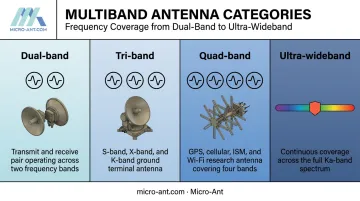
Multiband designs generally fall into a few groups:
- Dual-band: Two operating frequencies, such as a transmit path and a separate receive path
- Tri-band: Three bands integrated into one aperture, often used in ground and terminal antennas
- Quad-band: Four discrete bands, common in research antennas covering cellular and ISM ranges
- Ultra-wideband (UWB): One continuous, broad frequency range rather than several discrete bands
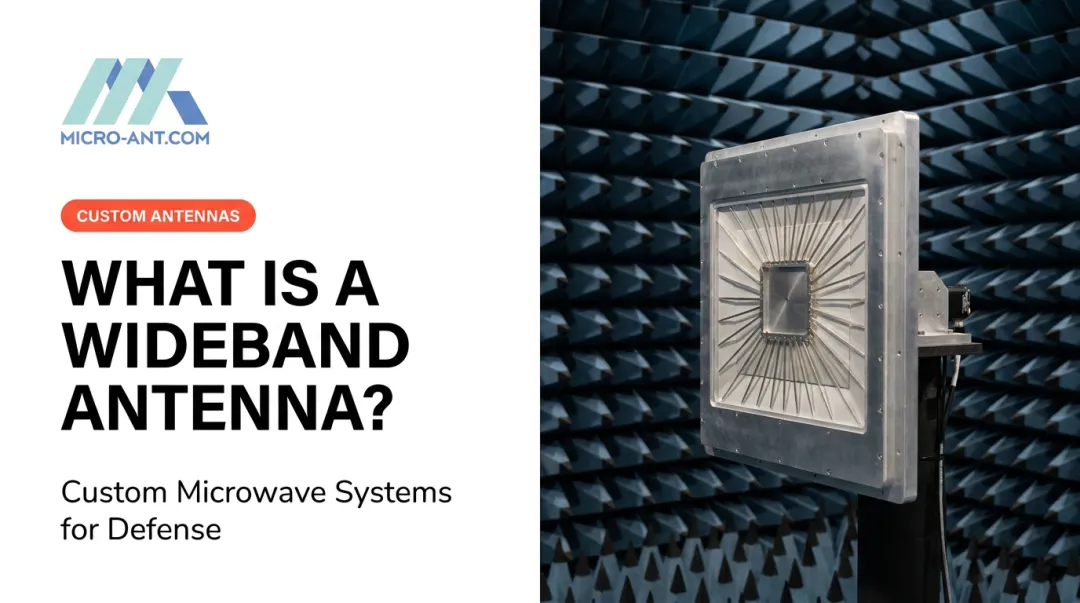
Micro-Ant's Ultra-Wide Band (3.5 GHz) Ka Antenna System sits in this last category, engineered to cover the full commercial and military Ka spectrum in one platform rather than stitching together multiple narrowband units.
Multiband vs. Single-Band: When Each Makes Sense
Multiband antennas cost more per unit and require tighter engineering tolerances to keep every band performing well. Single-band antennas remain the smarter pick when:
- The application is fixed-frequency and unlikely to change (a dedicated GPS L1 receiver, for instance)
- Budget constraints outweigh the value of future flexibility
- Space is not a limiting factor, so running separate antennas costs less than a custom multiband build
Outside those specific cases, multiband design earns its added cost. Real-world use spans SATCOM terminals, cellular infrastructure, GPS/GNSS receivers, radar systems, and land mobile radio networks — anywhere a platform needs to talk across more than one slice of spectrum without adding hardware.
How Do Multiband and Dual-Band Antennas Work?
The core engineering principle is straightforward: multiple resonant elements or feed structures, each tuned to a different frequency, share a single physical aperture. The hard part is keeping them from interfering with each other.
Design Techniques That Make It Possible
Engineers use a handful of proven architectures:
- Stacked patches: a second radiating patch sits above the driven patch, each tuned to a different resonance. NASA testing on a stacked circularly polarized design achieved 2.22% impedance bandwidth, compared to under 1.9% for single-layer versions.
- Multi-arm radiating elements: slot arms etched into a single radiator, each tuned to its own resonant frequency, cover multiple bands from one structure.
- Segmented reflector and feed systems: a shared reflector combines multiple feed paths. Micro-Ant's Tri-Band Segmented Reflectors and Feeds ("Veritas") technology uses carbon-fiber composite reflectors with no embedded conductor, making them rugged enough for man-pack and flyaway terminal use.
How Dual-Band Operation Actually Works
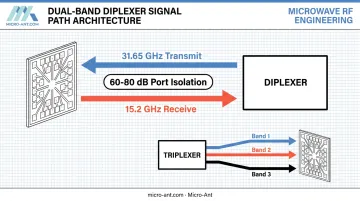
These architectures show how multiple bands can share a single aperture without interference. In a dual-band antenna, two separate resonant circuits or elements are tuned to different frequencies but share one common aperture. Filtering components, typically diplexers, keep the two signal paths from bleeding into each other.
NASA's dual-frequency feed-horn design separates a 31.65 GHz transmit path from a 15.2 GHz receive path using a two-port diplexer, achieving 60-80 dB of port isolation between them. That level of isolation is what keeps a high-power transmit signal from drowning out a much weaker receive signal in the same housing.
For three-band designs, triplexers perform the same function across three paths instead of two. Impedance matching across every band adds another layer of complexity: engineers must tune each resonant path so it doesn't detune the others. That tuning discipline is only half the challenge.
The Real Engineering Challenge
Maintaining consistent gain, bandwidth, and polarization across every band in the same aperture is where most of the difficulty lives. A design that performs beautifully in one band can lose axial ratio or gain in another if the elements aren't carefully isolated. This is precisely the kind of tolerance problem that separates catalog products from purpose-built engineering.
Types of Multiband Antennas by Frequency and Application
Not every multiband antenna looks the same, and the right form factor depends heavily on the platform.
By frequency coverage:
- Dual-band designs handle applications like Wi-Fi/cellular coexistence or paired transmit/receive paths
- Tri-band systems support simultaneous operation across bands like S, X, and K for ground terminals
- Quad-band antennas cover four discrete ranges, often combining GPS, cellular, ISM, and Wi-Fi bands in research designs
- Ultra-wideband designs cover one continuous, very broad range instead of separate discrete bands
By physical form factor:
- Omni-directional antennas for vehicle-mounted communications
- Directional antennas for point-to-point links
- Planar/patch antennas for low-profile aircraft and UAV installs
- Reflector-based systems for shipboard and high-gain SATCOM applications
Platform constraints usually decide the form factor before frequency does. A shipboard terminal needs a stabilized reflector; a UAV needs a flush-mounted patch that doesn't disrupt airflow.
Frequency stacking follows the same logic in precision positioning systems. Modern professional-grade GNSS units increasingly track GPS, Galileo, BeiDou, and regional systems across L1, L2, and L5 simultaneously, all from one multiband antenna. Micro-Ant's proprietary high-precision GNSS antenna designs support multiple satellite constellations, giving platforms in agriculture, construction, and logistics the positioning accuracy modern automation demands without stacking separate receivers.
Key Advantages of Multiband Antennas
The case for multiband hardware comes down to five practical benefits.
Optimized signal strength across changing environments. A multiband antenna adjusts to available frequencies rather than dropping connection when a platform moves out of range of one operator.
Micro-Ant's UWB Ka system covers 17.7–21.2 GHz on receive and 27.5–31 GHz on transmit, spanning the full commercial and military Ka spectrum in a single system. That range lets it roam across operators without a hardware swap.
Reduced hardware footprint and weight. Every antenna removed from an airframe or vessel deck is weight and drag saved. For UAVs and small vessels, this isn't a minor consideration; it can determine payload capacity entirely.
Cost efficiency at the system level. One multiband unit replacing three single-band antennas cuts:
- Installation labor
- Cabling runs and connectors
- Long-term maintenance visits
Future-proofing against spectrum changes. New satellite constellations and shifting spectrum allocations don't require a full hardware refresh when the antenna already covers the relevant bands.
Ruggedness for field deployment. Micro-Ant builds every antenna to perform in demanding environments, not just controlled lab conditions, which matters when the unit is riding on a Humvee roof or a flight line in the desert.
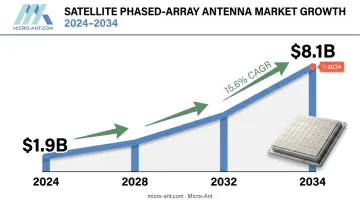
These advantages explain why demand for multiband hardware isn't slowing. Global Market Insights values the satellite phased-array antenna market at $1.9 billion in 2024, projecting a 15.6% CAGR through 2034 that would push the market to $8.1 billion. That growth reflects the same multi-orbit, multi-band connectivity driving these five advantages.
Multiband Antennas in Defense, Aerospace, and Satellite Communications
Warfighters, aircraft, and ships all need seamless handoff between SATCOM bands and operators. Losing a connection mid-mission because a platform crossed into a different operator's frequency isn't an option.
NATO's 2020 NSS6G agreement increased available SHF capacity by 15% and UHF capacity by 25%, pooling resources across member nations. Programs like this only work if ground and terminal antennas can actually access the expanded frequency ranges being made available.
Micro-Ant supports major SATCOM operators requiring this kind of extended-band roaming, including:
- SES O3B mPower MEO constellations
- Eutelsat
- Intelsat
- Inmarsat
- Iridium
- Thuraya
Supporting this many operators across overlapping frequency allocations demands rigorous verification. Micro-Ant validates every antenna leaving its Jacksonville facility in spherical and planar near-field testing chambers spanning 750 MHz to 40 GHz.
That range covers everything from UHF land mobile radio up through Ka-band SATCOM. A single test facility confirms gain, pattern, and polarization performance across the full spectrum a multiband antenna is designed to handle before it reaches the field.
Choosing the Right Multiband Antenna for Your Application
Selecting a multiband antenna comes down to matching engineering specifics to mission requirements, not just picking the widest frequency range available.
Key selection factors:
- Required frequency bands: Confirm exact uplink/downlink allocations, not just the general band designation
- Gain and radiation pattern needs: A directional reflector performs very differently than an omni-directional patch
- Environmental ruggedization: Salt fog resistance matters for maritime platforms; vibration tolerance matters for airborne ones
- Platform integration: Vehicle, vessel, aircraft, or fixed-site mounting each imposes different structural and weight limits
Off-the-shelf multiband products work fine for standard use cases. But when a mission profile calls for a specific combination of bands, gain figures, and ruggedization that no catalog product hits exactly, bespoke engineering becomes the more reliable path.
Micro-Ant has spent over 20 years building more than 1,000 custom antenna products across defense, aviation, maritime, and land applications. Every design comes out of an ISO 9001:2015 and AS9100:2016 certified, US-based facility in Jacksonville, Florida. If your platform needs a multiband solution that standard products can't deliver, Micro-Ant's engineering team can help scope a design built around your specific mission.
Frequently Asked Questions
What is a multiband antenna?
A multiband antenna is a single unit designed to transmit and receive across two or more distinct frequency bands. Single-band antennas, by contrast, are optimized for just one narrow frequency range.
How do dual-band antennas work?
Dual-band antennas use two separate resonant elements or circuits, each tuned to a different frequency, sharing one common aperture. Filtering components like diplexers prevent the two signal paths from interfering with each other.
What is the difference between a multiband and a wideband antenna?
Multiband antennas support several discrete frequency bands within one structure. Wideband or ultra-wideband antennas instead cover one continuous, very broad frequency range.
Can multiband antennas support satellite communications across multiple operators?
Yes. Extended frequency-band coverage, such as full Ka-band spanning both military and commercial allocations, lets a single antenna roam across different satellite operators without any hardware changes.
Are multiband antennas more expensive than single-band antennas?
Unit cost is often higher, but total system cost usually comes out lower. Replacing three single-band antennas with one multiband unit cuts installation, cabling, and maintenance expenses.
What industries commonly use multiband antennas?
Defense, aviation, maritime, telecom, and satellite communications all rely heavily on multiband antenna technology, along with growing use in agriculture and logistics through multi-constellation GNSS.