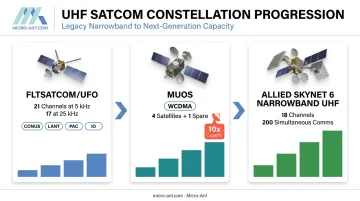
Legacy constellations like UFO and FLTSATCOM, now being succeeded by the Mobile User Objective System (MUOS), keep these links alive for beyond-line-of-sight voice and data. The Navy states that MUOS supplies more than 10 times the capacity of the legacy UHF constellation it replaces, a signal of just how strained the old system had become.
For program managers and RF engineers, the real question isn't whether UHF still matters. It's whether a given mission needs UHF's ruggedness, or the throughput of VHF, L-band, or Ka/Ku alternatives. This guide breaks down the UHF band, the systems running on it, the antenna designs that make it work, and what to look for in a manufacturing partner.
Key Takeaways
- Tactical UHF SATCOM operates in the 250-317 MHz range, trading bandwidth for reliability, foliage penetration, and rugged, low-power hardware.
- MUOS delivers over 10x the capacity of legacy UFO/FLTSATCOM while staying backward-compatible with fielded terminals.
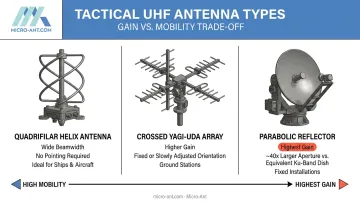
- Antenna choice depends on each platform's mobility-versus-gain trade-off, ranging from quadrifilar helix to crossed Yagi to parabolic designs.
- Legacy UHF channels have run at full utilization for years, making early terminal planning essential.
- Judge manufacturing partners on certifications, domestic sourcing, and test infrastructure, not marketing claims.
What Is UHF Satellite Communication?
The ITU defines UHF as 300 MHz to 3 GHz. Tactical "UHF milsatcom," though, doesn't sit neatly inside that box. The multiservice TACSAT guide lists an uplink range of 292.850-316.975 MHz and a downlink range of 250.350-270.000 MHz, meaning part of the downlink actually falls just below the ITU's UHF boundary, technically in VHF territory.
This matters for engineers because wavelength drives everything downstream. At 300 MHz, wavelength runs close to a meter; at 3 GHz, it shrinks to about 10 centimeters. Longer wavelengths mean:
- Larger physical antennas for a given gain
- Wider beamwidths and more forgiving pointing tolerance
- Better diffraction around obstacles
Channel bandwidth tells a different story than many engineers expect. Legacy UHF SATCOM doesn't use wide 5 MHz transponder slots. Instead, MIL-STD-188-181C and the multiservice TACSAT guide specify 5-kHz and 25-kHz access channels.
Data rates published for these channels run from 75 bps up to 9.6 kbps on 5-kHz channels, and up to 64 kbps on 25-kHz channels, depending on waveform and COMSEC overhead. That's voice and command-and-control traffic, not video.
Key Military UHF Satellite Systems
The US Navy's legacy FLTSATCOM and UFO (UHF Follow-On) constellations cover four geostationary regions: CONUS, Atlantic (LANT), Pacific (PAC), and Indian Ocean (IO). UFO's payload channelizes into 21 channels at 5 kHz plus 17 channels at 25 kHz, feeding terminals across manpack, shipboard, and aircraft platforms:
- AN/PSC-5 manpack terminal
- AN/PRC-117F tactical radio
- AN/ARC-210 airborne terminal
- AN/WSC-3 shipboard terminal
- Mini-DAMA AN/USC-42(V) terminal
MUOS is the modern replacement. Built around WCDMA technology, its four operational satellites plus one on-orbit spare provide global coverage while remaining compatible with legacy UHF terminals during the transition. Space Force is now procuring MUOS SV-6 and SV-7 to extend service toward 2035.
Allied nations aren't sitting this out either. The UK's Skynet 6 program includes a dedicated Narrowband UHF SATCOM System, and an Airbus-operated hosted UHF payload carries 18 channels supporting up to 200 simultaneous communications across Europe, the Middle East, Africa, and into the Atlantic. UHF's tactical relevance is far from a US-only story.
Why Defense Relies on UHF SATCOM: Key Advantages
Rain doesn't touch tactical UHF the way it hammers higher bands. The ITU's rain-attenuation model (P.838-3) is only validated starting at 1 GHz, well above the 240-318 MHz tactical UHF range. In practical terms, UHF links keep working through weather that would badly degrade a Ka or Ku-band signal.
Foliage and obstacles are a different challenge, but still manageable. A UK field trial measured 8 dB of additional loss at 254 MHz for receivers positioned in woodland.
That's a real cost, but it's a fraction of what higher frequencies lose when fully blocked by terrain, buildings, or dense canopy. UHF's longer wavelength lets it diffract around obstacles rather than simply stopping at them.
Beamwidth is where UHF really earns its keep for mobile forces:
- Wide-beamwidth UHF antennas don't require precision auto-tracking
- SHF dishes need narrow beams and active pointing systems to maintain a link
- A moving vehicle, ship, or aircraft can maintain a UHF link with far simpler hardware
This same simplicity carries through to power and cost. Lower-frequency RF chains generally require less complex amplification and filtering than SHF systems, which matters directly for man-portable terminals running on batteries in the field.
These advantages compound for defense operators:
- Weather resilience keeps links up when higher bands fail
- Obstacle penetration maintains connectivity through terrain and foliage
- Forgiving pointing requirements simplify mobile operations
- Simpler electronics reduce cost and power demands
Together, they explain why UHF remains the default for critical, low-bandwidth command and control links even as higher bands dominate data-heavy applications. None of that works, though, without hardware built to survive the environments where it's deployed.
UHF Antenna Designs for Tactical and Fixed Defense Applications
Antenna choice at UHF comes down to a straightforward trade-off: how much mobility do you need versus how much gain?
Quadrifilar helix antennas (QHA) produce a cardioid radiation pattern with wide beamwidth, which means no pointing is required. That makes them a natural fit for ships and aircraft that can't dedicate resources to tracking hardware. They're compact, mechanically simple, and forgiving of platform motion.
Crossed Yagi-Uda arrays step up the gain for fixed or semi-fixed ground stations where a stronger link budget matters more than mobility. More elements mean higher directivity, at the cost of needing a fixed or slowly adjusted orientation.
Parabolic reflector antennas at UHF frequencies push gain higher still, useful for higher-data-rate applications. The trade-off is size. Based on the standard aperture-gain relationship (gain scales with aperture area over wavelength squared), a UHF antenna needs roughly 40 times the linear aperture of an equivalent-gain Ku-band dish. UHF parabolics aren't small, but they're still practical for fixed defense installations needing that extra margin.
None of these designs survive field deployment without the right build. Ruggedization considerations include:
- Fiberglass encapsulation to protect elements from moisture and impact
- Aluminum structural components for durability under vibration and shock
- Materials rated for extreme temperature swings across deployment environments
Micro-Ant designs across all three of these antenna archetypes, including helical, bifilar, and quadrifilar configurations for close ground-plane environments on land, maritime, and airborne platforms. That experience, built over two decades of custom antenna work and validated through in-house near-field testing chambers, shows up in how these antennas hold up once they leave the lab.
Every program has to weigh mobility against link budget performance. That decision should shape antenna selection from day one, not get retrofitted later.
UHF vs Other Frequency Bands: VHF, L-band, and SHF/Ka-band
VHF (30-300 MHz) and UHF (300 MHz-3 GHz) sit right next to each other, and legacy TACSAT systems actually straddle both. Recall that tactical UHF's downlink range dips to 250-350 MHz, technically within VHF territory, while the uplink stays above 292 MHz. This duplex split is a design artifact of the original TACSAT architecture, not a strict band boundary.
L-band (1-2 GHz) fills the middle ground between UHF and SHF, and its trade-offs reflect that position. Commercial MSS networks like Inmarsat and Iridium operate here, delivering:
- Data rates in the kbps-to-low-Mbps range, above tactical UHF but well below SHF/Ka
- Antennas roughly half the size of equivalent-gain UHF apertures
- Rain fade resistance better than Ka-band, though still more sensitive than sub-1 GHz UHF
For defense terminals that need global mobile coverage without the bulk of a UHF antenna or the tracking complexity of Ka, L-band often becomes the practical middle choice.
| Factor | UHF (tactical) | SHF/Ka-Ku band |
|---|---|---|
| Typical data rate | 75 bps-64 kbps per channel | Megabit-class throughput |
| Weather resilience | Strong; below ITU rain model's 1 GHz floor | Vulnerable to rain fade |
| Antenna size (equal gain) | Larger aperture required | Roughly 1/40th the linear size |
| Pointing requirements | Wide beamwidth, often no tracking needed | Narrow beam, precision tracking required |
SHF bands offer far greater bandwidth and data rate, which is exactly why they dominate video and high-volume data links. But that comes paired with narrower beams, more complex ground terminals, and real exposure to rain fade. UHF gives up throughput in exchange for a link that keeps working when weather or terrain gets difficult. That trade-off is why defense programs keep both bands in the toolkit rather than picking one over the other.
Limitations and Challenges of UHF SATCOM
UHF's biggest constraint is spectrum scarcity. With only 5-kHz and 25-kHz channels available, throughput caps out in the kbps range. Video, imagery, and high-speed data simply don't fit.
Congestion compounds the problem. A 2021 GAO report on Navy UHF SATCOM usage found consistent use of 100% of available legacy channels dating back to 2019. Actual demand is likely even higher, since some users skip requests they expect will be denied. Co-channel interference becomes a real risk when every slot is already spoken for.
The ionosphere adds its own complications, specific to lower frequencies:
- Faraday rotation scales as 1/f², rotating UHF polarization far more than higher frequencies. ITU estimates up to 108 degrees at 1 GHz under low-elevation conditions—more at lower UHF bands.
- Scintillation causes signal fluctuation that intensifies near the magnetic equator and in auroral/polar regions, varying with time of day, season, and the roughly 11-year solar cycle.
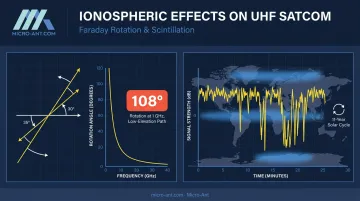
None of this makes UHF unreliable. It does mean engineers need to budget polarization loss and fade margin based on deployment geography and solar conditions, not assume a flat, universal number applies everywhere.
Choosing the Right UHF Antenna Manufacturing Partner
Selecting a UHF antenna supplier for a defense program comes down to a handful of concrete checks, not marketing language.
Certifications and sourcing should be verified directly, not assumed:
- AS9100 certification, which builds on ISO 9001 with aviation, space, and defense-specific quality requirements
- ISO 9001:2015 as the baseline quality management standard
- A valid CAGE code for government contracting
- Domestic manufacturing status under FAR Buy American and DFARS provisions, which are contract-specific and worth confirming line by line
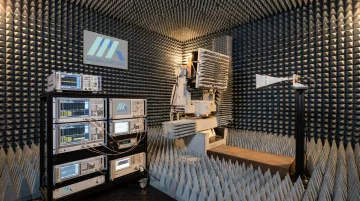
Testing infrastructure matters just as much. US-based spherical and planar near-field testing chambers cut down on program risk by eliminating overseas travel, reducing schedule delays, and giving engineers faster access to calibrated gain, pattern, and polarization data during qualification.
Micro-Ant meets each of these benchmarks directly. The company operates as a vertically integrated design-build-test facility in Jacksonville, Florida, holding both AS9100:2016 and ISO 9001:2015 certification under CAGE code 6XJFO.
In-house spherical and planar near-field testing chambers cover 750 MHz to 40 GHz, supporting antenna qualification without shipping hardware offsite. Over two decades, that combination of certified quality systems and in-house test capability has supported satellite operators like Intelsat, Inmarsat, Iridium, and Eutelsat, along with defense customers such as ARSTRAT.
For a program manager evaluating suppliers, the practical move is to request calibrated pattern data, VSWR measurements across the target frequency range, and environmental qualification records directly, rather than relying on a supplier's self-description.
Frequently Asked Questions
Do satellites use UHF?
Yes. Legacy military systems like UFO and FLTSATCOM, along with the modern MUOS constellation, use UHF for tactical voice and data links because of its reliability and simpler ground equipment.
What is the difference between VHF and UHF satellites?
VHF covers 30-300 MHz and UHF covers 300 MHz-3 GHz. UHF generally allows smaller antennas and better data capacity, while VHF sees more use in legacy amateur and CubeSat telemetry, tracking, and command links.
Is satellite TV UHF?
No. Consumer satellite TV runs in Ku-band or Ka-band, since those frequencies carry the bandwidth needed for video broadcast. UHF's narrowband allocation simply isn't built for that.
What is a UHF antenna?
A UHF antenna transmits and receives signals across 300 MHz-3 GHz, commonly built as a quadrifilar helix, Yagi array, or parabolic dish, such as the composite reflector designs Micro-Ant builds for Manpack and flyaway terminals, depending on the gain and mobility the application requires.
What data rates can UHF SATCOM support for tactical communications?
UHF channels are narrowband, typically supporting voice and low-rate data from 75 bps up to 9.6 kbps on 5-kHz channels, and up to 64 kbps on 25-kHz channels. MUOS improves overall system capacity well beyond legacy UFO transponders.
What is MUOS and how does it differ from legacy UHF satellites?
MUOS is the Space Force's current UHF SATCOM constellation, built to replace UFO with more than 10 times the system capacity while maintaining backward compatibility with legacy UHF terminals still in the field.