Introduction
Most defense, aerospace, and satcom companies don't build their own hardware from scratch. They rely on outside manufacturing partners to turn drawings into working equipment.
The problem: terms like contract manufacturer, OEM, and ODM get used interchangeably, even though they describe very different business relationships.
That confusion carries real risk. A GAO report found the Department of Defense depends on more than 200,000 suppliers to produce weapon systems and noncombat goods, yet visibility into who's actually building what stays limited.
Pick the wrong manufacturing partner for mission-critical hardware like antennas, and you risk missed specs, IP exposure, or a delayed program.
This guide breaks down what a CM actually is, how it differs from OEM and ODM, and what to look for before signing anything.
Key Takeaways
- A contract manufacturer (CM) builds to your design and specs — you keep full IP ownership
- CM differs from OEM (shared expertise, partial IP) and ODM (manufacturer owns the design)
- You get the most customization and IP control with a CM, but expect greater upfront investment
- AS9100 and ISO 9001 certifications, plus domestic production, matter most to defense and aerospace buyers
What Is a Contract Manufacturer (CM)?
A contract manufacturer is a third-party company that builds parts or finished products for another company based entirely on that company's own design, drawings, and bill of materials (BOM). The DFARS regulatory definition frames it simply: a CM produces goods under contract, sold under the hiring company's label or brand, not its own.
That's the core distinction. The CM executes. It doesn't design, own, or sell the product itself.
How the CM Relationship Actually Works
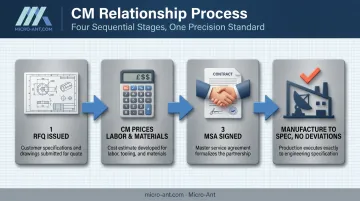
The process typically follows a standard sequence:
- The hiring firm issues an RFQ (Request for Quotation) with finalized drawings, specs, and a BOM
- The CM prices out labor, tooling, and materials based on those exact requirements
- Both parties sign a Manufacturing Services Agreement (MSA) covering production volume, quality standards, IP handling, and delivery terms
- The CM manufactures to spec — no design changes, no substitutions, no sign-off
A well-known example: Foxconn builds Apple's iPhones to Apple's exact engineering specifications. Reuters has described Foxconn as the world's largest electronics contract manufacturer, building products it doesn't own and can't sell under its own name.
One clarification: "contract manufacturing" gets used two ways in the industry. Sometimes it's shorthand for any outsourced production. Other times it refers specifically to this design-owned-by-customer model, distinct from OEM and ODM arrangements. This guide uses the second, more precise definition.
Contract Manufacturer vs OEM vs ODM: What's the Difference?
This is the question most engineering and procurement teams actually need answered before they sign a contract. The three models sit on a spectrum of who controls the design.
In a CM model, the customer owns 100% of the design, tooling specs, and BOM. The manufacturer contributes execution, not engineering input.
In an OEM model, per DFARS, the manufacturer designs the product itself and sells it under its own name and trademark, though OEM terminology also gets applied loosely when a manufacturer contributes category expertise alongside a customer's partial design. [135]
In an ODM model, the manufacturer originates the design entirely. The customer buys an existing platform and rebrands or lightly customizes it. ScienceDirect describes ODM hardware as built from the manufacturer's own designs and specifications rather than the customer's. [88]
Comparing the Three Models
| Criteria | CM | OEM | ODM |
|---|---|---|---|
| IP ownership | Customer owns 100% | Manufacturer typically owns design IP | Manufacturer owns background design |
| Design input | None (customer-supplied) | Manufacturer designs the product | Manufacturer originates design |
| Tooling ownership | Customer-funded, customer-owned (per contract) | Manufacturer-owned | Manufacturer-owned |
| Product specialization | Built to any customer spec | Manufacturer's own product line | Manufacturer's existing platform |
Note: tooling and IP ownership aren't automatic under any of these labels. They're allocated by the actual contract language in your MSA, not implied by the acronym. [135]
Which Model Fits Your Product?
If you're building something IP-sensitive, highly engineered, or mission-specific (custom RF or antenna hardware is a good example), you almost always need a true CM. An OEM relationship means sharing design authority. An ODM relationship means you don't own the core IP at all. Neither works well when your antenna's performance is your competitive edge. Micro-Ant offers dedicated CM engagements for exactly this reason: on these contracts, customers retain full ownership of their antenna IP, tooling, and specs, while our team handles production execution to their designs.
Benefits and Risks of Working with a Contract Manufacturer
Benefits of Contract Manufacturing
Working with a CM instead of building in-house comes with clear advantages:
- Avoids capital costs of building and maintaining a factory, specialized tooling, or test equipment
- Provides access to expertise, including certifications, testing infrastructure, and process knowledge you'd otherwise have to build from zero
- Scales production up or down as program needs shift, which matters enormously for defense and satcom contracts where demand isn't linear
This flexibility matters most for government contracts, which rarely run at a steady, predictable volume. A CM with flexible capacity absorbs that variability better than an in-house line sized for one demand scenario.
Risks and How to Mitigate Them
Three risks come up consistently in mission-critical manufacturing relationships:
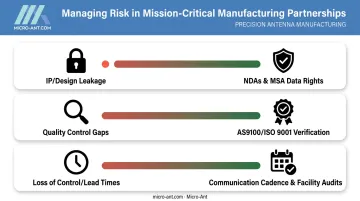
IP and design leakage. Handing over drawings and specs always carries exposure. Mitigate it with signed NDAs, a well-drafted MSA that explicitly assigns data rights, and a CM with a clean track record and no competing product lines of its own. The DoD's IP Guidebook stresses planning data rights up front rather than assuming an NDA alone covers it.
Quality control gaps. Verify certifications like ISO 9001 and AS9100 before signing anything, and request documented testing and QA processes rather than taking a certificate at face value.
Loss of direct control and longer lead times. Set a clear communication cadence early, and don't skip a facility or process audit before committing. GAO has flagged limited visibility into supply-chain origins as a recurring defense procurement risk — the same logic applies at the individual vendor level.
Industries and Applications of Contract Manufacturing
Contract manufacturing shows up across a wide range of sectors:
- Aerospace and defense
- Automotive
- Medical devices
- Semiconductors
- Electronics and consumer goods
Regulated, mission-critical categories carry a higher bar. Defense, satellite communications, and aviation programs need CMs with specific certifications, cleared facilities, and domestic manufacturing capability. This is exactly where specialized antenna and RF hardware manufacturing fits: a niche Micro-Ant has served for over 20 years across defense, aviation, maritime, and land applications.
There's also a broader policy shift underway. The 2024 National Defense Industrial Strategy calls for more resilient, flexible domestic supply chains, and semiconductor industry projections show US chip-manufacturing capacity growing 203% between 2022 and 2032.
Those figures reflect semiconductor capacity specifically, but the underlying pressure (security, tariffs, and supply-chain reliability) is pushing defense and satcom buyers toward US-based manufacturing partners generally.
How to Choose the Right Contract Manufacturer
Selecting a CM for mission-critical hardware means going well beyond a price quote. Focus on a handful of criteria that actually predict performance.
Certifications and quality systems. Look for AS9100:2016 and ISO 9001:2015 at minimum, plus documented QA workflows, not just a certificate on a wall. IAQG's 9100 standard applies at every level of the aviation, space, and defense supply chain, which makes it a reliable baseline for this industry.
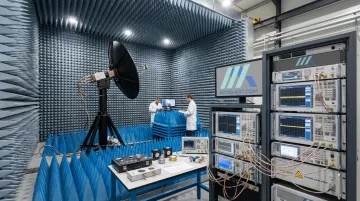
In-house testing capability. A CM that can test what it builds, on-site, saves you time and eliminates a layer of third-party dependency. Micro-Ant, for instance, operates spherical and planar near-field testing chambers spanning 750 MHz to 40 GHz inside its 65,000-square-foot Jacksonville facility.
Communication and supply chain transparency. Ask directly whether the CM will work with your designated component suppliers, and how they handle change requests or delays.
Category-specific experience. A CM with a track record in your exact product type shortens the learning curve considerably. Micro-Ant has designed more than 1,000 bespoke antenna products across defense, aviation, maritime, and land applications. That kind of repetition matters when you're building something as tolerance-sensitive as RF hardware.
Before signing a long-term master service agreement (MSA), request a facility tour or a sample quote. It's the fastest way to gauge whether a CM's actual capabilities match what's on their website.
Frequently Asked Questions
What is a CM (Contract Manufacturer)?
A CM is a company that manufactures products or components for another company based entirely on that company's own design, specs, and bill of materials. It builds exactly what the customer specifies without contributing original design work.
What is the difference between OEM and CM?
OEMs typically design and sell products under their own brand, contributing their own IP alongside any customer input. CMs manufacture strictly to the customer's fully-owned specifications with no design input of their own.
What industries commonly use contract manufacturers?
Aerospace, defense, satcom, automotive, medical devices, and electronics are the most common categories. Specialized niches like antenna and RF hardware manufacturing fall under this umbrella too.
Is contract manufacturing the same as outsourcing?
Not quite. Contract manufacturing is one specific form of outsourcing focused solely on production. Outsourcing more broadly can also include design, logistics, or other business functions.
How do I choose a good contract manufacturer?
Prioritize relevant certifications (AS9100, ISO 9001), documented testing capability, clear communication practices, and proven experience in your specific product category.
What is the difference between a CM and an EMS provider?
EMS (Electronics Manufacturing Services) providers specialize in electronics assembly and often offer design support. A general CM can work across broader product categories, typically with less design involvement.