Polarization choice isn't a footnote in an RFP. It determines whether your platform needs one antenna or three, whether a signal survives urban multipath, and whether a data link holds up under jamming.
Yet "dual polarity" shows up in defense datasheets and requirement documents more often than it's actually understood at the design level. It gets confused with dual-band operation, automatic MIMO capability, or circular polarization: three different things entirely.
This article breaks down what dual polarity antennas are, how they work, why defense systems increasingly rely on them, and when they aren't the right call.
Key Takeaways
- Dual polarity antennas combine two orthogonal polarization paths (H/V or slant) in one radome
- SWaP-constrained platforms gain capacity without adding mast space or antenna count
- Polarization diversity reduces multipath fade in non-line-of-sight urban environments
- Performance hinges on isolation, cross-pol discrimination, and ruggedization, not the label alone
- Fixed point-to-point links often perform fine, and more cheaply, with single-polarized dishes
What Is a Dual Polarity Antenna?
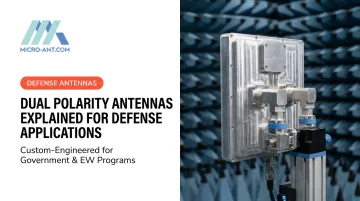
Strip away the marketing language, and a dual polarity antenna is simple: it's two independently fed, orthogonally arranged sets of radiating elements (dipoles, patches, or slots) packaged inside one radome. Each set is its own electrically separate RF path, with its own connector and feed line.
That's the whole concept. Two antennas, one housing.
What this buys you: a single footprint that behaves like two co-located antennas. Instead of mounting two separate units to get two data streams or polarization diversity, you get both from one aperture.
No extra mast space, no second bracket, no additional cable run. For SWaP-constrained defense platforms, think UAV wings, vehicle roofs, dismounted soldier kits, that consolidation is often the entire business case.
How It Differs From Single- and Circularly Polarized Antennas
- Single-polarized antennas radiate in one fixed orientation only. If the transmitting and receiving antennas aren't aligned, you get polarization mismatch loss, sometimes severe enough to break a link entirely.
- Circularly polarized antennas rotate the field continuously, which is why they dominate GNSS and satcom applications where the receiver's orientation keeps changing, such as a rotating UAV or a rolling ship.
- Dual polarity antennas hold two fixed, orthogonal linear states, commonly horizontal/vertical or ±45° slant, available simultaneously through isolated feed paths.
That last point matters. Dual polarity is typically a dual-linear architecture, not a circular one. Confusing the two leads to spec mismatches that surface late in integration testing, when they're expensive to fix.
Why Dual Polarity Antennas Matter in Defense Applications
Contested environments punish signals in ways clean lab tests never predict. Urban combat zones, mountainous terrain, and maritime operations all generate heavy multipath: reflections bouncing a signal off buildings, ridgelines, or wave surfaces until the receiver sees a faded, garbled waveform instead of a clean one.
Polarization diversity directly counters this. One documented urban non-line-of-sight measurement campaign found more than 3 dB of gain at 80% reliability and nearly 7 dB at the 99.5% level, a meaningful margin when a dropped packet means a lost telemetry frame or a garbled voice call.
Gains like this are environment- and correlation-specific, though; they don't automatically transfer to a maritime or mountain link without platform-specific testing.
The SWaP Math
Vehicles, UAVs, and dismounted soldier systems all fight the same battle: limited size, weight, and power budget. DARPA has been explicit about this pressure, noting that conventional long-range tactical communications have relied on large, power-hungry dish antennas that don't fit smaller, distributed platforms.
Dual polarity antennas relieve some of that pressure. Instead of mounting two separate antennas to get two data streams, or an antenna plus a diversity-receive pair, a single dual-polarity aperture does the job.
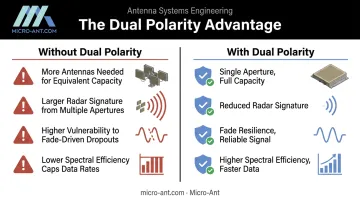
Without dual polarity, defense systems typically need:
- More antennas to match equivalent capacity, adding weight and cost
- Larger radar signatures from multiple protruding apertures
- Higher vulnerability to fade-driven signal dropouts
- Lower spectral efficiency, capping data rates for ISR video and telemetry feeds
Resilience Against Jamming and Interception
Beyond the weight and cost savings, dual polarity strengthens a system's defenses against adversaries. Orthogonal polarization channels add a dimension an adversary has to work harder to defeat: jamming or intercepting a signal on one polarization plane is one problem, but doing it across two orthogonal planes at once is a bigger one.
This supports Low Probability of Intercept/Detection objectives that DoD roadmaps call out as core communications goals, though it's one layer in the anti-jam stack rather than a standalone solution, alongside frequency hopping, spread spectrum, and directional gain.
Where This Shows Up in Practice
These capacity and resilience gains aren't theoretical: dual and multi-polarization is becoming standard practice in DoD and allied satcom and radar procurement precisely because it delivers both without adding hardware. Micro-Ant's Ultra-Wide Band (3.5 GHz) Ka Antenna System is a working example: a bespoke dual-polarization design built to give defense and government users the bandwidth to roam across multiple satellite operators without swapping hardware in the field.
Dual polarity gets specified early, during platform design and procurement, and shows up in fielded SATCOM terminals, radar arrays, EW pods, and UAV datalinks. It's also worth revisiting during a technology refresh, since older single-polarized systems are often the easiest upgrade path to unlock immediate capacity gains.
How Dual Polarity Antennas Work (Conceptual Flow)
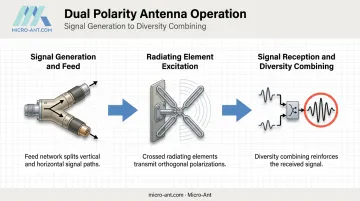
At a conceptual level, a dual polarity antenna shares one physical aperture between two orthogonally arranged sets of radiating elements, each fed through an isolated port. RF signals are generated or received independently per polarization channel, routed through separate feed networks from connector to element.
When both channels are excited, electromagnetic waves radiate in two orthogonal planes (0°/90° or +45°/−45°) simultaneously, without significant interference, provided isolation between the two paths is high enough.
Feed network design, phasing, and radome geometry govern that isolation along with cross-polarization discrimination. The result: either two independent data streams for MIMO-style throughput, or improved diversity-combining gain for a single stream, measurable as a lower bit error rate and better link margin.
Step 1: Signal Generation and Feed
A dual-port feed network, an orthomode transducer (OMT) in many Ka-band systems, generates or separates the two orthogonally polarized signals from the same radio or modem. This component keeps the two RF chains electrically distinct from the moment the signal leaves the connector.
Step 2: Radiating Element Excitation
Crossed dipoles, patches, or slots, arranged 90° or ±45° apart inside the radome, radiate the two polarizations simultaneously. Because the elements are orthogonal by geometry, each polarization state stays largely independent of the other, assuming the feed network and radome design maintain adequate isolation.
Step 3: Signal Reception and Diversity Combining
On the receive side, the system captures both polarization signals and combines them. This happens either through selection combining (picking the stronger branch) or maximum-ratio combining (phase-aligning and weighting both branches for the best signal-to-noise ratio). This is what mitigates multipath fading in the field, keeping a tactical data link from dropping when one polarization path fades.
Key Factors Affecting Dual Polarity Antenna Performance in Defense Applications
Specifying a dual polarity antenna on paper is easy. Getting the isolation, bandwidth, and ruggedization right for the actual mission is where programs succeed or fail.
- Isolation and cross-polarization discrimination. These aren't the same measurement. Isolation controls coupling between feed ports, while cross-pol discrimination (XPD) controls how clean the far-field polarization actually is. ETSI's guidance for fixed radio systems targets 25-35 dB isolation at 1-3 GHz and 35-50 dB at 3-60 GHz. Defense requirements should still flow down from the actual band, scan angle, and mission rather than a generic figure.
- Frequency band and bandwidth. A UHF tactical radio and a wideband Ka-band SATCOM terminal have almost nothing in common structurally. Ultra-wideband dual-polarization designs, such as Micro-Ant's 3.5 GHz UWB Ka Antenna System, let a terminal roam across multiple satellite operators without a hardware swap.
- Environmental ruggedization. Land and maritime defense platforms need MIL-STD-810 shock, vibration, and temperature tolerance, plus sealed radomes that hold up against salt fog, sand, and extreme heat. MIL-STD-810H Change 1 defines the test methods, but every requirement needs tailoring; a method name alone doesn't set a temperature limit or vibration spectrum.
- Platform SWaP tradeoffs. Antenna size, weight, and power budget constraints look completely different on a soldier-worn radio versus a UAV wing versus a vehicle roof array. The right design fits the platform, not the other way around.
- Manufacturing and validation precision. Two independent RF chains sharing one radome demand tight tolerances. Pre-deployment validation in a near-field antenna chamber confirms isolation and pattern performance before a unit ships, not after it's fielded. Micro-Ant runs an in-house facility covering 750MHz to 40GHz for exactly this kind of testing.
Common Misconceptions & When Dual Polarity May Not Be Appropriate
Common Misconceptions
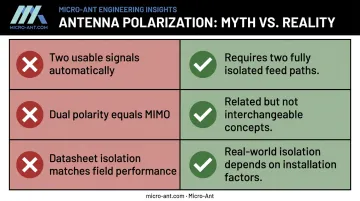
Three misunderstandings come up constantly in defense procurement conversations:
- "Dual polarity means two usable signals, automatically." True only if the antenna has two fully isolated feed paths running from connector to element; some designs share internal conductors and combine paths early. Check the feed diagram, not just the label.
- "Dual polarity and MIMO are the same thing." They're related, not interchangeable. MIMO can also be achieved with same-polarity antennas through spatial diversity, separating identical antennas rather than polarizing them orthogonally.
- "The datasheet isolation number is what I'll get in the field." Real-world isolation depends on installation factors: nearby structures, co-located antennas, and mounting geometry. Budget margin beyond the lab spec.
When Dual Polarity May Not Be Appropriate
Dual polarity isn't a default-good decision. Some scenarios don't need it:
- Fixed, long-range point-to-point links with stable orientation and minimal multipath, such as a backhaul between two known stationary points, often perform better and more cost-effectively with a high-gain single-polarized dish.
- Simple, one-way links. A beacon transmitter or one-way telemetry downlink rarely benefits from diversity gain or dual data streams, so dual polarity often just adds cost and complexity.
- Space- and weight-constrained platforms. When a single-polarization antenna already meets the link budget, the added feed network and weight of a dual polarity design may not be worth it.
The tell is usually in the requirement document itself. If "dual polarity" appears without a corresponding need for diversity gain or simultaneous dual streams, it's likely being specified by habit rather than mission analysis.
Conclusion
A dual polarity antenna is, functionally, two antennas built into one footprint, improving resilience, capacity, and SWaP efficiency for defense platforms that can't afford extra mast space or added weight. The label alone doesn't guarantee any of that, though.
Isolation, feed architecture, frequency band, and environmental qualification determine whether a given design actually delivers diversity gain, dual data streams, or anti-jam benefit, or whether it's just added cost without a corresponding mission requirement.
Understanding the mechanism, not just the spec sheet, is what separates the right antenna choice from an expensive guess. Matching polarization strategy to the platform, the environment, and the actual data requirement is where the value shows up.
Working with an antenna engineering partner that designs, builds, and tests these systems in-house, as Micro-Ant does at its Jacksonville, Florida facility, helps ensure that match happens before a unit ships.
Frequently Asked Questions
What is dual polarization in an antenna?
It refers to an antenna transmitting and receiving on two orthogonal polarization planes, horizontal/vertical or slant, simultaneously through isolated feed paths. Functionally, it operates as two antennas built into one unit.
What is the difference between single polarized and dual polarized antennas?
Single-polarized antennas radiate in one fixed plane and are prone to polarization mismatch loss when alignment isn't perfect. Dual-polarized antennas use two orthogonal paths, maintaining performance and enabling diversity combining or MIMO-style use.
What are the advantages of dual-polarized (cross-polarized) antennas?
They reduce multipath fading and improve spectral efficiency, while also cutting the number of antennas needed per platform or site. In contested or high-interference RF environments, that translates to better link resilience.
What are the two types of antenna polarization?
The two broad categories are linear polarization (horizontal, vertical, or slant) and circular polarization (right-hand or left-hand). Dual polarity antennas are typically dual-linear designs, not circular ones.
Are dual polarized antennas suitable for tactical and rugged military environments?
Yes, when built to MIL-STD-810 ruggedization standards with sealed radomes and validated isolation performance. They're well suited to vehicle-mounted, UAV, and dismounted tactical systems that need to survive field conditions.
Do dual polarized antennas cost more than single polarized antennas?
They typically require more manufacturing precision and a more complex feed network, which can raise unit cost. But they often lower total system cost by eliminating the need for multiple separate antennas.