Key Takeaways
- V-Band spans 40–75 GHz (IEEE Std 521), with the FCC's unlicensed 57–71 GHz allocation driving most commercial deployments
- The ~15 dB/km oxygen absorption peak at 60 GHz limits terrestrial range but enables secure crosslinks and spatial frequency reuse
- V-Band supports diverse use cases — WiGig, 5G backhaul, satellite feeder links, and defense communications — each exploiting the band's high bandwidth and natural propagation limits
- Only 24.7% of U.S. commercial buildings are fiber-connected, making V-Band fixed wireless a strong last-mile alternative
- Choosing the right band requires evaluating link distance, regulatory environment, required data rate, and security requirements
What Is V-Band? IEEE Classification and Spectrum Fundamentals
IEEE Std 521 designates V-Band as 40–75 GHz, with corresponding wavelengths of 4–7.5 mm — placing it squarely in the millimeter wave (mmWave) portion of the electromagnetic spectrum. One common source of confusion: V-Band is entirely distinct from "Band V" in the UHF range (600–1,000 MHz). The designation shares only a letter — the frequency ranges are separated by orders of magnitude.
The 60 GHz Oxygen Absorption Characteristic
Understanding V-Band's practical limits starts with its most consequential physical property: the oxygen absorption complex near 60 GHz. ITU-R P.676 models this absorption, and secondary technical literature reports approximately 15 dB/km at the peak under typical atmospheric conditions — though the exact value depends on pressure, temperature, humidity, and altitude.
This has a dual effect:
- Restricts terrestrial range to roughly 1–2 km for practical high-availability links
- Provides natural signal confinement, reducing interference between co-channel deployments and enabling dense spatial frequency reuse in urban environments
U.S. Regulatory Framework
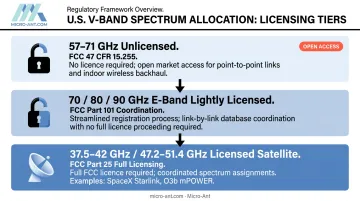
The FCC has established a tiered allocation structure for V-Band frequencies:
- 57–71 GHz: Unlicensed operation under 47 CFR 15.255; FCC Order 16-89 expanded this from the original 57–64 GHz to include 64–71 GHz
- 70/80/90 GHz (E-Band): "Lightly licensed" — streamlined licensing with low fees but interference protection
- 37.5–42 GHz / 47.2–51.4 GHz: Licensed satellite allocations, as seen in FCC authorizations for SpaceX and O3b NGSO constellations
Beyond U.S. borders, allocation varies considerably. The UK's Ofcom designates 57–71 GHz as exempt use for commercial deployment, while the EU's Implementing Decision 2019/1345 covers wideband data transmission in the same range. Some nations reserve sub-bands for defense without public disclosure.
V-Band Terrestrial Applications: Backhaul, Fixed Broadband, and Short-Range Wi-Fi
Short-Range Wi-Fi: 802.11ad and 802.11ay
IEEE 802.11ad (WiGig) operates in the 57–71 GHz unlicensed band, delivering data rates up to approximately 7 Gbps at ranges under 10 meters. Its successor, 802.11ay, bonds up to four 2.16 GHz channels and adds MIMO, targeting 100 Gbps-class aggregate throughput for dense enterprise environments.
Practical limitations are real: 60 GHz signals do not penetrate walls. Deployments require beamforming and band-switching for mobility scenarios. For specific use cases (wireless display, kiosk data offloading, dense stadium connectivity, intra-datacenter links), the bandwidth density is unmatched at any lower frequency.
Mobile and Small Cell Backhaul
Mobile operators connecting 4G and 5G small cells have turned to V-Band and E-Band for multi-gigabit backhaul at a fraction of licensed microwave costs. The combined 27 GHz of spectrum across both bands supports multi-Gbps links with standard COTS radio hardware.
V-Band's unlicensed status is both an advantage and a risk. No frequency coordination means rapid deployment, but also no interference protection. Link engineering (careful spatial planning, antenna gain selection, and rain fade margin) replaces the protection that licensing would otherwise provide.
Fixed Wireless Broadband: Closing the Fiber Gap
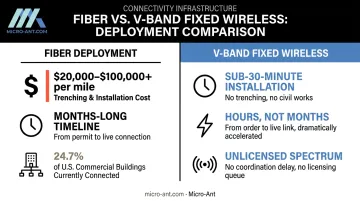
Vertical Systems Group reported that only 24.7% of U.S. commercial buildings were fiber-connected as of 2021. V-Band fixed wireless directly targets this gap.
The economics are compelling. An industry white paper from ADTRAN notes that 60 GHz site installations can take under 30 minutes, while fiber trenching in urban environments can cost $20,000 to over $100,000 per mile. V-Band Point-to-Point and Point-to-Multipoint configurations connect offices, apartment buildings, and campuses in hours — not months.
Campus, Enterprise, and Radar Applications
Beyond permanent deployments, V-Band serves several tactical use cases:
- Fiber backup and path diversity — rapid failover when primary fiber circuits fail
- Temporary event connectivity — broadcast video transport, HDTV feeds at stadiums and conferences
- Disaster recovery links — deployable within hours when terrestrial infrastructure is damaged
V-Band's narrow beamwidths also extend beyond connectivity into active sensing. At 60 GHz, high spatial resolution makes the band viable for automotive radar, imaging systems, and atmospheric sensing — applications where precision matters as much as throughput.
V-Band in Satellite Communications: Feeder Links, LEO Constellations, and Next-Gen Satcom
Why Q/V-Band for Satellite Feeder Links
Ka-Band currently dominates commercial satellite communications, but its feeder link spectrum is increasingly constrained as data demands grow. Q/V-Band is the logical progression: wider, more contiguous bandwidth that enables higher aggregate throughput for high-throughput satellite (HTS) and very-high-throughput satellite (VHTS) payloads.
ESA's HTS gateway program is a practical example: the project involves adapting a 6.8-meter Q/V-band antenna from an existing Ka-band design — reflecting the engineering continuity between bands while requiring meaningful redesign for higher frequency operation. Q and V-Band are frequently used together as a paired feeder link architecture, with Q handling one polarization or direction and V handling the other, to maximize aggregate bandwidth.
LEO and NGSO Constellation Activity
The FCC has authorized multiple operators to deploy V-Band-adjacent NGSO satellite constellations:
- SpaceX: Authorized for 37.5–42.0 GHz downlinks and 47.2–51.4 GHz uplinks
- O3b/SES: FCC Order 18-70 covers 37.5–42.0 GHz and 47.2–50.2 GHz
- Boeing: FCC Order 21-115 includes processing-round V-Band spectrum for NGSO operations
Milstar's 60 GHz inter-satellite crosslinks — confirmed by DTIC documentation from the U.S. Army — established the military proof-of-concept for V-Band crosslinks, with Milstar-1 launching in February 1994. Commercial ambitions have since expanded far beyond that initial defense application.
Why 60 GHz Works Differently in Space
The oxygen absorption that limits terrestrial V-Band range is irrelevant above the atmosphere. Satellite-to-satellite crosslinks operate in near-vacuum, so a 60 GHz signal traversing hundreds of kilometers between satellites experiences negligible absorption loss, unless the path intersects the atmosphere at low elevation angles. V-Band is therefore unsuitable for long terrestrial links yet ideal for inter-satellite links, where that same absorption characteristic provides inherent protection from ground-based signal interception.
Antenna Precision Requirements for V-Band Ground Terminals
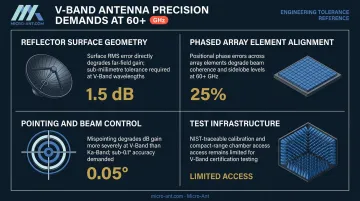
Those propagation physics translate directly into hardware demands. At 60+ GHz, ground terminal antenna engineering tolerances tighten considerably across every subsystem:
- Reflector surface geometry: Small deviations in parabolic surface accuracy produce amplified gain loss compared to Ka-Band equivalents
- Phased array element alignment: Positional errors in element placement degrade beam coherence at shorter wavelengths
- Pointing and beam control: A mispointing that causes negligible loss at Ka-Band can produce several dB of degradation at V-Band
- Test infrastructure: Validating performance above 40 GHz requires calibrated facilities that NIST has identified as limited in availability
Antenna design at these frequencies demands advanced materials and tight manufacturing tolerances throughout production — not just at final assembly.
Micro-Ant's 20+ years of bespoke satcom antenna development, including hardware for operators such as SES O3B mPower, Intelsat, Inmarsat, and Eutelsat, demonstrates the manufacturing precision and test rigor that V-Band ground segment programs require.
V-Band in Defense: Secure Crosslinks and Military Communications
Why V-Band Suits Military Requirements
Two physical properties make V-Band attractive for defense communications:
- Narrow beamwidth: At 60 GHz, antenna beams are extremely narrow, making signal interception geometrically difficult
- Oxygen absorption: The 15 dB/km terrestrial loss means off-path ground-based receivers cannot detect crosslink signals passing overhead — an inherent low-probability-of-intercept (LPI) mechanism confirmed in early IEEE analysis of the 60 GHz absorption band
Combined, these characteristics make V-Band well suited to contested environments where electronic warfare threats are significant.
Defense Use Cases
Current and emerging applications include:
- Secure inter-satellite crosslinks: Milstar's 60 GHz crosslinks remain the established reference point; DoD sources confirm the Earth's opacity at this frequency improves crosslink security against ground interception
- Tactical point-to-point data links: Short-range, high-capacity links in environments where RF signature management matters
- mmWave sensing: High spatial resolution at millimeter wavelengths enables precision target detection in guidance applications, though specific operational seeker frequency windows in the V-Band range are not well documented in open literature
GaN Technology Enabling V-Band Power Amplifiers
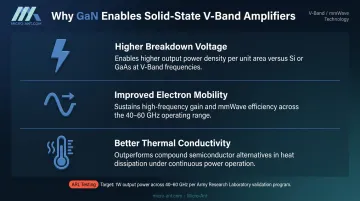
Advances in gallium nitride (GaN) semiconductor technology have made solid-state V-Band power amplifiers practical. U.S. Army Research Laboratory testing of a 90 nm GaN process developed by Qorvo targeted at least 1 W output over 40–60 GHz. This demonstrates that solid-state amplifiers can approach or rival traveling-wave tube amplifiers (TWTAs) at these frequencies.
GaN's advantages at V-Band include:
- Higher breakdown voltage — supports greater output power density
- Improved electron mobility — enables efficient operation at millimeter-wave frequencies
- Better thermal conductivity — outperforms earlier compound semiconductor options
The challenge is thermal management. As output power increases, heat dissipation from small die areas becomes a critical engineering constraint.
Defense customers procuring V-Band antenna hardware typically require AS9100-certified manufacturing, U.S.-sourced components, and demonstrated field ruggedness. Micro-Ant holds AS9100:2016 and ISO 9001:2015 certifications, manufactures entirely in Jacksonville, FL (CAGE: 6XJFO), and has supplied antenna systems to DoD and Intelligence Community programs requiring these standards.
V-Band Technical Challenges: Propagation, Rain Fade, and Antenna Engineering
Atmospheric Attenuation and Link Planning
Two propagation mechanisms limit V-Band terrestrial links:
- Oxygen absorption: ~15 dB/km near 60 GHz caps practical high-availability range at 1–2 km
- Rain attenuation: ITU-R P.838-3 models specific rain attenuation as γ_R = k·R^α, where R is rain rate in mm/h. The actual dB/km value depends on rain rate, polarization, elevation angle, and ITU regional coefficients — there is no universal figure applicable across all geographies
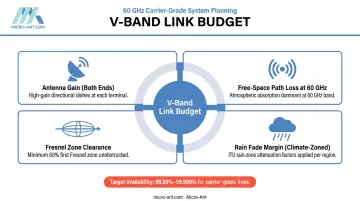
Link planners use ITU rain-rate statistics mapped by geographic region to design fade margins appropriate for target availability (typically 99.99% or 99.999% for carrier-grade links).
Fog illustrates this contrast well: while fog can render free-space optical (FSO) systems inoperable, V-Band RF links experience only modest incremental attenuation under the same conditions — making them more reliable than optical wireless in certain adverse weather scenarios.
Line-of-Sight Requirements and Link Budgets
Every V-Band link requires unobstructed line of sight. A practical link budget includes:
- Antenna gain at both ends
- Free-space path loss (substantial at 60 GHz even over short distances)
- Rain fade margin sized to the local climate zone
- Fresnel zone clearance above obstacles
The 1–2 km range constraint simultaneously enables urban frequency reuse — the same channel can be reused at short spatial intervals without interference, which is an architectural advantage for dense deployments.
Manufacturing Tolerances at 60 GHz
At 5 mm wavelength, antenna fabrication tolerances that are acceptable at Ka-Band become problematic. Surface irregularities in a reflector or element misalignments in a phased array translate directly to gain loss and degraded sidelobe performance.
NIST has identified antenna measurement above 40 GHz as a specialized challenge — calibrated test facilities capable of operating in this range are not widely available commercially.
Testing V-Band antennas requires near-field or far-field chambers designed for mmWave operation, along with measurement reference standards traceable to this frequency range.
V-Band vs. Adjacent Bands: Choosing the Right Spectrum
| Band | Frequency Range | Key Applications | Licensing | Primary Limitation |
|---|---|---|---|---|
| Ka | 26.5–40 GHz | Satellite user links, gateways, radar | Licensed | Spectrum congestion; rain fade |
| Q | 33–50 GHz | HTS feeder links (paired with V) | Licensed | Rain attenuation; less mature hardware ecosystem |
| V | 40–75 GHz (57–71 GHz unlicensed in U.S.) | WiGig, FWA backhaul, satellite feeder/crosslinks | Unlicensed (57–71 GHz); licensed for satellite | Oxygen absorption; range-limited terrestrially |
| E | 71–86 GHz | High-capacity terrestrial backhaul | Lightly licensed | Rain attenuation; no unlicensed access |
When V-Band Is the Right Choice
V-Band makes sense when:
- Short-range, high-capacity links are the priority (sub-2 km terrestrial)
- License-free operation reduces deployment cost and time
- Secure crosslinks benefit from 60 GHz atmospheric opacity
- Dense urban reuse is required — oxygen absorption enables channel reuse at short intervals
V-Band is the wrong choice when:
- Link distances exceed 2 km: E-Band or Ka-Band will deliver better availability
- A mature commercial ecosystem is required: Ka-Band has more vendors and more established hardware
- Non-line-of-sight paths are involved: no mmWave band will solve this
The Industry Trend Toward Higher Frequencies
Ka-Band spectrum congestion is measurable and growing. FCC data shows active NGSO authorizations pushing feeder links into Q/V-Band, and terrestrial backhaul migrating up to E-Band. Dell'Oro reported E-Band microwave transmission shipments grew 77% in Q2 2023, reflecting capacity demands that lower-band spectrum can no longer absorb.
Q/V-Band and E-Band are not alternatives to Ka-Band — they are additions to it. In next-generation satellite architectures, Ka typically handles user links while Q/V handles feeder links, with each band doing what its propagation characteristics and available spectrum make it best suited for.
Frequently Asked Questions
What are V-Band frequencies used for?
V-Band covers a broad range of deployment contexts: short-range high-speed Wi-Fi via IEEE 802.11ad/ay, 5G/4G small cell backhaul, fixed wireless last-mile broadband, satellite feeder links for HTS/VHTS payloads, and secure inter-satellite crosslinks for defense. Terrestrial deployments focus on the unlicensed 57–71 GHz range, while satellite applications span both licensed and unlicensed allocations.
Is V-Band technology widely available?
Commercial V-Band hardware — radios, antennas, chipsets — is widely available for terrestrial use, with the FCC's 57–71 GHz unlicensed allocation supporting a well-established WiGig and fixed wireless ecosystem in the U.S. Satellite feeder links and defense crosslink applications require custom-engineered components; off-the-shelf hardware is not adequate for those use cases.
What frequency range does V-Band cover?
IEEE Std 521 designates V-Band as 40–75 GHz. The commercially most active portion is the FCC's unlicensed 57–71 GHz allocation under 47 CFR 15.255. This should not be confused with "Band V" in the UHF range (600–1,000 MHz), which uses similar nomenclature but refers to an entirely different part of the spectrum.
What are the main limitations of V-Band communications?
Three constraints define V-Band's practical boundaries: (1) oxygen absorption limits terrestrial range to roughly 1–2 km at 60 GHz; (2) rain attenuation further restricts reliable link distance in high-rainfall climates, sized using ITU-R P.838-3 models; and (3) strict line-of-sight requirements mean signals cannot penetrate walls or terrain obstacles. These limitations make V-Band unsuitable for long-distance or non-LOS applications.
How does V-Band compare to Ka-Band for satellite communications?
Ka-Band (26.5–40 GHz) remains the commercial satcom standard, with lower atmospheric attenuation and a mature ecosystem. V-Band's far wider bandwidth makes it the preferred feeder-link path for next-generation HTS satellites — and as Ka feeder spectrum grows congested, Q/V-Band is the natural expansion. The two bands are increasingly paired rather than swapped: Ka for user links, Q/V for feeder links.